Build a system around your part numbers, your customer schedules and your control plans.
An automotive component plant works to its customer’s calendar. A vehicle maker or a tier one supplier sends a schedule, and the plant ships against it, part number by part number.
Behind each shipment sits a trail of records. A control plan lists the checks. A batch carries a material certificate. A rejection comes back with a corrective action request that has a due date.
Software built by GullySystem for such a plant would hold the schedule, the part, the lot and the quality record together. A customer’s question could then be answered from one place.
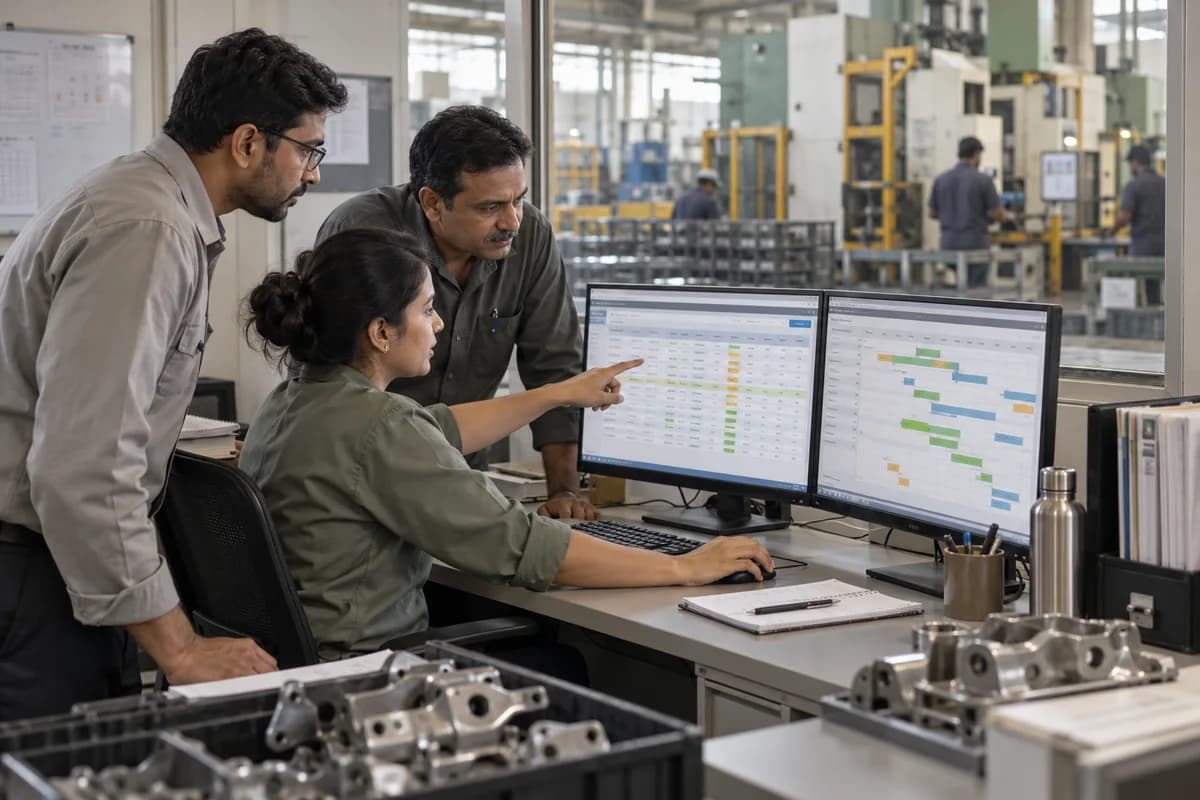
Plants this can be built for.
A fastener maker runs heading and rolling lines in large lots. A wiring harness maker assembles variants by hand. Both need traceability, but the unit of control is different.
- Auto parts manufacturers
- Engine component manufacturers
- Brake component manufacturers
- Suspension component manufacturers
- Automotive plastics manufacturers
- Wiring harness manufacturers
- EV component manufacturers
- Automotive fastener manufacturers
- Machined casting suppliers
- Forged part suppliers
- Sheet metal stamping shops
- Rubber and sealing part suppliers
- Tier two and tier three suppliers
- Aftermarket parts producers
The modules, and what each one covers.
Nothing here is a fixed package. Each module is built, left out or changed to match how your organisation already works.
Part master and customer drawings
Every part has a number, a revision and a customer who owns the drawing.
- Part number and customer part number
- Drawing revision and date
- Engineering change notice received
- Material and grade specified
- Weight and packing standard
- Tooling linked to the part
- Approval status of the part
- Parts by vehicle programme
Customer schedules and releases
Planners read the customer’s schedule every week and turn it into plant demand.
- Weekly and monthly schedule received
- Change from the last schedule
- Firm and forecast quantities
- Delivery date and dock
- Pull signals from the customer
- Parts on special instruction
- Shortfall against schedule
- Penalty or premium freight risk
Customers send schedules in their own formats. Whether they can be read in automatically depends on the format, so we check a sample before promising it.
Quote, costing and tooling
- Cost from material, process and overhead
- Raw material price index tracking
- Tooling cost recovery per piece
- Quote revision per customer
- Annual price reduction agreed
- Material price change claims
- Cost against actual after launch
Process routing and control plan
Process engineers write the route. Quality engineers write the checks that go with it.
- Raw material
- Cutting or forming
- Machining or moulding
- Heat treatment
- Surface treatment
- Inspection
- Packing
- Operation sequence per part
- Machine and tool for each operation
- Control plan with check frequency
- Process failure mode record
- Work instruction at the station
- Cycle time standard
Production planning and work orders
- Plan from customer demand
- Machine loading by part
- Changeover time counted
- Work order per lot
- Shift-wise production entry
- Rejection entered at source
- Rework and scrap separated
- Delayed orders flagged
Raw material and lot traceability
A lot of bar, sheet or granules is traced forward to every shipment made from it.
- Material test certificate on receipt
- Heat or batch number
- Lot split across work orders
- Finished lot linked to raw lot
- Customer lot code printed on the label
- Recall search by raw material lot
- First in, first out use
- Stock held by status
Tool, die and mould management
- Tool register by part
- Shots or strokes counted
- Maintenance due by count
- Tool repair history
- Tool in the shop or at a vendor
- Customer-owned tooling flagged
- Spare tool inserts held
- Tool life against plan
Incoming, in-process and final inspection
- Incoming material checks
- First piece approval after setup
- Patrol inspection record
- Dimensional readings by part
- Gauge and instrument calibration
- Final audit before packing
- Hold and release of a lot
- Inspection report for the customer
Statistical charts such as capability studies are drawn from the readings your team enters. The software shows the figures. Your quality team decides what they mean.
Production part approval documents
A new part ships only after the customer accepts a submission package.
- Dimensional results
- Material and performance test results
- Process flow and control plan
- Measurement system studies
- Sample submission record
- Customer approval status
- Documents by part revision
- Resubmission after a change
Customer complaints and corrective action
- Complaint logged with part and lot
- Containment action at the plant
- Sorting at the customer site
- Root cause analysis steps
- Corrective action with owner and date
- Response sent to the customer
- Effectiveness check
- Repeat complaints by part
Supplier and outside process control
- Approved supplier list
- Plating and heat treatment vendors
- Material sent and returned
- Vendor quality rejection
- Delivery performance by vendor
- Supplier audit record
- Vendor bill against receipt
Packing, labelling and dispatch
Dispatch teams pack to the customer’s standard and print the label the customer scans.
- Packing standard per part
- Customer label with lot code
- Barcode scanned at loading
- Advance shipping notice sent
- Tax invoice per shipment
- Returnable container balance
- Transport and vehicle record
- Proof of delivery
Maintenance and machine records
- Machine register
- Preventive maintenance schedule
- Breakdown logged with cause
- Spare parts for machines
- Downtime by machine
- Calibration of machine controls
- Energy per machine where metered
Wiring harness and electronics lines
For plants that build variants by hand, the variant is the order.
- Variant bill per harness
- Cutting list by circuit
- Crimp height and pull test record
- Electrical continuity test result
- Board assembly and label
- Operator skill matrix
- Rework by station
Who logs in, and what they see
- Plant head
- Planning team
- Production supervisors
- Process engineers
- Quality engineers
- Stores team
- Maintenance team
- Dispatch team
- Customer quality contacts
- Accounts team
One connected workflow, end to end.
Every stage below can sit in one system, so nobody re-enters what the last stage already captured.
- Part and drawing received
- Quote and tooling
- Part approval
- Customer schedule
- Production plan
- Material receipt
- Production
- Inspection
- Packing and labelling
- Dispatch
- Invoice and payment
- Complaint and action
You do not have to replace everything at once.
Each phase is usable on its own, so the system earns its place before the next part is built.
- 1
Parts, schedules and orders
The part master, customer schedules, production plan and work orders, so demand from each customer reaches the floor in one form.
- 2
Lots and the floor
Raw material lots, routing, control plans, tool records and shift entry, with finished lots linked back to the material they came from.
- 3
Quality and approvals
Inspection records, part approval documents, complaints, corrective actions and supplier quality, held per part and per revision.
- 4
Dispatch and cost
Labels, shipping notices, invoices, returnable containers and the cost reports that compare each part’s quote with its actual.
How a build actually runs.
- 01
Follow one part
We trace a single part number from the customer’s schedule to the delivered pallet, including the forms filled in on the way.
- 02
List the customer rules
Each customer has label formats, schedule formats and quality demands. We write them down per customer before any screen is drawn.
- 03
Design for the line
Entry screens for operators are short and sit at the station. Quality screens carry the readings, and managers get summaries.
- 04
Build around traceability first
Lots are recorded first and reports follow, since a recall search can only find what was written down months earlier.
- 05
Pilot on one customer
One customer’s parts run on the new system while the others continue as before, and the label and invoice are compared by hand.
- 06
Extend
Other customers, tools and supplier records are added one at a time, each with its own rules.
What you bring, and when.
The build moves at the speed of the answers. These are the things we ask for, in the order we ask.
- 01
Customer schedules, drawings and label formats
Send recent schedule files from your customers, part drawings with revision letters, a control plan, an inspection sheet and a printed shipping label. Formats differ by customer, so include each. Design starts here.
- 02
Quality, planning and dispatch
The quality head, the planner and the dispatch supervisor each speak for their desks. Their feedback shapes screens in their area. Where a customer demand clashes with plant habit, the plant head chooses.
- 03
Lot numbering, tool life limits and release authority
Work cannot move on lot code formats, tool life limits, who may release a lot, or who closes a customer complaint until you decide them. Users try each finished screen set.
- 04
Part, tool and supplier masters at cutover
Part numbers with the customer’s own part numbers, the tool register and the approved supplier list are loaded from your sheets. Portals used for schedules need logins arranged. The plant head gives the final nod.
Systems we can put together for you.
- Customer schedule and release management
- Production planning for component plants
- Lot and heat traceability systems
- Control plan and inspection records
- Part approval document tracking
- Customer complaint and corrective action systems
- Tool and die life tracking
- Supplier quality management
- Label and shipping notice generation
- Returnable container tracking
- Wiring harness variant management
- Part cost and quote comparison
- Preventive maintenance systems
- Management dashboards
Questions owners ask before starting.
What does custom software for a component plant change?
It puts the schedule, the part, the lot and the quality record into one system. A customer’s question then has one place to be answered from.
Can finished lots be traced to raw material?
Yes. Each finished lot links to the heat or batch it was made from, and a search runs in either direction.
How are customer schedules read in?
Often by file import, depending on the format the customer sends. We check a real sample during design before agreeing to automatic import.
Where are control plans and inspection readings kept?
On the part record. Checks are listed per operation, and readings are stored per lot and part revision.
Which customer labels does it print?
Any the customer requires. Label layouts are set per customer, with the lot code and barcode filled from the work order.
Where do part approval submissions live?
The system stores the documents and tracks the status per part. The content of each submission is still prepared by your quality team.
Can we track customer complaints through to closure?
Yes. Containment, cause, action, owner and date are recorded, and repeat complaints on a part are listed together.
Will it suit harness and electronics plants?
Yes. Variant bills, cutting lists and test records replace the single-product routing used in machining plants.
Would a ready product fit?
Possibly. Our auto parts and engine component software covers common records, and a custom build suits plants with unusual customer rules.
What about a business with several plants?
Several plants can run on one system. A plant’s floor records stay its own, and head office compares schedules, quality and cost across every site.
How we work with this trade.
Ready products for this work.
If one of these fits, it is cheaper and faster than building from scratch. We will say so.
Build a system that answers the customer from one record.
A supplier is judged by deliveries kept and complaints closed. Both depend on records that are found quickly and trusted.
Bring us one customer’s schedule and one rejection report. We will show where the trail breaks between them, and what already exists in our ready products.
Tell us how your automotive component manufacturing companies runs today.
We will tell you what can be digitised, what can be connected, what is worth automating, and what you should leave alone.
What happens after you share your requirements
- A senior engineer reads your answers. Nobody phones first.
- Within one business day you get a written note: what we understood, what we would start with, and the questions we still have.
- If it fits, a proposal follows with the order of work, what we need from you and what you receive at each step.
- No call is booked and nothing is paid until you have read the note. Your details stay with us.
Start with your requirements
Seven short steps that tell us what you need. A senior engineer reads them before anyone gets in touch.
Share your requirements