Web and Mobile Application Security Assessments
Application security assessments cover your web portal and mobile build by working through real journeys with each role. They go beyond automated scanners and run inside an agreed window.
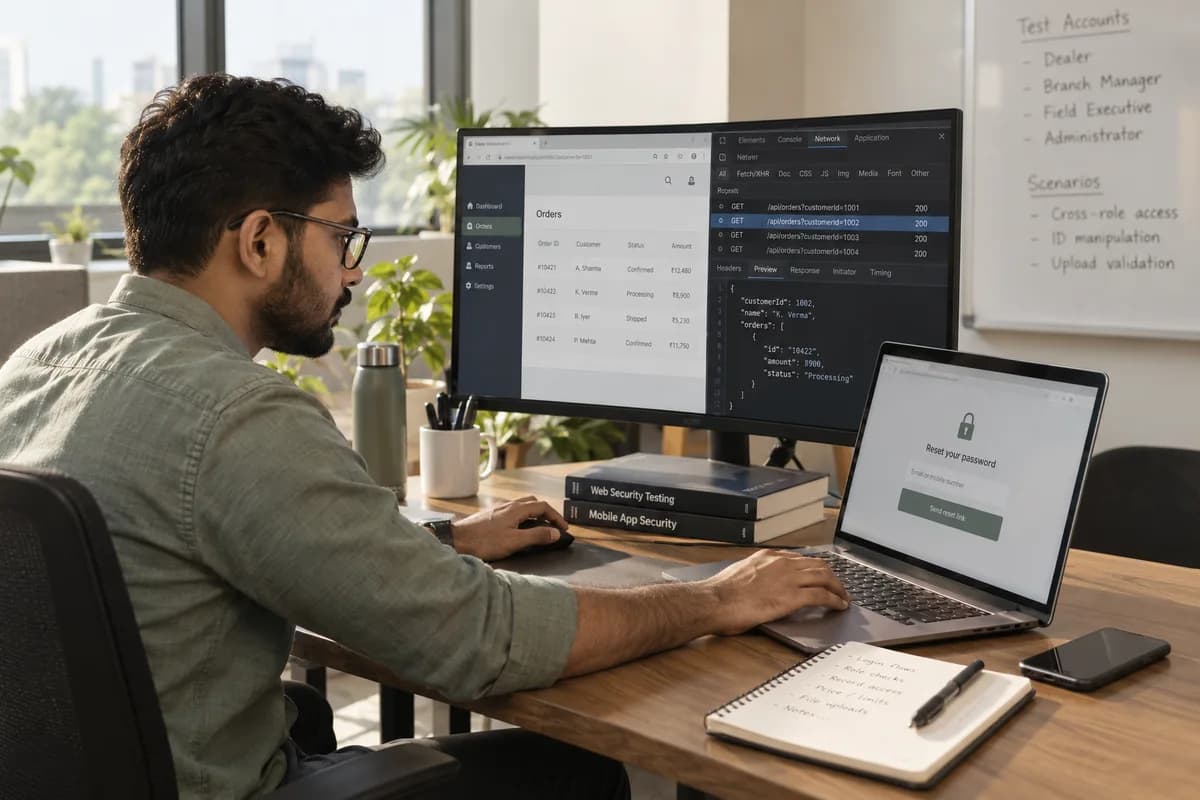
Tested role by role
Each role gets one test account, used the way that role uses the system: a dealer, a branch manager, a field executive, an administrator. Testers then try cross-role requests. A dealer account asks for the branch manager’s screen, or edits an identifier in the address bar to reach another customer’s invoice.
On the web side
On the mobile side
- What the app leaves on the phone: cached records, tokens, logs, photos from a site visit
- Keys and endpoints shipped inside the build and readable by anyone who unpacks it
- Whether traffic can be read or altered by somebody on the same network
- Screens or actions reachable outside the intended flow, without the normal checks
Frequently asked questions
Do you need our application source code for this?
No. The work is done from outside with normal accounts, which is the view an attacker has. A code review can run alongside it when that is worth the effort.
We have both a website and an Android app. Are those two separate assessments?
Partly. Both usually talk to the same backend, so permission testing is done once and applies to both. Device storage, build contents and network handling are extra mobile-only work.
Can application security assessments run without disturbing live customers?
Usually yes, on a recent copy of the system with test accounts. A finding that only appears in the live setup is confirmed with your contact first. Nothing destructive is attempted against real records.
When should the next assessment run after a release?
It depends on what changed. A change to login, permissions or payments is a reason to test again, and so is a new role or portal. A wording change on a page is not.
Tell us what you need.
Share your requirements and one of our engineers will come back to you within one business day.
- No obligation
- A reply within one business day
- Your details stay private
Start with your requirements
Seven short steps that tell us what you need. An engineer reads them before getting in touch.
Share your requirements