Bill of Materials for Adhesive manufacturers
Define the materials and quantities needed for a manufactured item.
Does this function belong in your operation?
Use when output quantities depend on a repeatable material or component list.
A product or production recipe is created or revised.
A recipe lists resins, polymers, solvents, fillers and additives with the charge order and allowed loss. Revisions are dated. A formulation change is visible to the laboratory before the next kettle.
Bring the records the workflow depends on.
- Finished-item codes
- Component quantities and units
- Revision and waste rules
Outputs to check
- Approved material and subassembly list
- Versioned material cost basis
- Quantity-exploded requirement sheet
Follow the bill of materials workflow.
Use this sequence to compare your current process with the proposed module. Agree the owner, permission and exception at each step.
Who uses the module, and who approves?
Keep responsibilities distinct even when one person holds more than one role.
Decide how exceptions are handled.
These business rules belong in configuration and testing. A normal transaction alone does not demonstrate that the workflow is ready.
Can this work independently?
A bill of materials can be maintained independently for costing and planning. Stock, purchasing and work orders use its approved version when connected. It does not reserve materials or schedule machines by itself, and a rate-based material total excludes labour or overhead unless separately defined.
Systems and records it connects with
- Production planning: Demand, planned quantities and resource or material constraints.
- Work orders: Released production jobs, material issues and output records.
- Purchase orders: Authorised supplier commitments and open line balances.
- Stock: Item-location quantities and authorised stock movements.
Configure, test and introduce the workflow.
- You show a few finished items and describe how they are made. You get a written note on how the parent items and sub-assemblies will be laid out. Begin with a few products.
- You supply item names, units and wastage habits from your sheets. A trial import comes back for you to correct before anything is relied on. Corrections come cheaply here. Recent purchase rates are connected to the lines. A costed list for a few products is laid beside your own working for comparison.
- The estimator and the storekeeper explode a batch on the trial. You hear what is missing, and the layout is changed. Gaps surface early. New quotations start from the list. The team is shown how to save a version and how to mark alternates.
Check the result before rollout.
Apply these checks to a sample from the agreed workflow, then repeat with an exception. Keep the expected result beside the test record.
- Component units are consistent.
- Production uses the approved version.
- Revisions preserve the earlier material definition.
How the business operates.
Adhesives are judged by whether they hold. A carton maker wants a glue that sets at line speed, a footwear factory wants a bond that survives flexing, and a woodworker wants an open time that fits the press. Each need leads to a different formulation. None is interchangeable.
The records that hold the operation together.
- Grades and formulations. Hold recipe revisions for every grade, with allowed substitutions of tackifier or plasticiser and quantities scaled to the kettle size.
- Raw material lots. Record resin, polymer, solvent and additive lots with incoming viscosity and solids. Each lot links to every batch that drew from it.
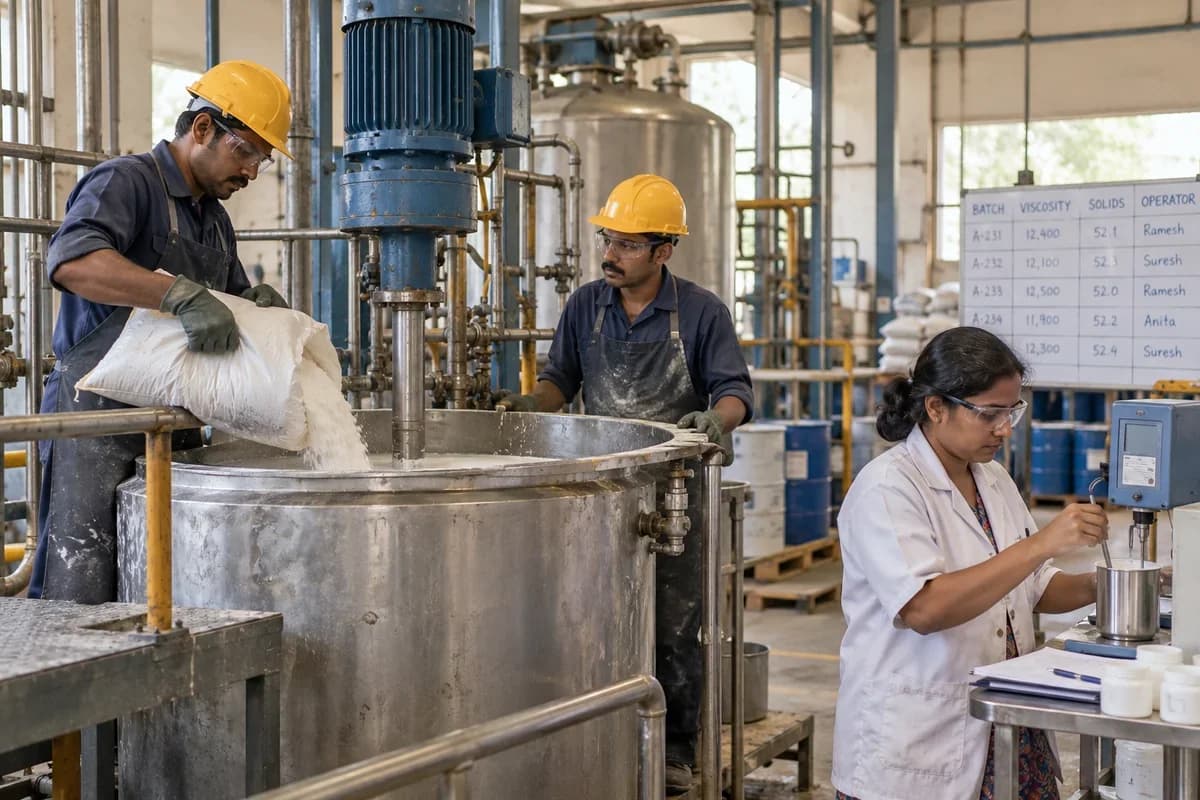
- Kettle batch records. Capture charging order, jacket temperature, dispersion blade speed, mixing time and the operator for each kettle batch.
- Viscosity and solids. Save Brookfield viscosity, solids content and pH against the batch. Readings are compared with each grade’s limits before release.
Operational bottlenecks to check
Viscosity drifts between batches
The same recipe gives a thicker batch when a resin lot changes. Readings sit in a notebook. The pattern is never seen.
Bond tests are not tied to the batch
A peel strength result is written on a test strip. Weeks on, nobody can say which pail in the customer’s store it describes.
How work flows across this business
This module sits within a wider operating process. Use the sequence to identify the other teams and records affected by a change.
1. Order and plan
A customer order, or a forecast for a repeat grade such as a case-sealing hot melt, opens a kettle batch. It carries the recipe revision and the quantity to make.
2. Weighing and charging
Resins, tackifiers, plasticisers, solvents or water, fillers and additives are weighed in charging order, and each raw lot number is recorded as it goes into the jacketed kettle. Scale readings stay on file.
3. Mixing
The operator notes jacket temperature, dispersion blade speed and mixing time, then a sample goes to the laboratory. The kettle waits.
4. Laboratory release
Viscosity, solids, pH, ring and ball softening point and peel or lap shear results are saved. The batch is released, reworked or held.
5. Filling
Pails, drums, IBC totes, tubes or cartridges are filled and checked on the scale, and a batch code and use-by date are printed on each. Short fills are caught at the scale.
6. Dispatch
Orders are picked by remaining shelf life and ship with the technical data sheet revision and safety data sheet the customer approved. Paperwork matches.
Industry reports to connect with
- Brookfield viscosity and solids by kettle batch and grade
- Peel and lap shear results against customer limits
- Resin and polymer lots used in a chosen batch
- Pails, drums and cartridges filled by batch code
Questions before implementation.
When should adhesive manufacturers consider bill of materials?
Use when output quantities depend on a repeatable material or component list. A product or production recipe is created or revised.
What should we bring to the requirements discussion?
Bring anonymised examples of Finished-item codes; Component quantities and units; Revision and waste rules. Show who creates, checks and changes each record. Use only records from an activity that meets the suitability conditions above.
Does this replace our existing business software?
The starting point is your current system and the gap you need to close. Define the materials and quantities needed for a manufactured item. Configuration, a connected module or a custom build are evaluated against that gap before a replacement is proposed.
What is outside this module?
Use only for operations that make, assemble or formulate physical goods; ordinary service delivery needs a different workflow.
How are scope, price and rollout decided?
The proposal follows a review of your records, user roles, branches and existing software. Data migration, connections, training and support are scoped separately where needed. Component units are consistent. Use this check when reviewing the first working version.
Discuss bill of materials for your business.
Tell us which workflow needs attention and which systems your team uses. The next step is a requirements discussion and a written scope.
What happens after you share your requirements
- We review your brief and the systems you already use.
- We clarify the workflow, missing information and the work to consider first.
- The proposed scope sets out the deliverables, responsibilities and dependencies.
- Review the scope and commercial terms before deciding whether to proceed.
Start with your requirements
Describe your current process, the people involved and the change you need. Start with the details you know; we can clarify the rest together.
Share your requirements