Attendance & Time Tracking for Bakeries
Record working time, absence and approved attendance corrections.
Does this function belong in your operation?
Use when staff attendance or working time affects pay, deployment or reporting.
A shift starts, ends or needs correction.
Early bakers clock in before dawn, and counter staff clock in by outlet. Late arrivals show against the oven start time. Swapped shifts are recorded, so the rota and attendance sheet agree.
Bring the records the workflow depends on.
- Employee and shift list
- Attendance sources
- Overtime and correction rules
Outputs to check
- Approved attendance register
- Correction and overtime history
- Payroll-ready period totals
Follow the attendance & time tracking workflow.
Use this sequence to compare your current process with the proposed module. Agree the owner, permission and exception at each step.
Who uses the module, and who approves?
Keep responsibilities distinct even when one person holds more than one role.
Decide how exceptions are handled.
These business rules belong in configuration and testing. A normal transaction alone does not demonstrate that the workflow is ready.
Can this work independently?
Attendance can use manual entries or imported device records. Employee and shift identifiers are required; payroll, leave and project time are separate processes. Device integration must define how missing, duplicated or delayed events are reconciled before a period closes.
Systems and records it connects with
- Payroll management: Approved pay inputs, deduction calculations and payment instructions.
- Leave and holiday management: Approved absence and branch calendar information.
- Project time tracking: Approved task hours and their billable classification.
- Biometric attendance devices: Device event imports and rejected or duplicated attendance events.
Configure, test and introduce the workflow.
- We go through the register, the sheets and the machine reports in use today. You supply samples from a recent month. You get back a written note of how attendance flows.
- Shifts, grace periods, half day and overtime rules are listed in plain words. You confirm them. A rules sheet comes back that you can show staff. We look at the biometric model and at each place where marking happens. You say who marks where. A note returns on what connects directly and what needs a file.
- Last month’s records are loaded into a trial screen. The admin team compares the result with the sheet they really used. Differences are discussed. Supervisors and the admin team practise marking and correcting. You choose the start date. The old register retires after a clean month close.
Check the result before rollout.
Apply these checks to a sample from the agreed workflow, then repeat with an exception. Keep the expected result beside the test record.
- Overnight shifts use the correct dates.
- Corrections retain the approver.
- Approved totals reconcile with the attendance period.
How the business operates.
A bakery sells bread, puffs and cakes over the counter, takes birthday cake orders by phone and fulfils delivery-platform orders. Each of these channels keeps its own record of what was sold.
The records that hold the operation together.
- Recipe costing from your own ingredients. Each product carries its recipe: ingredient quantities, yield per tray and the loss you expect in baking. With the latest supplier rate beside each ingredient, the ingredient cost of a tray and of a single piece can be read off. Labour, gas and packing are your own add-on rates, set once. When butter or cocoa moves, the cost view moves with the rate.
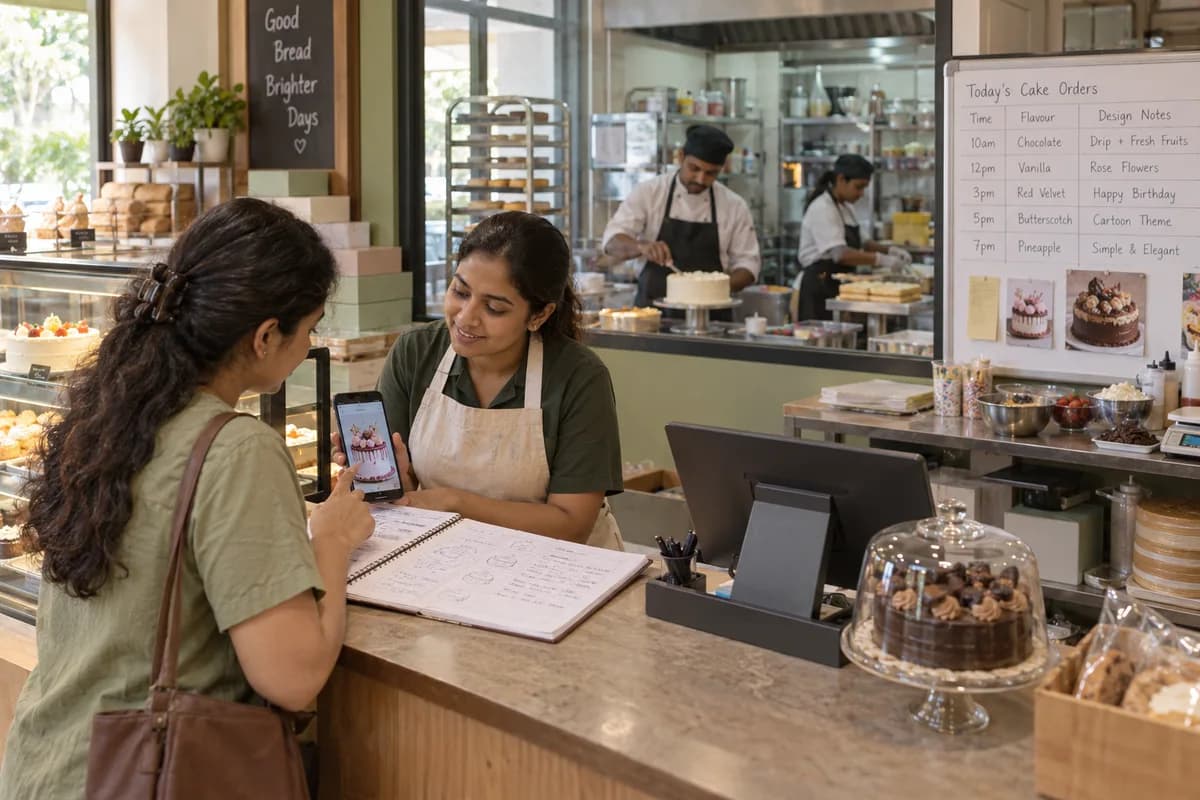
- Custom cake orders. Each cake slip records flavour, weight, inscription, design notes, advance paid, balance and pickup time. The counter reads out status to a caller. The kitchen sees which cakes are due today and which need a name piped. Repeat orders are copied from the last one.
- Daily production planning. Confirmed cake orders, standing café and hotel orders and your usual weekday counter quantities are added into one list of trays per item. The head baker loads the ovens from it. Unsold and binned stock at close feeds the next plan.
- Ingredient inventory. Flour, sugar, butter, cream and boxes fall as batches are logged, each with a reorder level. The plan is checked against the store the evening before, and a shortfall raises a purchase order to the supplier. Spoiled or dropped stock is recorded as wastage.
Operational bottlenecks to check
Custom cake orders are missed
An order is taken at one outlet while the design photo reaches a chef who is off that day. The customer arrives for a cake that was not made. The advance goes back.
Production is planned by estimate
Without sales by item and day, the kitchen guesses. Some items sell out by noon while others sit on the shelf. Waste and stock-outs happen together.
How work flows across this business
This module sits within a wider operating process. Use the sequence to identify the other teams and records affected by a change.
1. Recipes are costed
Each recipe is entered with quantities and yield, and priced from the latest supplier rate. When a rate changes, the cost per tray changes, and the owner sees which products need a new price before the next festival rush.
2. Orders are booked
Record custom cake orders with flavour, weight, inscription, design notes, advance paid and pickup time at the counter, while café and hotel orders sit in the same list.
3. The production plan is built
Confirmed orders, standing wholesale orders and the usual counter quantities are added together into one list, and the head baker reads trays per item before loading the ovens.
4. Ingredients are checked
The plan is matched against store stock for flour, sugar, butter and cream, and any shortfall raises a purchase order to the flour or dairy supplier the same evening. Nothing is ordered twice.
5. Batches are logged
Each batch is recorded with product, quantity, make date and the baker’s name, which leaves a record that survives the end of the day. The board can stay clean.
6. Selling, delivery and closing
The counter bills from the same item list, and every wholesale round leaves the van with a bill for each café. Unsold stock and wastage are entered at closing so tomorrow’s plan starts from what actually happened.
Industry reports to connect with
- Sales by product, by outlet and by hour of the day
- Wastage and unsold stock by product and by day
- Custom cake orders due today and this week
- Café, hotel and canteen dues outstanding
Questions before implementation.
When should bakeries consider attendance & time tracking?
Use when staff attendance or working time affects pay, deployment or reporting. A shift starts, ends or needs correction.
What should we bring to the requirements discussion?
Bring anonymised examples of Employee and shift list; Attendance sources; Overtime and correction rules. Show who creates, checks and changes each record. Use only records from an activity that meets the suitability conditions above.
Does this replace our existing business software?
The starting point is your current system and the gap you need to close. Record working time, absence and approved attendance corrections. Configuration, a connected module or a custom build are evaluated against that gap before a replacement is proposed.
What is outside this module?
Location tracking, biometrics and payroll connections require agreed scope and appropriate permissions.
How are scope, price and rollout decided?
The proposal follows a review of your records, user roles, branches and existing software. Data migration, connections, training and support are scoped separately where needed. Overnight shifts use the correct dates. Use this check when reviewing the first working version.
Related functions for bakeries.
Discuss attendance & time tracking for your business.
Tell us which workflow needs attention and which systems your team uses. The next step is a requirements discussion and a written scope.
What happens after you share your requirements
- We review your brief and the systems you already use.
- We clarify the workflow, missing information and the work to consider first.
- The proposed scope sets out the deliverables, responsibilities and dependencies.
- Review the scope and commercial terms before deciding whether to proceed.
Start with your requirements
Describe your current process, the people involved and the change you need. Start with the details you know; we can clarify the rest together.
Share your requirements