Expense Tracking for Contract farming companies
Record business spending with evidence, expense type and payment status.
Does this function belong in your operation?
Use when spending needs review by purpose, department or location.
A business cost occurs.
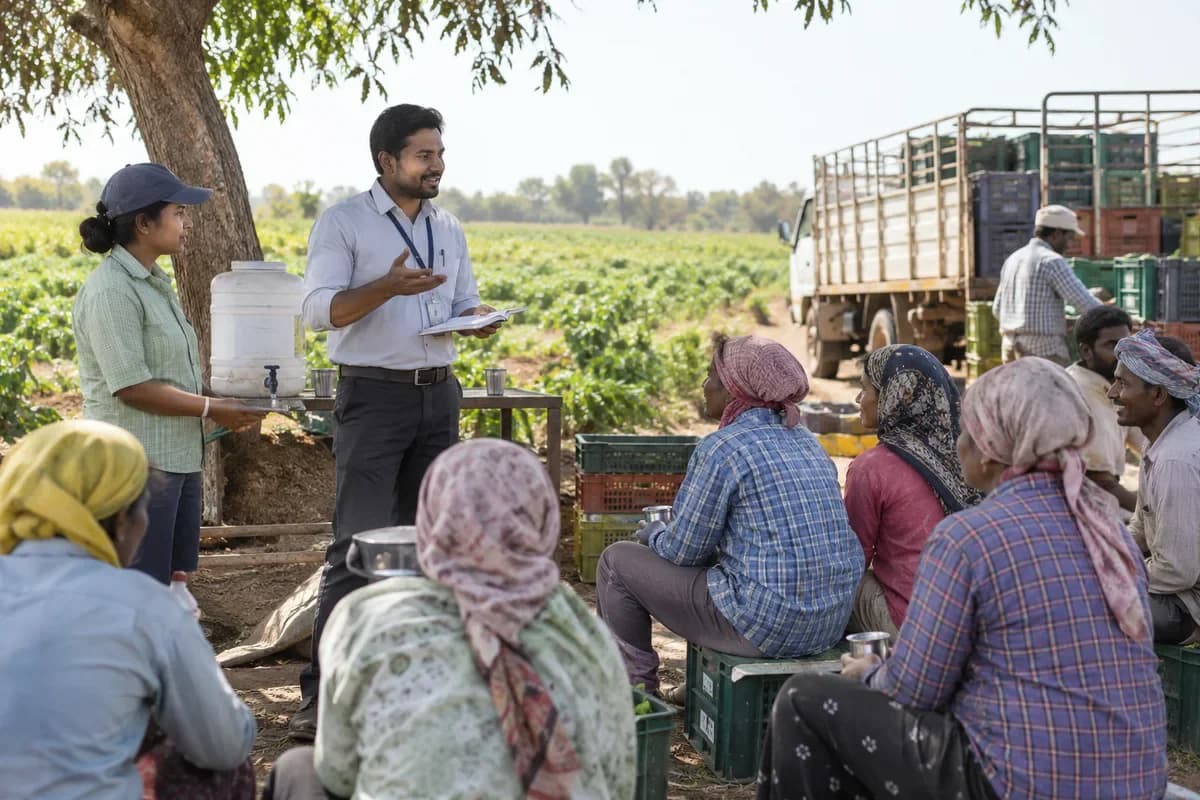
Field officers log fuel, travel and demonstration costs per village, and centre staff book labour and crate costs. Costs add up by crop. Managers compare spend with kilos procured.
Bring the records the workflow depends on.
- Cost categories
- Supporting bills
- Payment references
Outputs to check
- Categorised expense register
- Unpaid expense and advance list
- Cost-centre reporting inputs
Follow the expense tracking workflow.
Use this sequence to compare your current process with the proposed module. Agree the owner, permission and exception at each step.
Who uses the module, and who approves?
Keep responsibilities distinct even when one person holds more than one role.
Decide how exceptions are handled.
These business rules belong in configuration and testing. A normal transaction alone does not demonstrate that the workflow is ready.
Can this work independently?
Expenses can be entered with evidence without a complete accounting platform. Supplier, bank and reimbursement links connect the records to commitments and settlement. Accounting classification and payment approval remain separate responsibilities even where the records share one system.
Systems and records it connects with
- Vendor management: Approved supplier identities, terms and sensitive-change controls.
- Bank reconciliation: Cleared, unmatched and reversed bank transactions.
- Payroll management: Approved pay inputs, deduction calculations and payment instructions.
- Finance and accounting reporting: Ledger-based period totals and reconciliation outputs.
Configure, test and introduce the workflow.
- You walk us through petty cash, advances and vendor bills. You get a written list of expense heads to confirm. Heads can be trimmed.
- You decide which amounts need whom. A note of the limits and a login for each approver come back to you. A few supervisors enter real bills on a trial copy. You hear what slows them and the form is simplified. Simple forms win.
- The list of sites, vehicles and outlets is loaded. A view of a week’s spend by site is yours to compare with your own records. Costing begins here. Staff are trained to enter at the time of spending. Accounts stop collecting slips at month end.
Check the result before rollout.
Apply these checks to a sample from the agreed workflow, then repeat with an exception. Keep the expected result beside the test record.
- Totals trace to evidence.
- Unpaid and paid costs stay distinct.
- Cost-centre totals reconcile.
How the business operates.
The company never owns the field. It owns an agreement with several hundred growers, each holding a small plot of gherkin or sugarcane, a seed pack, a fertiliser advance and a promised delivery date. Most of that promise lives in a ledger at the area office, beside a stack of signed agreements, and the ledger ages faster than the crop.
The records that hold the operation together.
- Grower registry. Hold each grower’s identity, bank account, cluster and field officer, with the signed agreement, land record copy and nominee details attached to the file. Nothing lives in a cabinet.
- Agreement terms. Record crop, season, price band, grade rules, delivery window and recovery terms as fields the weighbridge reads, and keep the dated history of every revision to those terms. Old terms never vanish.
- Plots and crop calendar. Register each plot with area, variety, sowing date and expected harvest week, and let the calendar show which clusters are sowing, flowering or ready for the first picking. Harvest weeks drive trucks.
- Input store and issue. Receive seed, fertiliser and crop protection by batch number, issue them to growers against their agreements, and show the stock remaining in each store. Issues carry batch numbers.
Operational bottlenecks to check
Agreements are in cabinets, not linked
The price band, grade rules and delivery window sit on a signed paper, and a collection centre clerk applies them from memory. Growers dispute the slip.
Input advances are lost in a ledger
Seed, fertiliser and sprays go out in the pre-season rush, and weeks later finance cannot tell how much each grower owes before settlement. Recovery becomes a guess.
How work flows across this business
This module sits within a wider operating process. Use the sequence to identify the other teams and records affected by a change.
1. Sign the grower
The sourcing team records the grower, the plots with survey numbers, the crop and the agreement terms, and a cluster and a field officer are assigned to the file. Terms are entered as fields.
2. Issue inputs
Seed, fertiliser and crop protection leave the store against the agreement with batch numbers noted, and the value is added to the grower’s advance balance the same day.
3. Visit and forecast
Field officers log germination, crop stage, pest notes and a yield estimate for each plot, and the forecast for the cluster is built from those visits. Nobody forecasts from memory.
4. Plan procurement
Each plot carries a harvest week, and from it the system books trucks and pickup days for the whole cluster, then messages every grower with the slot and the collection centre.
5. Weigh and grade
Each lot is weighed at the centre, read for moisture or grade, and printed on a slip showing gross, tare and net weight. Rejected quantity gets a reason.
6. Settle and dispatch
Payment is computed from accepted weight, price band and advance recovery, lots go to the processor with delivery notes, and intake weight is reconciled against centre totals.
Industry reports to connect with
- Agreements, area and expected volume by crop and cluster
- Input issues and advance balances by grower
- Field officer visits done against plan
- Forecast against procured weight, by cluster and week
Questions before implementation.
When should contract farming companies consider expense tracking?
Use when spending needs review by purpose, department or location. A business cost occurs.
What should we bring to the requirements discussion?
Bring anonymised examples of Cost categories; Supporting bills; Payment references. Show who creates, checks and changes each record. Use only records from an activity that meets the suitability conditions above.
Does this replace our existing business software?
The starting point is your current system and the gap you need to close. Record business spending with evidence, expense type and payment status. Configuration, a connected module or a custom build are evaluated against that gap before a replacement is proposed.
What is outside this module?
Tax deductibility and employee claim policy require separate decisions.
How are scope, price and rollout decided?
The proposal follows a review of your records, user roles, branches and existing software. Data migration, connections, training and support are scoped separately where needed. Totals trace to evidence. Use this check when reviewing the first working version.
Related functions for contract farming companies.
Discuss expense tracking for your business.
Tell us which workflow needs attention and which systems your team uses. The next step is a requirements discussion and a written scope.
What happens after you share your requirements
- We review your brief and the systems you already use.
- We clarify the workflow, missing information and the work to consider first.
- The proposed scope sets out the deliverables, responsibilities and dependencies.
- Review the scope and commercial terms before deciding whether to proceed.
Start with your requirements
Describe your current process, the people involved and the change you need. Start with the details you know; we can clarify the rest together.
Share your requirements