Quality Control for Electrical equipment manufacturers
Record specified inspections and the disposition of checked goods.
Does this function belong in your operation?
Use when goods or production stages require documented checks before release.
Material or output reaches an agreed inspection stage.
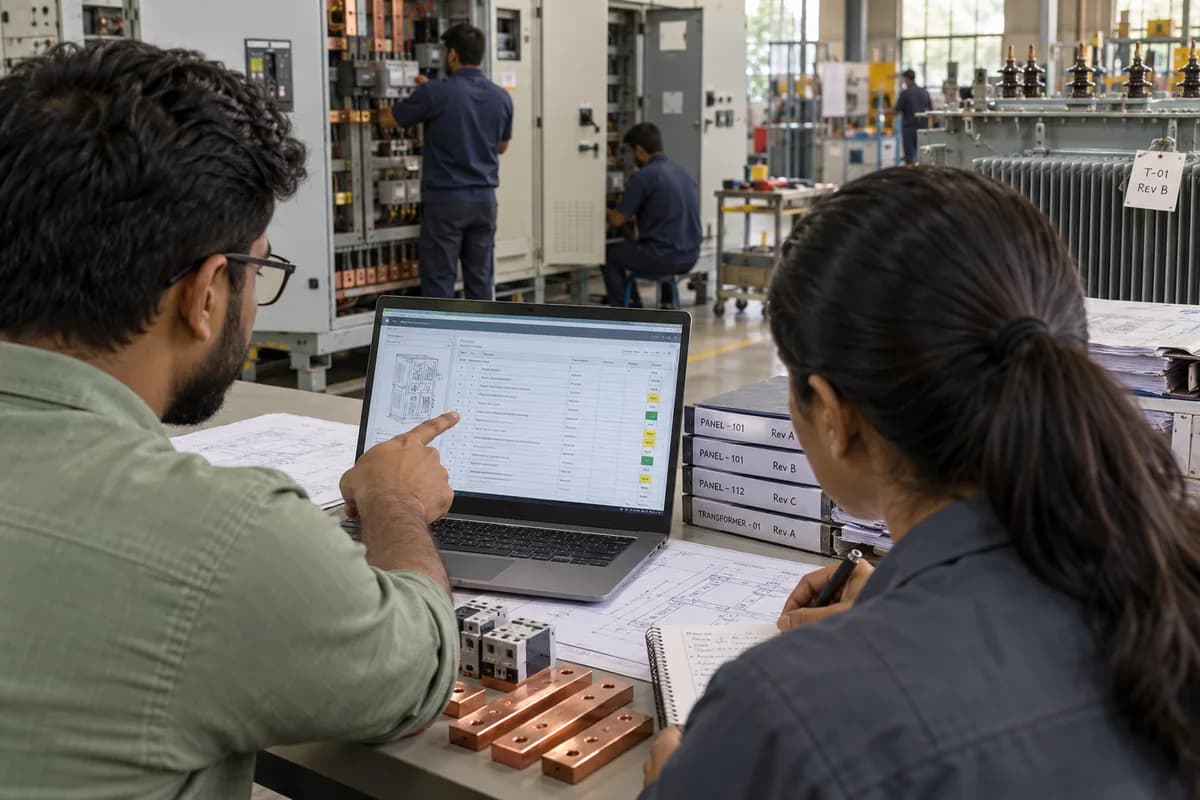
A panel's test sheet belongs to its serial or job reference and the approved engineering specification. Configure insulation, interlock and relay checks from the manufacturer's authorised procedure. If transformer testing is in scope, keep its winding and ratio results in the appropriate equipment record. Test software records evidence; engineers decide acceptance.
Bring the records the workflow depends on.
- Panel or transformer identifier, drawing revision and approved inspection or test procedure.
- Required readings, authorised acceptance criteria and test equipment references.
- Inspector identities, hold rules and the engineer permitted to release or require rework.
Outputs to check
- Equipment-specific inspection record linking readings, reviewer and final disposition.
- Quality hold list showing jobs that cannot proceed to dispatch pending a decision.
Follow the quality control workflow.
Use this sequence to compare your current process with the proposed module. Agree the owner, permission and exception at each step.
Who uses the module, and who approves?
Keep responsibilities distinct even when one person holds more than one role.
Decide how exceptions are handled.
These business rules belong in configuration and testing. A normal transaction alone does not demonstrate that the workflow is ready.
Can this work independently?
Quality records can be maintained independently against identifiable receipts or jobs. Inventory and production connections must enforce any hold or release decision. The module records authorised checks; it does not select a regulatory standard or replace a qualified inspector's judgement.
Systems and records it connects with
- Work orders: Released production jobs, material issues and output records.
- Goods receipt: Counted, accepted and rejected supplier-delivery quantities.
- Purchase returns: Approved supplier-return quantities and adjustment references.
- Batch and serial tracking: Lot or unit identifiers carried through stock movements.
Configure, test and introduce the workflow.
- Show us where checks happen now. A note names the checkpoints and the parameters to record.
- Provide limits and your list of rejection reasons. A test lot can then be checked on the trial screen. Checkers use it at a station for a trial run. Their remarks return as changes.
- Checkers, production and purchase each practise their part. Each group gets a printed card. Other stations join as the trial station settles. The team reviews rejection reasons together.
Check the result before rollout.
Apply these checks to a sample from the agreed workflow, then repeat with an exception. Keep the expected result beside the test record.
- An out-of-range sample produces a visible hold that dispatch staff cannot clear themselves.
- The record retains original readings and the separate retest after documented rework.
- A reviewer can identify the equipment, engineering revision, test criteria and releasing authority from the saved record.
How the business operates.
You make low-voltage panels, motor control centres, power factor correction panels, high-voltage switchgear, distribution transformers or busducts, mostly against a purchase order carrying its own specification. Very little is built for stock.
The records that hold the operation together.
- Customer specification and approved makes
- Drawing revision, comments and approval
- Order-specific bill of materials and shortage list
- Stage job card, serial number and test readings
Operational bottlenecks to check
Drawing approval stalls unnoticed
A GA drawing sits with the consultant for comments, and purchase cannot book breakers until it returns. No one owns the follow-up.
Bought-out items arrive after the enclosure
Breakers, relays and meters are booked late against a bill of materials kept in Excel. The finished enclosure waits empty.
How work flows across this business
This module sits within a wider operating process. Use the sequence to identify the other teams and records affected by a change.
1. Review the enquiry
Record the technical requirement, approved makes and deviations. Link the priced quotation to the specification used for it.
2. Approve drawings and material lists
Retain customer comments and release a named drawing revision with its bill of materials. Hold unapproved changes outside the shop instruction.
3. Procure and build
Order shortages and issue accepted components to the job. Record the applicable fabrication, assembly, wiring or winding stages.
4. Test and obtain clearance
Attach test readings to the order or serial number. Quality controls the inspection call, observations and clearance to dispatch.
5. Dispatch and follow the order
Send the identified equipment with its approved documents. Link later commissioning faults and customer payments to the same order.
Industry reports to connect with
- Drawing approvals awaiting action
- Bought-out component shortages by order
- Stage completion and inspection holds
- Order dispatch, invoice and receivable position
Questions before implementation.
When should electrical equipment manufacturers consider quality control?
Use when goods or production stages require documented checks before release. Material or output reaches an agreed inspection stage.
What should we bring to the requirements discussion?
Bring anonymised examples of Panel or transformer identifier, drawing revision and approved inspection or test procedure.; Required readings, authorised acceptance criteria and test equipment references.; Inspector identities, hold rules and the engineer permitted to release or require rework. Show who creates, checks and changes each record. Use only records from an activity that meets the suitability conditions above.
Does this replace our existing business software?
The starting point is your current system and the gap you need to close. Record specified inspections and the disposition of checked goods. Configuration, a connected module or a custom build are evaluated against that gap before a replacement is proposed.
What is outside this module?
The software records your inspection process and does not certify product safety or regulatory conformity.
How are scope, price and rollout decided?
The proposal follows a review of your records, user roles, branches and existing software. Data migration, connections, training and support are scoped separately where needed. An out-of-range sample produces a visible hold that dispatch staff cannot clear themselves. Use this check when reviewing the first working version.
Related functions for electrical equipment manufacturers.
Discuss quality control for your business.
Tell us which workflow needs attention and which systems your team uses. The next step is a requirements discussion and a written scope.
What happens after you share your requirements
- We review your brief and the systems you already use.
- We clarify the workflow, missing information and the work to consider first.
- The proposed scope sets out the deliverables, responsibilities and dependencies.
- Review the scope and commercial terms before deciding whether to proceed.
Start with your requirements
Describe your current process, the people involved and the change you need. Start with the details you know; we can clarify the rest together.
Share your requirements