Order Management for Institutional food suppliers
Track a confirmed order through fulfilment and billing.
Does this function belong in your operation?
Use when sales, operations and billing share confirmed orders.
A customer confirms goods or work.
An institutional food order begins with a kitchen indent, which may arrive as a call, message or photographed sheet. Capture the customer, delivery requirement and item units before combining demand for the market buyer. Preserve each institution's order identity even when several kitchens share a route pick list.
Bring the records the workflow depends on.
- Institution indent with item description, ordered quantity and the kitchen's delivery requirement.
- Contract or dated market-price reference and agreed sack, crate or weight units.
- Accepted amendments, route allocation and the customer contact authorised to confirm changes.
Outputs to check
- Confirmed institution order with a traceable version of the supplied indent.
- Aggregated buying and route-picking requirements that retain links to individual customer quantities.
Follow the order management workflow.
Use this sequence to compare your current process with the proposed module. Agree the owner, permission and exception at each step.
Who uses the module, and who approves?
Keep responsibilities distinct even when one person holds more than one role.
Decide how exceptions are handled.
These business rules belong in configuration and testing. A normal transaction alone does not demonstrate that the workflow is ready.
Can this work independently?
Orders can be entered from an accepted customer instruction without CRM. Stock, production, service delivery and invoicing connect through order-line references. Each owns its execution record; an order status should reflect their confirmed outcomes rather than assume delivery from a planned date.
Systems and records it connects with
- Quote and proposal management: Commercial proposal versions and acceptance details.
- Stock tracking and alerts: Item-location quantities and authorised stock movements.
- Invoice management: Issued invoice references, line amounts and outstanding balances.
- Accounting software: Posted financial entries and reconciliation references.
Configure, test and introduce the workflow.
- Walk us through an order from call to payment. A note shows the steps and the documents.
- Decide which changes need approval. A test order can then be taken, with your own staff at the keys. Share orders still pending. The trial import shows quantities dispatched and pending for the storekeeper to check.
- Sales and the store team practise a part delivery. A note for the counter follows. New orders go through the system from the date you agree. Changes from the opening week are reviewed together. Habits settle quickly.
Check the result before rollout.
Apply these checks to a sample from the agreed workflow, then repeat with an exception. Keep the expected result beside the test record.
- A route list can be traced back to the separate institution orders that contributed each quantity.
- An amended indent identifies who confirmed the change and which buying or packing list was affected.
- A shortage leaves an explicit accepted, pending or cancelled balance instead of being treated as full supply.
How the business operates.
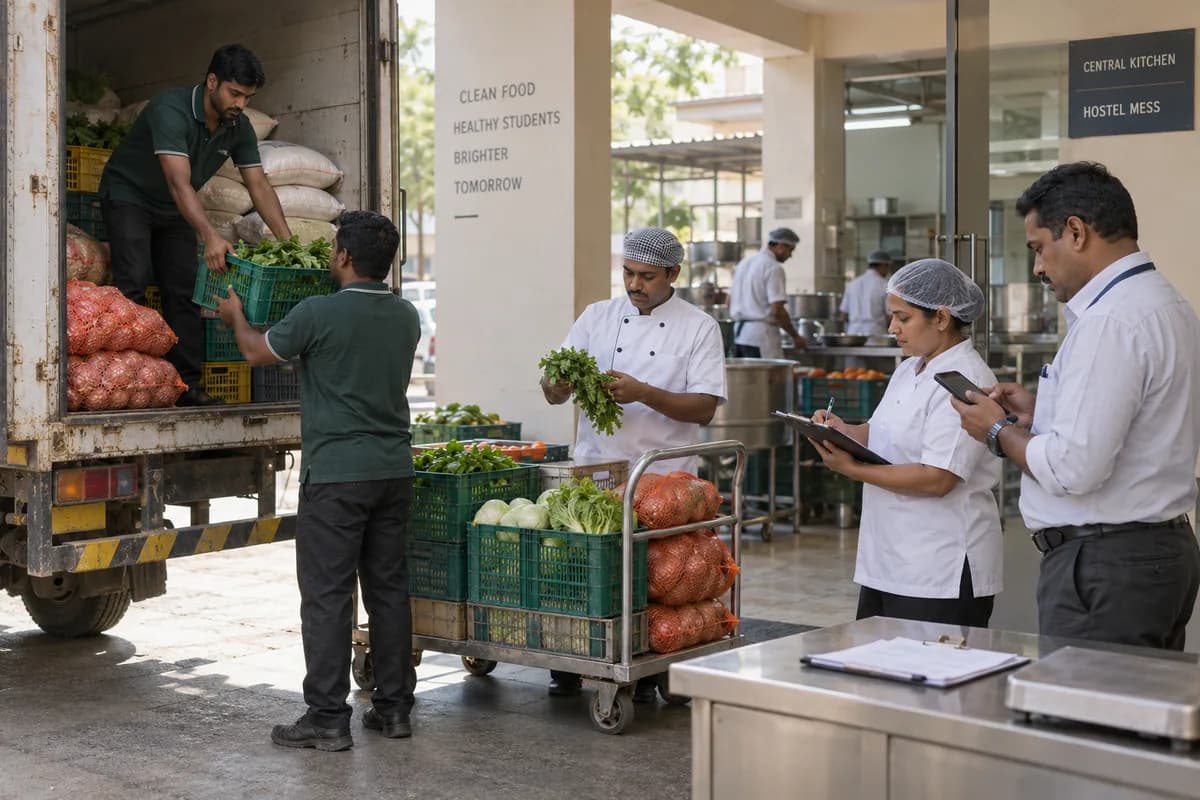
You supply the kitchen, not the shelf. Each hostel, hospital ward kitchen or caterer sends an indent, expects the sacks and crates at a fixed hour, and weighs them on its own platform scale before signing.
The records that hold the operation together.
- Institution, delivery location and authorised buyer
- Indent, standing requirement and effective rate contract
- Route picking and loading record
- Signed delivery note, weight difference and rejection
Operational bottlenecks to check
Daily indents arrive by call, message and sheet
Calls, voice notes and photographed sheets all reach the order desk in different layouts, and one item is missed. The cook finds out at the gate.
Contract rates drift from billed rates
A rate agreed for a tender period lives in a letter, and bills are raised at the last price used. The customer’s auditor notices before you do.
How work flows across this business
This module sits within a wider operating process. Use the sequence to identify the other teams and records affected by a change.
1. Confirm the indent
Record the institution’s requirement and delivery location. Retain changes to standing quantities rather than silently overwriting the earlier request.
2. Source and prepare the route
Confirm availability and any proposed substitution, then prepare the route pick list using the agreed units.
3. Record receiving-gate decisions
Capture the quantity accepted, short supply and rejected items against the delivery note. Keep the receiving person’s acknowledgement with the record.
4. Resolve quantity and rate differences
Apply the contract version effective for the delivery and review unapproved substitutions or disputed weights before billing.
5. Consolidate and collect
Build the agreed billing statement from supported deliveries, with each adjustment traceable to its source. Reconcile receipts and unresolved deductions.
Industry reports to connect with
- Indents and standing quantities awaiting supply
- Route shortages, rejections and delivery differences
- Delivered quantities against contract-rate versions
- Consolidated bills, deductions and outstanding balances
Questions before implementation.
When should institutional food suppliers consider order management?
Use when sales, operations and billing share confirmed orders. A customer confirms goods or work.
What should we bring to the requirements discussion?
Bring anonymised examples of Institution indent with item description, ordered quantity and the kitchen's delivery requirement.; Contract or dated market-price reference and agreed sack, crate or weight units.; Accepted amendments, route allocation and the customer contact authorised to confirm changes. Show who creates, checks and changes each record. Use only records from an activity that meets the suitability conditions above.
Does this replace our existing business software?
The starting point is your current system and the gap you need to close. Track a confirmed order through fulfilment and billing. Configuration, a connected module or a custom build are evaluated against that gap before a replacement is proposed.
What is outside this module?
Stock, production and carrier connections need agreed scope.
How are scope, price and rollout decided?
The proposal follows a review of your records, user roles, branches and existing software. Data migration, connections, training and support are scoped separately where needed. A route list can be traced back to the separate institution orders that contributed each quantity. Use this check when reviewing the first working version.
Related functions for institutional food suppliers.
Discuss order management for your business.
Tell us which workflow needs attention and which systems your team uses. The next step is a requirements discussion and a written scope.
What happens after you share your requirements
- We review your brief and the systems you already use.
- We clarify the workflow, missing information and the work to consider first.
- The proposed scope sets out the deliverables, responsibilities and dependencies.
- Review the scope and commercial terms before deciding whether to proceed.
Start with your requirements
Describe your current process, the people involved and the change you need. Start with the details you know; we can clarify the rest together.
Share your requirements