Territory Management for Institutional food suppliers
Assign sales coverage by area, route or customer group.
Does this function belong in your operation?
Use when sales responsibility follows geography, segments or channels.
Coverage or account ownership changes.
Group institutional accounts by the delivery areas and commercial ownership used by the supplier. The same area assignment lets a supervisor review kitchen visits and service coverage, while van dispatch remains a separate operational process. This configuration does not imply automated routing, travel-time estimates or vehicle tracking.
Bring the records the workflow depends on.
- Hostel, hospital-kitchen and canteen accounts with their delivery addresses and assigned area.
- Named account or route supervisors and the agreed customer-coverage responsibilities.
- Delivery-window references and authorised rules for adding or transferring an institution.
Outputs to check
- Area-to-account register showing the person responsible for each kitchen relationship.
- Coverage and transfer report retaining the previous and current account assignments.
Follow the territory management workflow.
Use this sequence to compare your current process with the proposed module. Agree the owner, permission and exception at each step.
Who uses the module, and who approves?
Keep responsibilities distinct even when one person holds more than one role.
Decide how exceptions are handled.
These business rules belong in configuration and testing. A normal transaction alone does not demonstrate that the workflow is ready.
Can this work independently?
Coverage can be managed from an imported account list without a full CRM. Lead, deal and collection records need the same territory or owner reference for useful reporting. Travel routes and live location are separate capabilities, not a consequence of defining a sales area.
Systems and records it connects with
- Lead management: Enquiry sources, owners and qualification decisions.
- Contact and account management: Account identifiers, authorised contacts and relationship ownership.
- Pipeline management: Opportunity-stage movement and open-deal ownership.
- Collections and follow-up: Due balances, payment promises and follow-up outcomes.
Configure, test and introduce the workflow.
- We go through the areas as people use them. You provide dealer lists. A draft map comes back.
- Boundaries are set by code, district or route. Area managers check each. Dealers and shops are assigned. Gaps and overlaps appear in a report to settle.
- Weekly beats are entered for executives. They try the view on a phone. Targets by area are loaded. The first review after that uses the new figures. Coverage is reviewed after the first full cycle of beats. Area managers and the owner read the report together, and any territory that proved too large or too thin is split or merged on the spot. Changes are saved with a date.
Check the result before rollout.
Apply these checks to a sample from the agreed workflow, then repeat with an exception. Keep the expected result beside the test record.
- Each institutional site has an identifiable coverage owner without duplicating the parent customer's account.
- A transfer preserves the previous assignment and the date responsibility changed.
- The area view distinguishes commercial ownership from actual van allocation and delivery completion.
How the business operates.
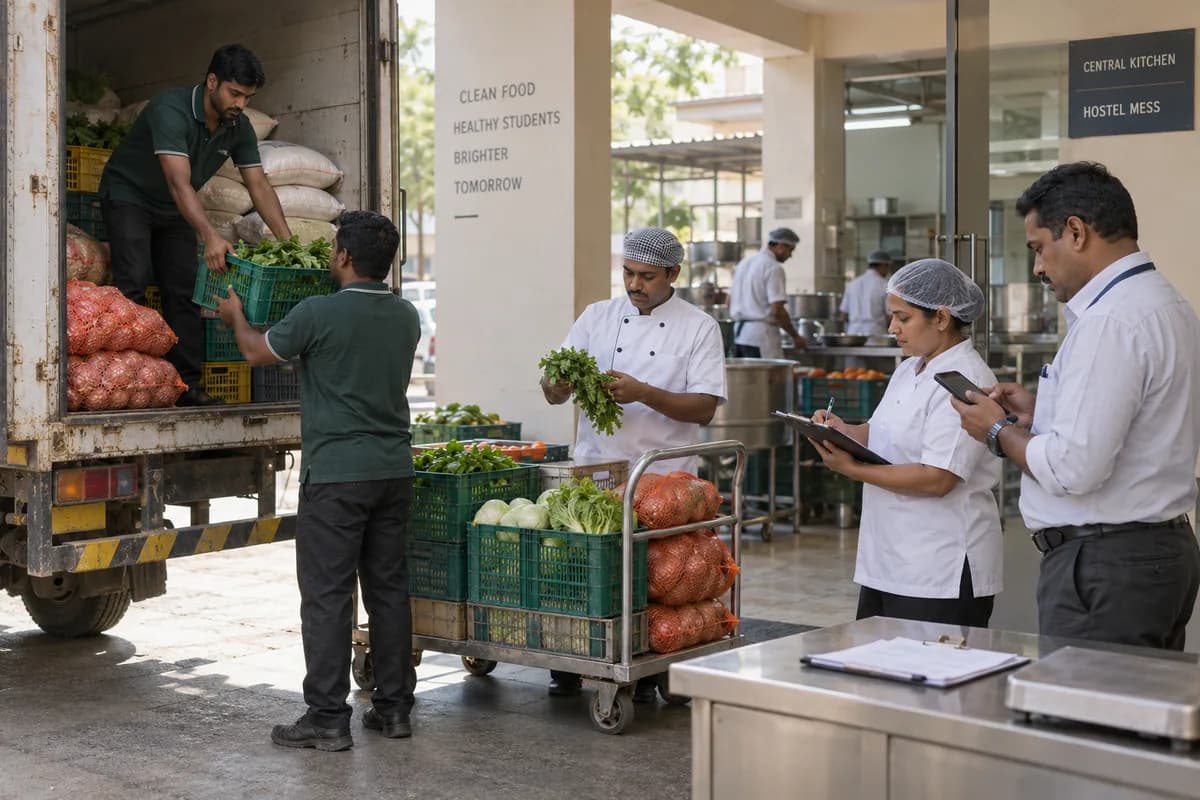
You supply the kitchen, not the shelf. Each hostel, hospital ward kitchen or caterer sends an indent, expects the sacks and crates at a fixed hour, and weighs them on its own platform scale before signing.
The records that hold the operation together.
- Institution, delivery location and authorised buyer
- Indent, standing requirement and effective rate contract
- Route picking and loading record
- Signed delivery note, weight difference and rejection
Operational bottlenecks to check
Daily indents arrive by call, message and sheet
Calls, voice notes and photographed sheets all reach the order desk in different layouts, and one item is missed. The cook finds out at the gate.
Contract rates drift from billed rates
A rate agreed for a tender period lives in a letter, and bills are raised at the last price used. The customer’s auditor notices before you do.
How work flows across this business
This module sits within a wider operating process. Use the sequence to identify the other teams and records affected by a change.
1. Confirm the indent
Record the institution’s requirement and delivery location. Retain changes to standing quantities rather than silently overwriting the earlier request.
2. Source and prepare the route
Confirm availability and any proposed substitution, then prepare the route pick list using the agreed units.
3. Record receiving-gate decisions
Capture the quantity accepted, short supply and rejected items against the delivery note. Keep the receiving person’s acknowledgement with the record.
4. Resolve quantity and rate differences
Apply the contract version effective for the delivery and review unapproved substitutions or disputed weights before billing.
5. Consolidate and collect
Build the agreed billing statement from supported deliveries, with each adjustment traceable to its source. Reconcile receipts and unresolved deductions.
Industry reports to connect with
- Indents and standing quantities awaiting supply
- Route shortages, rejections and delivery differences
- Delivered quantities against contract-rate versions
- Consolidated bills, deductions and outstanding balances
Questions before implementation.
When should institutional food suppliers consider territory management?
Use when sales responsibility follows geography, segments or channels. Coverage or account ownership changes.
What should we bring to the requirements discussion?
Bring anonymised examples of Hostel, hospital-kitchen and canteen accounts with their delivery addresses and assigned area.; Named account or route supervisors and the agreed customer-coverage responsibilities.; Delivery-window references and authorised rules for adding or transferring an institution. Show who creates, checks and changes each record. Use only records from an activity that meets the suitability conditions above.
Does this replace our existing business software?
The starting point is your current system and the gap you need to close. Assign sales coverage by area, route or customer group. Configuration, a connected module or a custom build are evaluated against that gap before a replacement is proposed.
What is outside this module?
Route optimisation and location tracking require separate scope.
How are scope, price and rollout decided?
The proposal follows a review of your records, user roles, branches and existing software. Data migration, connections, training and support are scoped separately where needed. Each institutional site has an identifiable coverage owner without duplicating the parent customer's account. Use this check when reviewing the first working version.
Related functions for institutional food suppliers.
Discuss territory management for your business.
Tell us which workflow needs attention and which systems your team uses. The next step is a requirements discussion and a written scope.
What happens after you share your requirements
- We review your brief and the systems you already use.
- We clarify the workflow, missing information and the work to consider first.
- The proposed scope sets out the deliverables, responsibilities and dependencies.
- Review the scope and commercial terms before deciding whether to proceed.
Start with your requirements
Describe your current process, the people involved and the change you need. Start with the details you know; we can clarify the rest together.
Share your requirements