Work Order Management for Investment casting companies
Track a production job from material issue to completed output.
Does this function belong in your operation?
Use when physical production needs a job-level record of materials and output.
A production plan releases a specific job.
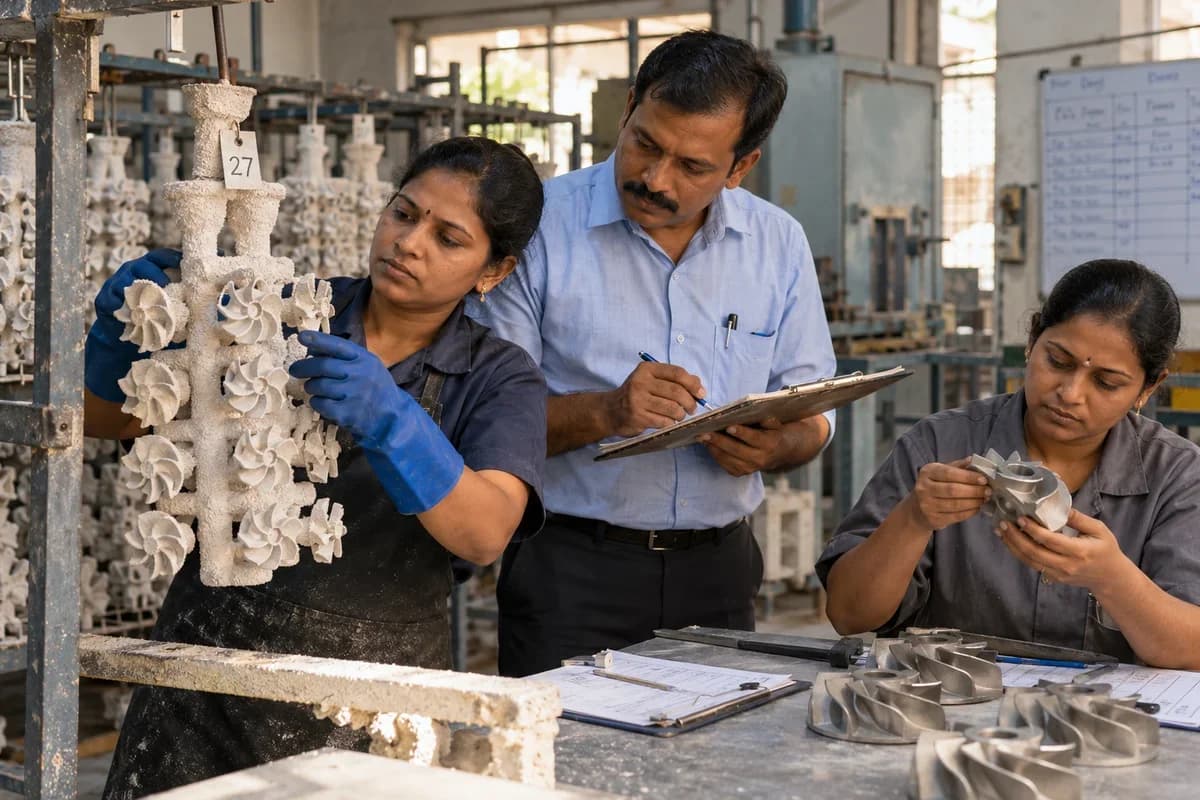
A work order follows a batch of trees from wax room to final inspection, with a stage sign-off at each step. The supervisor sees where it sits. Delays in shell build show before pour day.
Bring the records the workflow depends on.
- Required output
- Approved material list
- Process steps and due dates
Outputs to check
- Released production-job record
- Material and output reconciliation
- Work-in-progress and variance list
Follow the work order management workflow.
Use this sequence to compare your current process with the proposed module. Agree the owner, permission and exception at each step.
Who uses the module, and who approves?
Keep responsibilities distinct even when one person holds more than one role.
Decide how exceptions are handled.
These business rules belong in configuration and testing. A normal transaction alone does not demonstrate that the workflow is ready.
Can this work independently?
A work order needs an output definition and process instructions. It can use entered materials and progress, but bill-of-materials, stock and quality links make execution traceable. Sales orders provide demand; closing production is not the same as dispatching or invoicing the finished goods.
Systems and records it connects with
- Bill of materials: Approved component quantities and production-definition versions.
- Production planning: Demand, planned quantities and resource or material constraints.
- Stock: Item-location quantities and authorised stock movements.
- Job work delivery notes: Material dispatch and return references for outside processing.
Configure, test and introduce the workflow.
- Tell us the stages a job passes through, in your words. A stage list comes back to confirm.
- Sales orders are connected, and so is the bill of materials. A sample work order draws on each. A screen shows jobs by stage. The supervisor tries it beside the whiteboard.
- Supervisors and the store use live work orders. The whiteboard is retired after a trial period.
Check the result before rollout.
Apply these checks to a sample from the agreed workflow, then repeat with an exception. Keep the expected result beside the test record.
- Output links to its work order.
- Material usage is traceable.
- Unfinished quantities remain visible.
How the business operates.
An investment casting begins as wax. It is injected in a die, joined to a runner into a tree, dipped in slurry and stucco several times, dried, dewaxed and fired. Metal is poured into the hot shell, and the shell is knocked off the casting.
The records that hold the operation together.
- Enquiries and part quotations. Price a casting from die amortisation, wax, shell, alloy weight, finishing hours and inspection, from your own rates, with each revision kept.
- Wax die register. Hold every die with part number, cavities, shot count, repairs and rack position, and flag a die near its planned service.
- Wax injection and pattern stock. Record shots, rejects and trimmed patterns, with wax batch and injection settings noted for each run.
- Tree assembly. Build trees from patterns of a single order or of mixed orders, and give each tree a number that follows it through shell, pour and cut-off.
Operational bottlenecks to check
Wax dies are hard to account for
Dies are made for each part and sit on racks between orders for months, while the people who knew their history move on to other jobs. Their shot count, repairs and cavity wear are known to one person. Or to nobody.
Shell coats are logged on paper
The count of dips, the stucco grade and the drying time per coat decide whether a shell survives the pour. A missed coat shows up as a leak.
How work flows across this business
This module sits within a wider operating process. Use the sequence to identify the other teams and records affected by a change.
1. Enquiry and quotation
A drawing and a quantity arrive. The estimator prices die cost, wax, shell, alloy, finishing and inspection, and each revision is kept.
2. Die and wax plan
A new die is ordered or an existing one is booked. Wax injection quantities are planned to match tree and pour dates.
3. Tree and shell
Patterns are assembled onto trees. Each tree is dipped and stuccoed through its coats, and dry times are logged.
4. Dewax, fire and pour
Trees are dewaxed and fired. The melt is recorded with its heat number, and the pour is tied to each tree.
5. Cut-off and finishing
Shells are knocked off and parts cut from the tree. Grinding, blasting, straightening and heat treatment are logged per part.
6. Inspection and dispatch
Dimensional, penetrant and X-ray results are entered per lot. The report, packing list and invoice go out with the shipment.
Industry reports to connect with
- Yield by part number from wax injected to castings accepted
- Trees by stage: wax, shell, dewax, poured, cut off
- Die shot count and next service date
- Shell rejects and cracked shells by cause
Questions before implementation.
When should investment casting companies consider work order management?
Use when physical production needs a job-level record of materials and output. A production plan releases a specific job.
What should we bring to the requirements discussion?
Bring anonymised examples of Required output; Approved material list; Process steps and due dates. Show who creates, checks and changes each record. Use only records from an activity that meets the suitability conditions above.
Does this replace our existing business software?
The starting point is your current system and the gap you need to close. Track a production job from material issue to completed output. Configuration, a connected module or a custom build are evaluated against that gap before a replacement is proposed.
What is outside this module?
This is a production work order; field repairs and customer visits belong in job cards.
How are scope, price and rollout decided?
The proposal follows a review of your records, user roles, branches and existing software. Data migration, connections, training and support are scoped separately where needed. Output links to its work order. Use this check when reviewing the first working version.
Related functions for investment casting companies.
Discuss work order management for your business.
Tell us which workflow needs attention and which systems your team uses. The next step is a requirements discussion and a written scope.
What happens after you share your requirements
- We review your brief and the systems you already use.
- We clarify the workflow, missing information and the work to consider first.
- The proposed scope sets out the deliverables, responsibilities and dependencies.
- Review the scope and commercial terms before deciding whether to proceed.
Start with your requirements
Describe your current process, the people involved and the change you need. Start with the details you know; we can clarify the rest together.
Share your requirements