Business solutions for Investment casting companies
Explore software for work such as “Stainless steel valve and pump bodies”. Review each business function below, including when it fits and what to check before implementation.
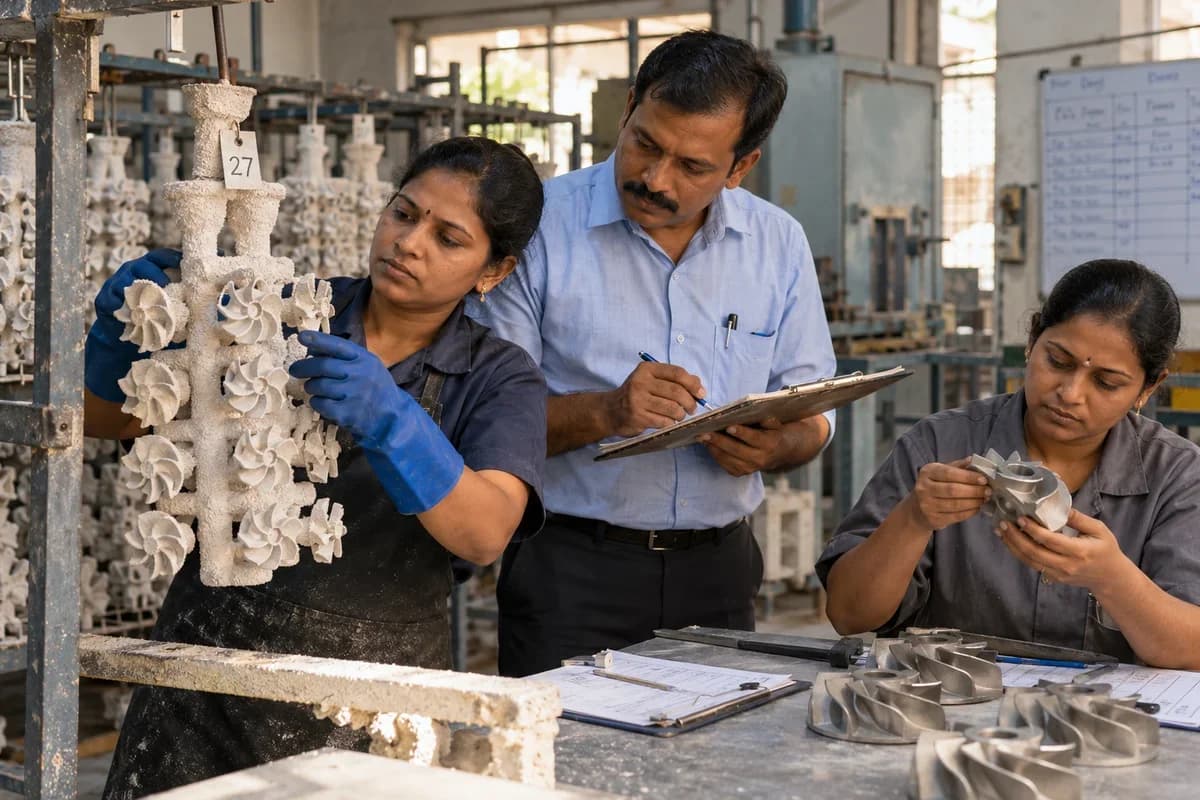
How the business operates.
An investment casting begins as wax. It is injected in a die, joined to a runner into a tree, dipped in slurry and stucco several times, dried, dewaxed and fired. Metal is poured into the hot shell, and the shell is knocked off the casting.
The records that hold the operation together.
- Enquiries and part quotations. Price a casting from die amortisation, wax, shell, alloy weight, finishing hours and inspection, from your own rates, with each revision kept.
- Wax die register. Hold every die with part number, cavities, shot count, repairs and rack position, and flag a die near its planned service.
- Wax injection and pattern stock. Record shots, rejects and trimmed patterns, with wax batch and injection settings noted for each run.
- Tree assembly. Build trees from patterns of a single order or of mixed orders, and give each tree a number that follows it through shell, pour and cut-off.
- Shell build log. Log slurry, stucco grade, coats, drying time and room conditions for every tree, and warn when a coat is skipped.
- Dewax, firing and melt log. Plan autoclave and furnace loads, record each melt with its alloy and heat number, and tie poured trees to that heat.
- Cut-off and finishing. Track parts through knockout, cut-off, grinding, blasting, straightening and heat treatment, with hours and rework recorded per part.
- Inspection and lot reports. Capture dimensional, penetrant and X-ray results and compile the lot report with heat and drawing revision for the customer.
Operational bottlenecks to check
Wax dies are hard to account for
Dies are made for each part and sit on racks between orders for months, while the people who knew their history move on to other jobs. Their shot count, repairs and cavity wear are known to one person. Or to nobody.
Shell coats are logged on paper
The count of dips, the stucco grade and the drying time per coat decide whether a shell survives the pour. A missed coat shows up as a leak.
Yield is a guess
Trees are built, poured and cut off, but parts lost to wax defects, shell cracks and inclusions are counted at different desks. Nobody can say the true yield per part number.
Heats and trees do not meet
The melt log names a heat. The shell room names a tree. Linking the two for a certificate takes a search through both books, a slow job that is easy to get wrong when a lot is waiting at the dock.
Rework hides in finishing
Grinding, weld repair and straightening happen on the finishing bench with no per-part record. The true hours behind a small casting, with its straightening passes and second blast, never reach the next quote.
Follow the work across teams.
This is a planning flow. Confirm the steps, owners and approval rules against your actual operation.
Roles and responsibility boundaries.
Reports your managers need.
- Yield by part number from wax injected to castings accepted
- Trees by stage: wax, shell, dewax, poured, cut off
- Die shot count and next service date
- Shell rejects and cracked shells by cause
- Rework hours by part and finishing step
- Inspection rejects by defect and alloy
- Open orders by promised date and customer
Connections to scope
- WhatsApp or other messaging
- Spectrometer readings by import
- Accounting export
- Barcode labels for trees
Confirm data access, record ownership and the exchange method for each connection. Inclusion here does not mean every connection is available in a standard package.
Setup decisions and adoption risks.
Use these requirements to plan phases, data migration and user training. Agree the release sequence after reviewing your current systems.
Limitations to settle before implementation
- A hobby or art foundry that casts a few pieces a week can track wax and moulds in a notebook.
- Sand moulding shops and pressure die casters will find Sand Casting Foundry Management Software or Gravity Die Casting Company Management Software closer.
Modules to consider first.
These functions connect to the operating model above. Confirm each one against the work your business actually runs.
Choose the operation you want to improve.
Use these activities to explain your scope. Your business does not need every function in the directory.
- Stainless steel valve and pump bodies
- Alloy steel parts for defence and aerospace
- Surgical and instrument castings
- Complex parts replacing machined assemblies
- Castings with machining and heat treatment finished
- Stainless fittings for food and dairy plants
- Export investment castings with certificates
Explore the business functions.
Production, stock, fleet and recurring billing functions apply only where your business runs those activities. Read the suitability conditions on each page.
Manufacturing
Batch and Serial Tracking
Trace goods using batch identifiers or individual serial numbers.
View workflow and suitability →Job Work Management
Track material sent to an outside processor and returned after work.
View workflow and suitability →Production Planning
Plan manufacturing quantities against demand, materials and capacity.
View workflow and suitability →Quality Control
Record specified inspections and the disposition of checked goods.
View workflow and suitability →Work Order Management
Track a production job from material issue to completed output.
View workflow and suitability →
Finance & Accounting
Inventory Management
Start with the problem your team can describe.
Bring a sample record and show where information is copied, missed or waiting for approval. Scope the first useful change from there.
What happens after you share your requirements
- We review your brief and the systems you already use.
- We clarify the workflow, missing information and the work to consider first.
- The proposed scope sets out the deliverables, responsibilities and dependencies.
- Review the scope and commercial terms before deciding whether to proceed.
Start with your requirements
Describe your current process, the people involved and the change you need. Start with the details you know; we can clarify the rest together.
Share your requirements