Business solutions for Milk collection centres
Explore software for work such as “Recruiting new farmers in nearby villages”. Review each business function below, including when it fits and what to check before implementation.
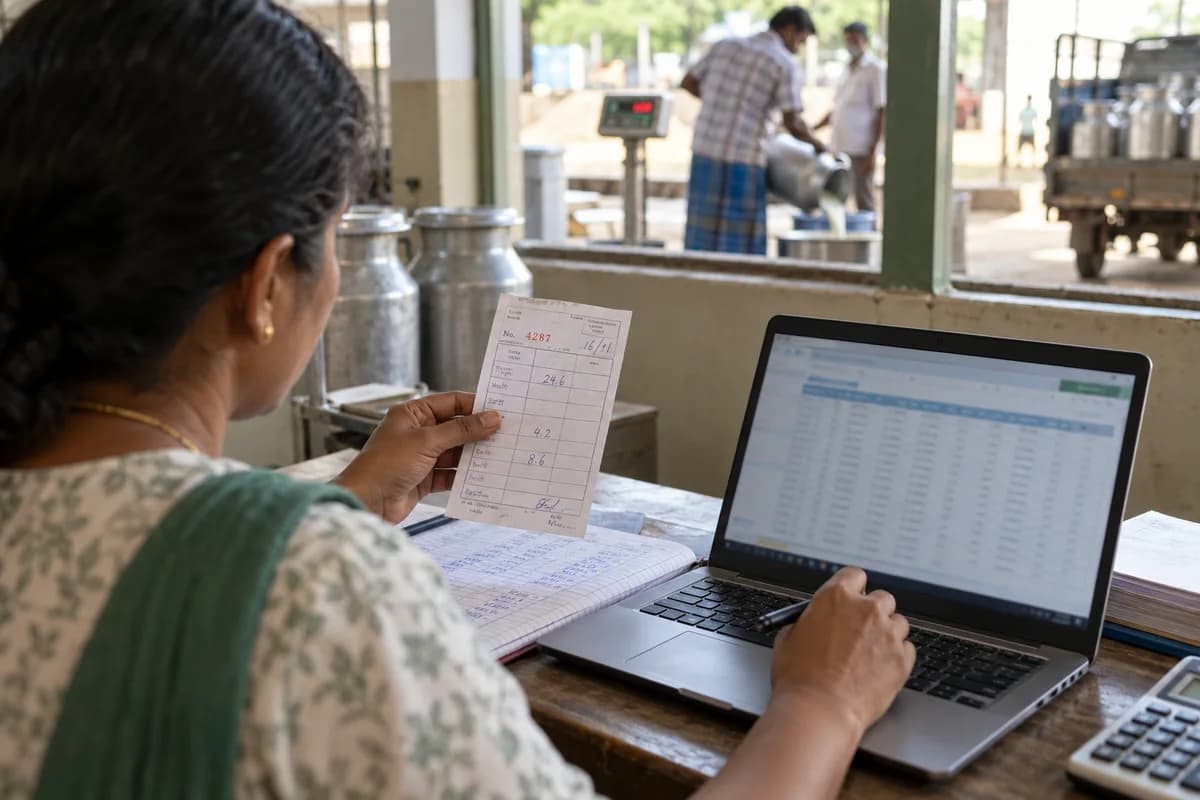
How the business operates.
A collection centre is a short, busy window. Suppliers queue with cans, the pan scale reads, a sample goes to the tester, and a slip is written for a person who has walked four kilometres at dawn. Seconds per supplier. Errors here are paid for later.
The records that hold the operation together.
- Supplier register and pass book. One record per supplier holds village or route, animals in milk, bank details and payment cycle, and the pass book lists each shift’s quantity, test and amount.
- Milk weighing and test entry. Litres or kilograms, fat and solids-not-fat are recorded at the weighing platform from an analyser file or by key, and the shift, can count and tester are stored with the line.
- Rate chart and price slabs. The plant’s rate chart by fat and solids-not-fat is held with bonus slabs and effective dates, and every entry takes the row that applied on its day. Old shifts stay as they were.
- Rejection and quality log. Clot, alcohol and adulteration results are recorded with the rejected cans and the reason given, and suppliers with repeated rejections appear on a review list for the manager.
- Cooler temperature and shift log. Bulk cooler readings are logged at set times with the taker’s name and a reading above the limit is marked for the manager and kept on the shift record.
- Dispatch and plant reconciliation. Each tanker load is recorded with seal number, vehicle, quantity and averaged fat and solids, with plant receipt figures beside it and differences listed by load and cooler.
- Feed sales and stock. Feed is sold at the counter. Bag stock comes down, the supplier’s due goes up, and a warning appears when a line such as pellet feed or mineral mix runs low.
- Advances and deductions. Cash advances, feed dues and vet charges are held per supplier and recovered at the next cycle, with the running balance on the pass book.
Operational bottlenecks to check
The pass book and the register disagree
Each supplier holds a pass book, and the clerk keeps a register. A smudged line, a skipped shift or a sheet lost in the rain leaves two versions of the same morning, and neither can be proved. Each side trusts its own.
Rates are applied by memory
The rate chart has changed three times this season, and the clerk reads from a laminated sheet. A wrong row pays one supplier too little and another too much for months.
Plant readings differ from the platform
The dairy plant reports its own litres and fat at receipt. With no lot record kept at the centre, nobody can place a short load against a particular shift or can.
Deductions are worked out at the end of the cycle
Cattle feed on credit, vet visits and advances are tallied just before payment. Suppliers see a smaller cheque than they expected, and a queue forms at the office window while the clerk searches for the scrap that explains each cut.
A warm cooler goes unnoticed
Tank temperature is checked when someone remembers. A power cut overnight spoils a whole tanker load. Nobody knows from when.
Follow the work across teams.
This is a planning flow. Confirm the steps, owners and approval rules against your actual operation.
Roles and responsibility boundaries.
Reports your managers need.
- Litres and average fat and solids by supplier, shift and route
- Rejected cans by supplier and reason
- Cooler readings above limit, with time and person
- Tanker loads against plant receipts, with differences
- Feed and mineral mix sold, with dues by supplier
- Payment statements by cycle, with deductions
- Suppliers whose supply has fallen across the last cycles
Connections to scope
- Milk analyser file or cable
- Receipt printer
- SMS
- WhatsApp or other messaging
- Bank payment file
- Accounting export
Confirm data access, record ownership and the exchange method for each connection. Inclusion here does not mean every connection is available in a standard package.
Setup decisions and adoption risks.
Use these requirements to plan phases, data migration and user training. Agree the release sequence after reviewing your current systems.
Limitations to settle before implementation
- A farm that only sells its own milk to a processor is better served by Dairy Farm Management Software.
- A plant that processes milk into packs needs a manufacturing system, with batches and shelf life.
Modules to consider first.
These functions connect to the operating model above. Confirm each one against the work your business actually runs.
Choose the operation you want to improve.
Use these activities to explain your scope. Your business does not need every function in the directory.
- Recruiting new farmers in nearby villages
- Printed rate chart and testing transparency
- Prompt payment record for farmers
- Supply profile for dairies
- Chilling and cleanliness documentation
- Cattle feed sales to supplying farmers
- Flush season and lean season planning
Explore the business functions.
Production, stock, fleet and recurring billing functions apply only where your business runs those activities. Read the suitability conditions on each page.
Sales and Distribution
Procurement
Manufacturing
Finance & Accounting
Inventory Management
Assets and Fleet
Start with the problem your team can describe.
Bring a sample record and show where information is copied, missed or waiting for approval. Scope the first useful change from there.
What happens after you share your requirements
- We review your brief and the systems you already use.
- We clarify the workflow, missing information and the work to consider first.
- The proposed scope sets out the deliverables, responsibilities and dependencies.
- Review the scope and commercial terms before deciding whether to proceed.
Start with your requirements
Describe your current process, the people involved and the change you need. Start with the details you know; we can clarify the rest together.
Share your requirements