Business solutions for Rice mills
Explore software for work such as “Wholesale and mandi trader orders”. Review each business function below, including when it fits and what to check before implementation.
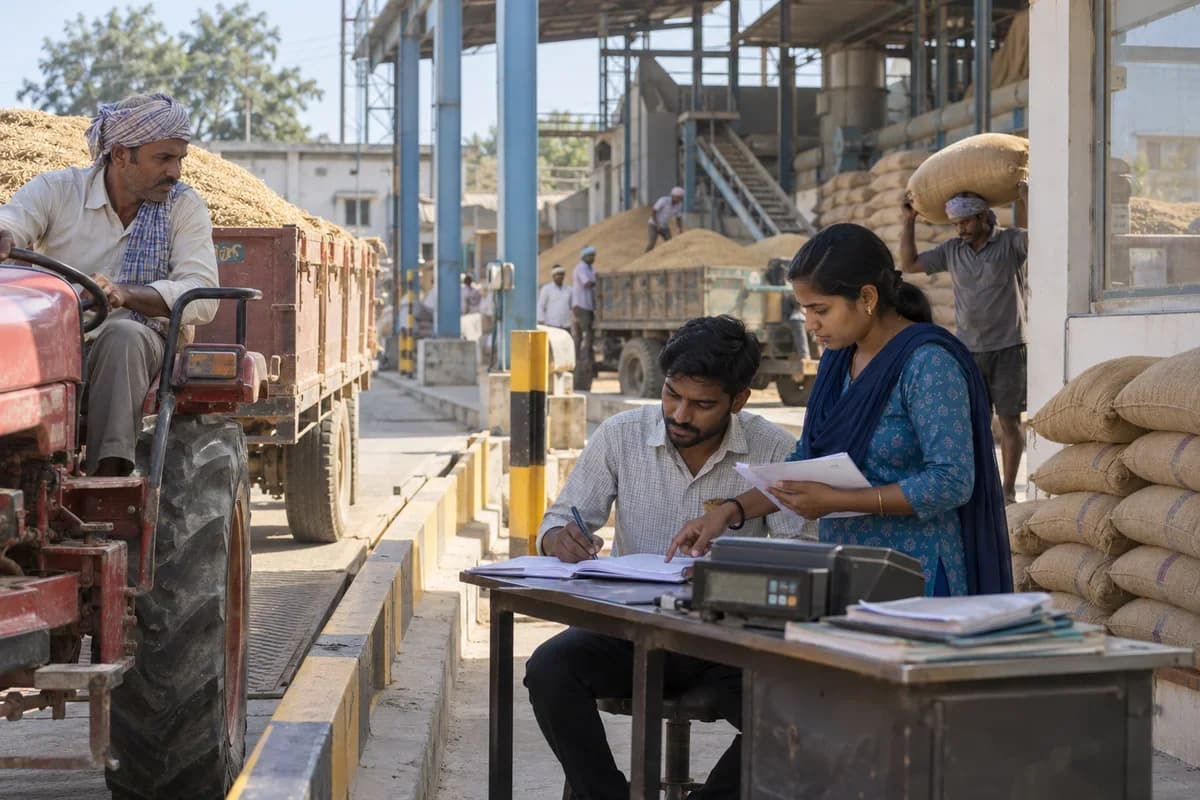
How the business operates.
Paddy arrives from farmers and agents at different moisture levels and grain types, and the price paid depends on the reading taken at the gate. A clerk takes it with a handheld meter and a sample tray, with a queue of trucks waiting behind. What the mill earns depends on how much whole grain comes out of each tonne.
The records that hold the operation together.
- Weighbridge and gate intake. Record gross and tare weight, moisture and foreign matter for each load, then price the paddy and open a lot.
- Paddy suppliers and advances. Keep farmers and agents with their advances, part payments and balances, so a supplier’s dues are one lookup.
- Drying yard and dryer log. Record sun drying and dryer batches with start and end moisture, so paddy is released to milling at the right reading.
- Parboiling batches. Log soak, steam and dry times by batch, so cracked or discoloured grain can be set beside the process used.
- Husking and polishing runs. Record paddy in and husk, bran and rice out for each run, with the polisher setting used.
- Grading and broken share. Split head rice, brokens and discoloured grain by grade and read the broken percentage for each lot.
- Bag filling and stacks. Count bags by variety, grade and fixed weight, and note the stack position in the warehouse.
- By-product sales. Book bran, husk and broken rice by buyer and weight, and credit the value to the lot that produced them.
Operational bottlenecks to check
The gate price and the final yield are never compared
A lot is bought on a moisture reading. Nobody checks later whether that lot milled well or poorly. The next purchase repeats the mistake.
Parboiling and drying times are unrecorded
Soaking and steaming times differ between batches and between operators, and the dryer that follows can be set for a different final moisture each shift. When grain cracks, nobody can say which batch or operator caused it. It sells at a lower rate.
Broken share is only measured at the end
Head rice and brokens are separated, but the share is not tied to the paddy lot or the polisher setting. Adjusting the machine is guesswork. Polish is judged by eye.
By-products are not valued
Bran, husk and broken rice go to different buyers by weight on a slip. Their income is never set against the lot that produced them. The true return is hidden.
Bags are counted by stack
Variety, grade and bag weight are noted on chalk marks or a paper count. A short dispatch to a wholesaler is found only on arrival. The credit note follows.
Follow the work across teams.
This is a planning flow. Confirm the steps, owners and approval rules against your actual operation.
Roles and responsibility boundaries.
Reports your managers need.
- Milling yield by paddy lot and variety
- Broken percentage by polisher setting
- Paddy purchased by supplier with moisture readings
- Bran, husk and broken rice sold by buyer
- Bag stock by variety, grade and stack
- Wholesaler balances, oldest first
Connections to scope
- Weighbridge scale import
- SMS
- Barcode and label printing
- Accounting export
Confirm data access, record ownership and the exchange method for each connection. Inclusion here does not mean every connection is available in a standard package.
Setup decisions and adoption risks.
Use these requirements to plan phases, data migration and user training. Agree the release sequence after reviewing your current systems.
Limitations to settle before implementation
- A village huller milling a few bags for neighbours can keep a notebook.
- Flour millers working with wheat will find Flour Mill Management Software closer.
Modules to consider first.
These functions connect to the operating model above. Confirm each one against the work your business actually runs.
Choose the operation you want to improve.
Use these activities to explain your scope. Your business does not need every function in the directory.
- Wholesale and mandi trader orders
- Brand packs for distributors and supermarkets
- Bulk supply to hostels, caterers and canteens
- Export enquiries and agent introductions
- Sorted and polished grades at a better rate
- A customer list the mill owns
- Rate and stock updates sent to buyers on WhatsApp
- Repeat orders from existing traders
Explore the business functions.
Production, stock, fleet and recurring billing functions apply only where your business runs those activities. Read the suitability conditions on each page.
Manufacturing
Batch and Serial Tracking
Trace goods using batch identifiers or individual serial numbers.
View workflow and suitability →Production Planning
Plan manufacturing quantities against demand, materials and capacity.
View workflow and suitability →Quality Control
Record specified inspections and the disposition of checked goods.
View workflow and suitability →
Sales and Distribution
Procurement
CRM
Inventory Management
Start with the problem your team can describe.
Bring a sample record and show where information is copied, missed or waiting for approval. Scope the first useful change from there.
What happens after you share your requirements
- We review your brief and the systems you already use.
- We clarify the workflow, missing information and the work to consider first.
- The proposed scope sets out the deliverables, responsibilities and dependencies.
- Review the scope and commercial terms before deciding whether to proceed.
Start with your requirements
Describe your current process, the people involved and the change you need. Start with the details you know; we can clarify the rest together.
Share your requirements