In this guide 7 sections
The EU battery passport is a digital record tied to one battery through a QR code. It holds identity, chemistry, material content, carbon footprint, performance and end-of-life details. Pack makers must collect that data per unit, not as a batch summary. Check scope with your own advisers.
Which batteries does the passport cover?
The EU Battery Regulation applies the passport to electric vehicle batteries, industrial batteries above a stated capacity and light means of transport batteries. A stationary storage pack of that size falls inside. A small consumer cell does not.
Check your own product list against the regulation text, not a customer’s email. Models sold under a buyer’s brand still need the data, and you are often the only one who holds it. Ask which of your models each buyer resells. Add every variant to a single list with capacity, chemistry and intended use, because the passport duty follows the product and not the order.
- Electric vehicle packs
- Industrial packs above the stated capacity
- Stationary storage racks and containers
- Light transport packs such as e-bike batteries
What identity records does a unit need?
Every pack needs a unique identifier that survives for years. The passport links that identifier to the manufacturer, the plant, the date of manufacture and the model. A label printed at end of line is the usual carrier.
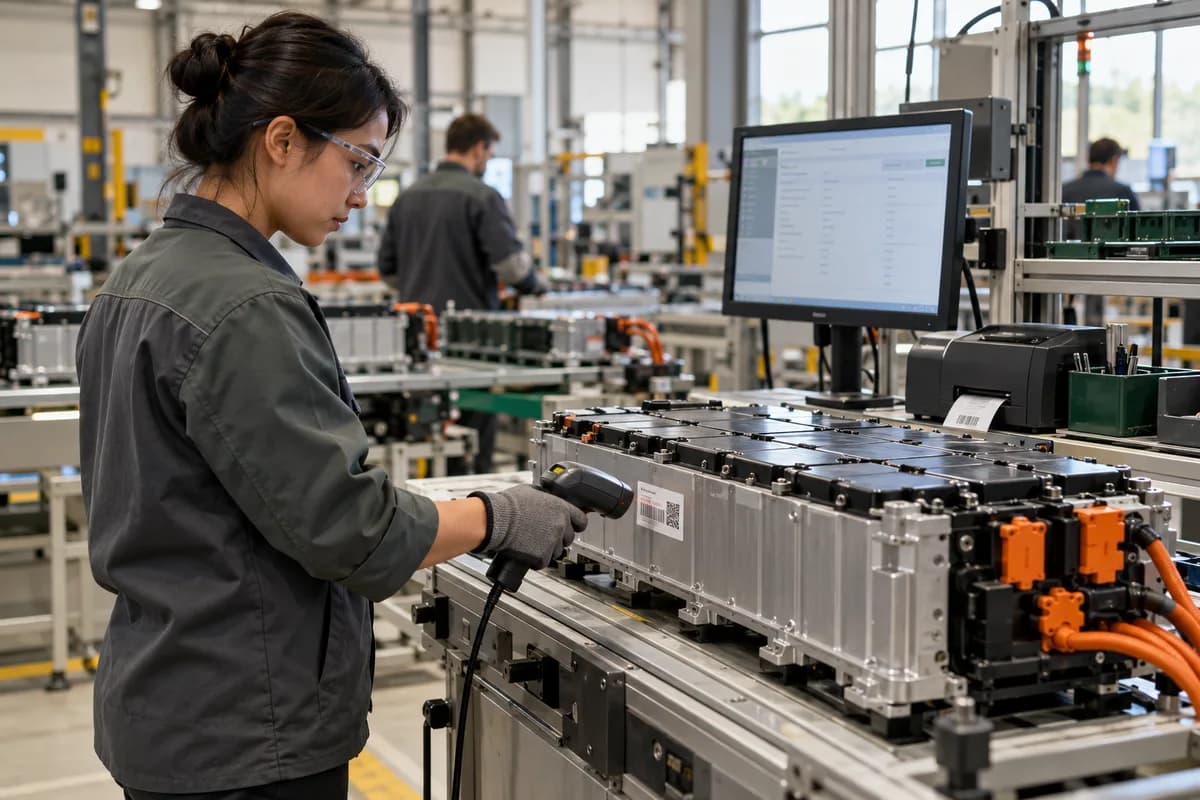
One serial, one record. If serials live in a spreadsheet beside the packing list, a reprint or a rework can break the link. Cell lot numbers and module serials must hang under the pack serial. Do it at the end-of-line station, where a scanner reads the printed code and writes the pack record in one step. Print once, never reissue.
What composition and carbon data are expected?
The regulation asks for chemistry, the share of recycled cobalt, lead, lithium and nickel in active materials, and hazardous substance content. Your cell supplier supplies most of it, but only if you ask for it per cell lot and keep the reply.
A carbon footprint declaration sits on top. It needs the energy used at your own plant and the declared footprint of each bought-in cell. Collect supplier declarations on receipt, not when a buyer asks.
Missing paperwork is the usual gap. A cell lot arrives, goes into a module, and the declaration never reaches the file. Ask each cell supplier for a declaration format now. A PDF attached to one email thread is not a record you can export later.
- Cell lot number and supplier declaration
- Recycled content figures per cell lot
- Substance declarations for housing and electrolyte
- Plant energy records for the footprint statement
What performance and durability records follow?
Expect rated capacity, voltage limits, expected cycle life, power limits and state of health data. Some of it comes from type testing. Some comes from end-of-line tests on each pack, such as capacity check, insulation resistance and BMS firmware version.
Store the test result against the pack serial at the moment of the test. A tester that writes only to a CSV on the line PC loses the trail when the PC is replaced.
Warranty claims draw on the same records. Field returns point to the failed cell lot, but only when the link between pack serial and cell lot exists. Without it you replace packs blindly.
- Rated capacity and voltage window
- Cycle life and power limits
- End-of-line capacity and insulation test results
- BMS firmware version at dispatch
How does a unit record in software feed the passport?
Build one record per pack: serial, model, bill of materials revision, cell lots, module serials, test results, firmware and dispatch date. Each production step adds to it. At the end, the passport export is a view of that record, not a fresh data hunt.
Start with ten recent packs. Trace each one back to its cell lot and supplier paper by hand. Whatever you cannot find shows which fields your process fails to capture. Count how many fields needed a phone call to a supplier. That count is your real workload once buyers start asking for passports on every shipment.
Passport data sheet
A single-page sheet listing each data item in its own row. Columns: passport field, where it comes from, who supplies it, the record that holds it, and a status of held, partly held or missing. Rows run in four blocks: identity, composition, carbon footprint and performance. A last block lists the ten packs you traced by hand.
Open a blank worksheet to printQuestions owners ask
Is the passport only for batteries sold in the EU?
It applies to batteries placed on the EU market. A pack made elsewhere and shipped to a European buyer is covered once it is sold there. Confirm scope with your own advisers.
Who fills in the passport, the pack maker or the cell supplier?
The economic operator placing the battery on the market is responsible. Cell suppliers provide inputs, but the pack maker owns the final record and answers for gaps.
Can a spreadsheet hold this data?
For a handful of packs, yes. Once serials, cell lots and test files run into hundreds, links break. A system that stores one record per serial keeps them intact.
When should we start collecting?
Now. Supplier declarations and test results are easy to capture at the time and hard to reconstruct later from emails and old files.
Sources
- European Commission: Batteries and accumulators — verified 17 Oct 2026