In this guide 6 sections
A route card follows the part from bar stock to dispatch. It carries a header with part number, drawing revision and quantity, then one line per operation with work centre, programme number, fixture, tooling and inspection point. Operators sign each line, so the card also becomes the record of what was done.
Build the header so nobody guesses the job
The top of the card answers what, how many and for whom. Put the job number, customer, part number, drawing revision, quantity and due date in one block. Add the material grade and the heat or lot number of the bar.
Revision is the field most often skipped and most often regretted. A part made to revision B when the customer changed to C is scrap with a good finish.
Add a space for the material certificate reference, so the matching of paper to metal happens at the start.
- Job number and customer purchase order
- Drawing number and revision letter
- Material grade and lot or heat number
- Quantity released and quantity of spares
Write each operation as a line the operator can follow
Number operations in tens, so a missed step can be added later without renumbering. Each line names the operation, such as rough turn, mill flats, drill and tap, or deburr.
Give the work centre, not just the machine type. Operation 20 on the VMC with the four-jaw vise differs from operation 20 on the horizontal with the tombstone. Add the planned setup and cycle time for each.
Keep the wording of the operation short. If the operator needs a paragraph, the work instruction belongs on a separate sheet.
Tie programme, fixture and tooling to the line
The programme number on each line should match a file in your controlled folder, with its revision. When the card says O1042 rev 3, nobody loads the old rev 2 from the machine memory by habit.
Add the fixture code and the work offset it uses, such as G54 for the first fixture position. Then list the tool numbers in order, with holder codes where length matters.
A night shift operator relies on this line once the programmer has gone home. It must be right. It must be complete.
- Programme number with revision
- Fixture code and work offset
- Tool list in turret or magazine order
- Special notes such as coolant or stock allowance
Place inspection points where defects start
Put a first piece check after the setup that changes the geometry, not only at the end. A bore cut off position at operation 30 costs one part if caught at the first piece, and the whole batch if found at final inspection.
For each point, name the characteristic, the gauge and the sample size. A line might read bore diameter, plug gauge, first piece and every twentieth. Leave boxes for the measured value and the inspector’s initials.
Mark any characteristics the customer flagged as key, so they are never skipped when the shop is busy.
Keep the card as the record that follows the part
At each operation, the operator enters start time, finish time, quantity good and quantity rejected, with a signature. Those figures are the source of your actual hours against the planned hours.
Outside processes, such as heat treatment or anodising, get their own lines with the vendor and the date sent and received. This keeps parts from vanishing between sites.
Test the template on one live job this week and ask the operators what they would change. Adjust the layout before printing a stack.
Machined part route card template
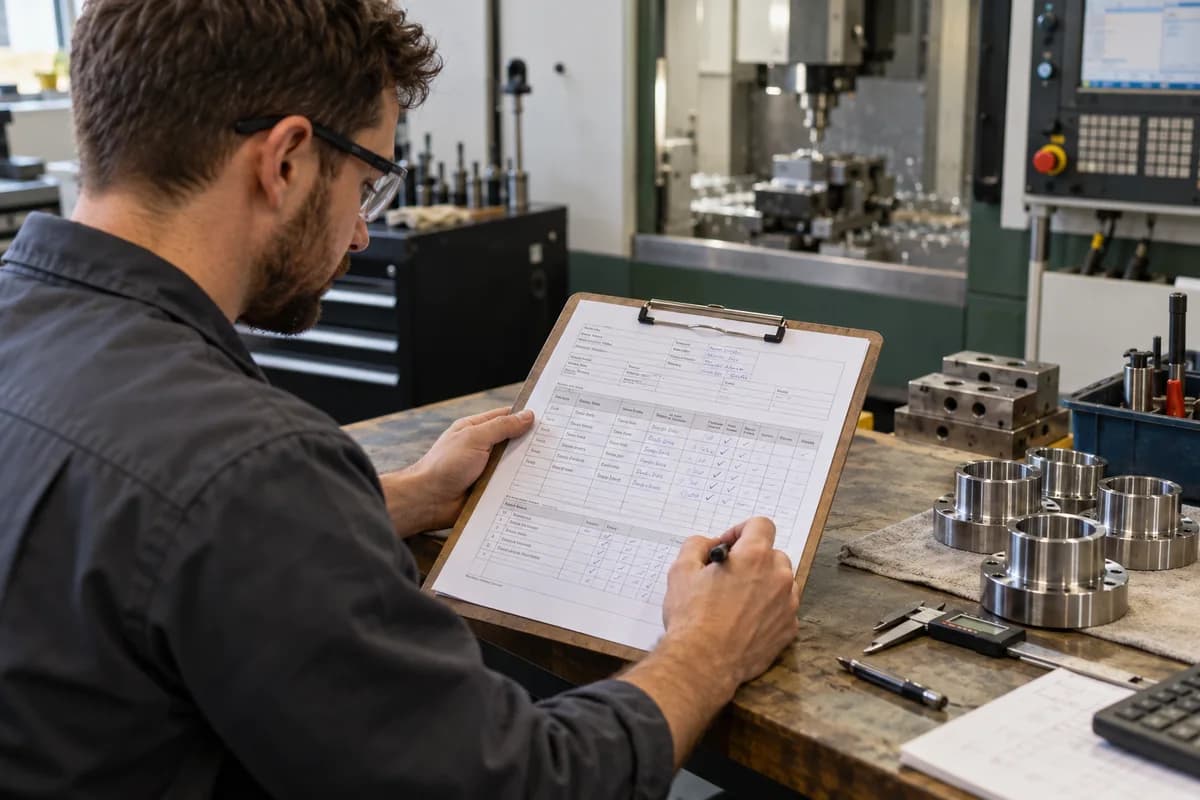
A template with a header block for job, customer, drawing revision, material lot and quantity. Below sits an operation table. Its columns: operation number, description, work centre, programme and revision, fixture and offset, tool list. Then planned time, start, finish, good, rejected and operator initials. A side panel lists inspection points with characteristic, gauge, sample size and measured value.
Open a blank worksheet to printQuestions owners ask
What is the difference between a route card and a job traveler?
Many shops use the terms for the same sheet. Where they differ, the route card lists the planned operations and the traveler is the copy that moves with the part and collects signatures.
Should the card show the cycle time?
Yes, as a planned figure. Operators then book the actual time beside it, and the gap shows where a part runs slower than quoted.
How do we handle a drawing revision change mid job?
Stop the card at the current operation, tag the parts made so far and issue a new card or a stamped amendment. Record who approved the change and the parts affected.
Can the card be digital?
Yes. A digital card keeps the same blocks and adds checks, such as refusing to close an operation without a first piece sign off. Print a copy for machines with no screen.