Build a system around your drawings, your bills of material and your test certificates.
An electrical equipment plant ships a product that has to be proven before it leaves. A panel, a transformer or a motor goes out with a test record attached to a serial number.
The records behind that test sit in several places. Drawings live with design. Bills of material live in spreadsheets. Winding data, torque readings and routine test results live on paper formats at the test bay.
Software built by GullySystem for this kind of plant would join those records. Each order would carry its drawing revision, its parts, its test results and its dispatch papers.
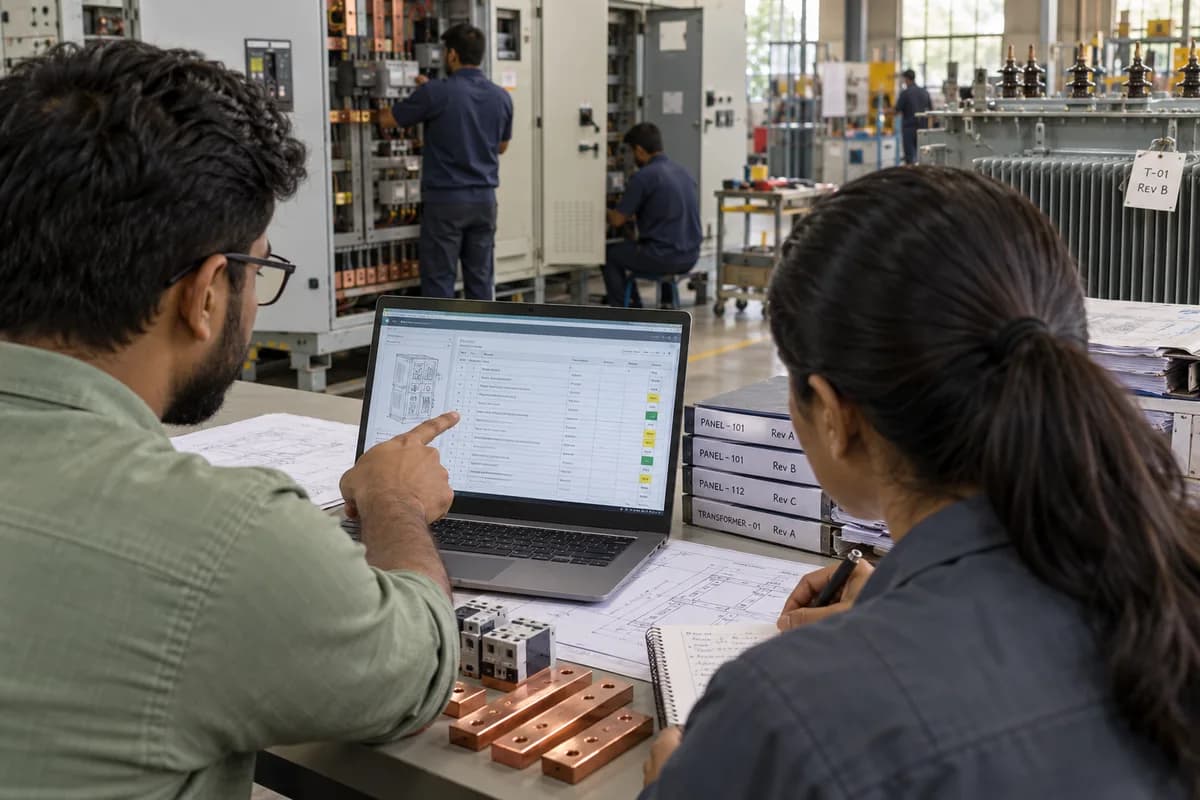
Plants this can be built for.
A control panel shop builds one-off assemblies from a customer’s drawing. A cable plant runs continuous lots. The records each one needs are different, and the build follows them.
- Control panel manufacturers
- Transformer manufacturers
- Electric motor manufacturers
- Switchgear manufacturers
- Cable and wire manufacturers
- Industrial lighting manufacturers
- Power distribution equipment manufacturers
- EV charger manufacturers
- Busbar and busduct fabricators
- Capacitor and reactor manufacturers
- Motor rewinding and repair workshops
- Generator set assemblers
- Meter and instrument makers
- Electrical enclosure fabricators
The modules, and what each one covers.
Nothing here is a fixed package. Each module is built, left out or changed to match how your organisation already works.
Enquiry and technical offer
Sales and design teams read the customer’s specification before anyone prices it.
- Enquiry with specification attached
- Single line diagram received
- Rating, voltage and frame size
- Standards the customer names
- Deviations listed against the specification
- Technical clarification raised
- Offer revisions kept together
- Enquiries lost and the stated reason
Quote and costing
Copper, steel, insulation and components are priced from current supplier rates, and labour from the routing.
- Costing from the bill of material
- Copper and aluminium weight by rate
- Bought-out component prices
- Labour hours from the routing
- Test and inspection charges
- Price variation clause tracking
- Quote validity and revision
- Quote against final cost
Metal prices move between the quote and the purchase. The system keeps the rate used on each quote, so a margin review can see what changed.
Drawings and revisions
Design teams release drawings. Shop floor teams build only from the released revision.
- General arrangement drawing
- Wiring and schematic drawings
- Winding and core details
- Revision number and date
- Customer approval of drawings
- Comments received and answered
- Released set for production
- Superseded drawings withdrawn
Bill of material
- Multi-level bill for each product
- Variants by rating and option
- Engineering change to a bill
- Alternate components allowed
- Customer-specified makes
- Quantity per unit with wastage
- Bill frozen once released
- Bill compared across orders
Purchase of components and raw material
Purchase teams buy against the bill, with long-lead items raised first.
- Requirement from the order bill
- Long-lead items flagged
- Breakers, relays and meters by make
- Core steel and copper strip orders
- Supplier test certificates received
- Delivery date promised and chased
- Goods receipt with inspection
- Supplier rating by delay and rejection
Stores and component kitting
- Stock by location and bin
- Reserved against an order
- Kit prepared for each panel
- Shortage list before assembly
- Issue against the work order
- Return of unused items
- Scrap and off-cut record
- Count and adjustment
Routing and work orders
Each product follows a set of steps through the plant. Work orders record where it stands.
- Sheet metal cutting
- Bending and welding
- Powder coating
- Component mounting
- Wiring
- Testing
- Final inspection
- Packing
- Work order per unit or lot
- Operations with standard hours
- Operator and bay recorded
- Time started and finished
- Job held for a missing item
- Rework raised after a failed check
Winding, core and coil records
For transformer and motor plants, winding data is the heart of the job card.
- Turns, conductor size and layers
- Core grade and stacking record
- Coil weight against design
- Insulation and varnish batch
- Drying cycle and temperature log
- Winder and shift
- Resistance reading after winding
- Oil filling and quantity
Routine and type tests
Test engineers record each reading against the value the design expects.
- Insulation resistance
- High voltage withstand
- Winding resistance
- Ratio and polarity
- No-load and load readings
- Temperature rise run
- Functional test of a control panel
- Instrument calibration due date
Which tests apply to a product follows the standard your customer names. The test list for each product is agreed during design, not assumed.
Serial numbers and test certificates
- Serial number assigned per unit
- Components linked to the serial
- Test results stored against the serial
- Test certificate in the customer’s format
- Nameplate data printed
- Witness inspection by the customer
- Certificate reissued with a reason
- History searched by serial
Quality checks and non-conformance
- Incoming inspection of components
- In-process checks at each stage
- Final inspection checklist
- Defect recorded with photograph
- Rework or scrap decision
- Cause recorded and action assigned
- Customer complaint tied to a serial
- Repeat defects by station
Outside processes
- Galvanising and plating
- Powder coating by a vendor
- Laser cutting sent out
- Casting and forging bought in
- Material sent and received back
- Vendor delivery date
- Vendor bill matched to the delivery note
- Rejection returned to the vendor
Packing, dispatch and installation
Dispatch teams release a unit only when its tests are complete and its papers are ready.
- Packing list per unit
- Dispatch held until the test is closed
- Transport and vehicle details
- Tax invoice from the work order
- Delivery note
- Site commissioning visit
- Installation and handover record
- Warranty start date
Service, spares and warranty
- Units installed by customer
- Service call logged against a serial
- Spare parts quoted from the bill
- Warranty claim and root cause
- Repair job card
- Annual maintenance contract visits
- Retrofit and upgrade offers
- Failure history by model
Who logs in, and what they see
- Owner
- Sales team
- Design engineers
- Purchase team
- Stores team
- Production supervisor
- Test engineers
- Quality team
- Dispatch team
- Accounts team
Integrations
- Accounting software
- CAD and drawing storage
- Test bench instruments
- Barcode and label printers
- Supplier portals
- Transport tracking
- Customer vendor portals
Reading values straight from a test bench depends on the instrument making them available. Where it cannot, the test engineer enters them and the system checks them against the expected range.
One connected workflow, end to end.
Every stage below can sit in one system, so nobody re-enters what the last stage already captured.
- Enquiry
- Technical offer
- Order
- Drawing release
- Bill of material
- Purchase and kitting
- Fabrication and assembly
- Testing
- Final inspection
- Dispatch
- Commissioning
- Service
You do not have to replace everything at once.
Each phase is usable on its own, so the system earns its place before the next part is built.
- 1
Orders, drawings and bills
Enquiries, offers, released drawings, multi-level bills of material and costing, so every order starts from one agreed set of records.
- 2
Purchase, stores and the floor
Component purchase, kitting, work orders and routing, so shortages show before assembly starts and not on the day of testing.
- 3
Tests and traceability
Serial numbers, winding data, routine test readings and certificates tied to each unit, with quality checks at each stage.
- 4
Dispatch and after-sales
Packing, dispatch release, commissioning, warranty and service history by serial, plus reports for the owner.
How a build actually runs.
- 01
Walk one order
We follow a single panel or transformer from the customer’s specification to the gate, and note every paper that changes hands.
- 02
Map the records
Drawings, bills, test formats, certificates and the checks your customers ask for are listed, with the person who owns each.
- 03
Design around the test bay
The test screen is built with the engineers who use it, since they enter readings with gloves on and a meter in hand.
- 04
Build in steps
Orders and bills come first. Stores, routing and test records follow once the bills are trusted.
- 05
Run alongside the old formats
Two or three live orders are entered both ways, and their test sheets are checked against each other before the paper format is dropped.
- 06
Go live by product line
One product family moves first. Others follow when that family’s tests and certificates come out as your customers expect.
- 07
Refine
Costing reports, supplier ratings and failure history are added after the daily records are steady.
What you bring, and when.
The build moves at the speed of the answers. These are the things we ask for, in the order we ask.
- 01
Bills of material, drawings and test reports
Share a bill of material for a product, its general arrangement drawing and a routine test report. Add a recent quote. They show how an order becomes a unit.
- 02
Design, stores, production and testing
Each department owns a rule the system must keep. Design owns revisions, and testing owns release. The works head settles clashes.
- 03
Component masters and pass limits
The component master, approved alternates and pass limits for each test must be settled as building goes on. Engineers review modules on a live order. Late answers stall later stages.
- 04
Orders in progress and serial history
Open orders and any serial history worth keeping are brought across. The testing head checks the printed certificates. Only then does the switch happen.
Systems we can put together for you.
- Control panel order and project tracking
- Transformer manufacturing management
- Motor and generator production systems
- Switchgear assembly and test records
- Cable and wire lot traceability
- Multi-level bill of material systems
- Drawing revision control
- Test certificate generation
- Serial number and warranty tracking
- Component kitting and shortage lists
- Quote and costing tools
- Service and spares management
- Customer dispatch portals
- Management dashboards
Questions owners ask before starting.
What does custom electrical equipment software change?
It links the drawing, the bill, the build and the test to one order. Today those usually sit in four separate files.
Can test results be stored against each serial number?
Yes. Readings are recorded per unit and printed into a certificate in the format your customer expects.
Can it handle one-off panel orders and repeat products?
Yes. One-off orders start from a customer drawing and a fresh bill. Repeat products start from a stored bill and change only what the order requires.
Does it support transformer winding records?
Yes. Turns, conductor, core grade, drying cycles and resistance readings sit on the job card for each unit.
How are drawing revisions controlled?
The floor sees only the released revision. A superseded drawing is withdrawn when a new one is released.
Can we link components to the finished unit?
Yes, where you choose to track them. Breakers, meters and core batches can be recorded against the serial for later warranty work.
Does it read values from test equipment?
Sometimes. That depends on whether the instrument can export readings. Otherwise engineers key them in and the system checks the range.
Can customer witness inspections be recorded?
Yes. The visit, the inspector, the tests witnessed and the sign-off are kept with the order.
Will a ready product do the job?
Often. Our control panel and transformer management software cover many of these records, and a custom build is worth discussing only where your process differs.
Can several plants share one system?
Yes. Every plant has separate stores and work orders. The owner still reads orders and dispatches for all sites in one view.
How we work with this trade.
Ready products for this work.
If one of these fits, it is cheaper and faster than building from scratch. We will say so.
Build a system that keeps every unit’s record in one place.
A buyer who receives a transformer or a panel trusts the certificate in the box. The better your records behind it, the sooner a query is settled.
Bring us one finished order with its drawings, its bill and its test sheets. We will show where the records break apart, and which of those our ready products already cover.
Tell us how your electrical equipment manufacturing companies runs today.
We will tell you what can be digitised, what can be connected, what is worth automating, and what you should leave alone.
What happens after you share your requirements
- A senior engineer reads your answers. Nobody phones first.
- Within one business day you get a written note: what we understood, what we would start with, and the questions we still have.
- If it fits, a proposal follows with the order of work, what we need from you and what you receive at each step.
- No call is booked and nothing is paid until you have read the note. Your details stay with us.
Start with your requirements
Seven short steps that tell us what you need. A senior engineer reads them before anyone gets in touch.
Share your requirements