Natural Language Processing for Business Text
Natural language processing covers the ways software reads written text: sorting it, extracting fields, searching by meaning and answering from it. This page sets out which piece of the field fits which business problem.
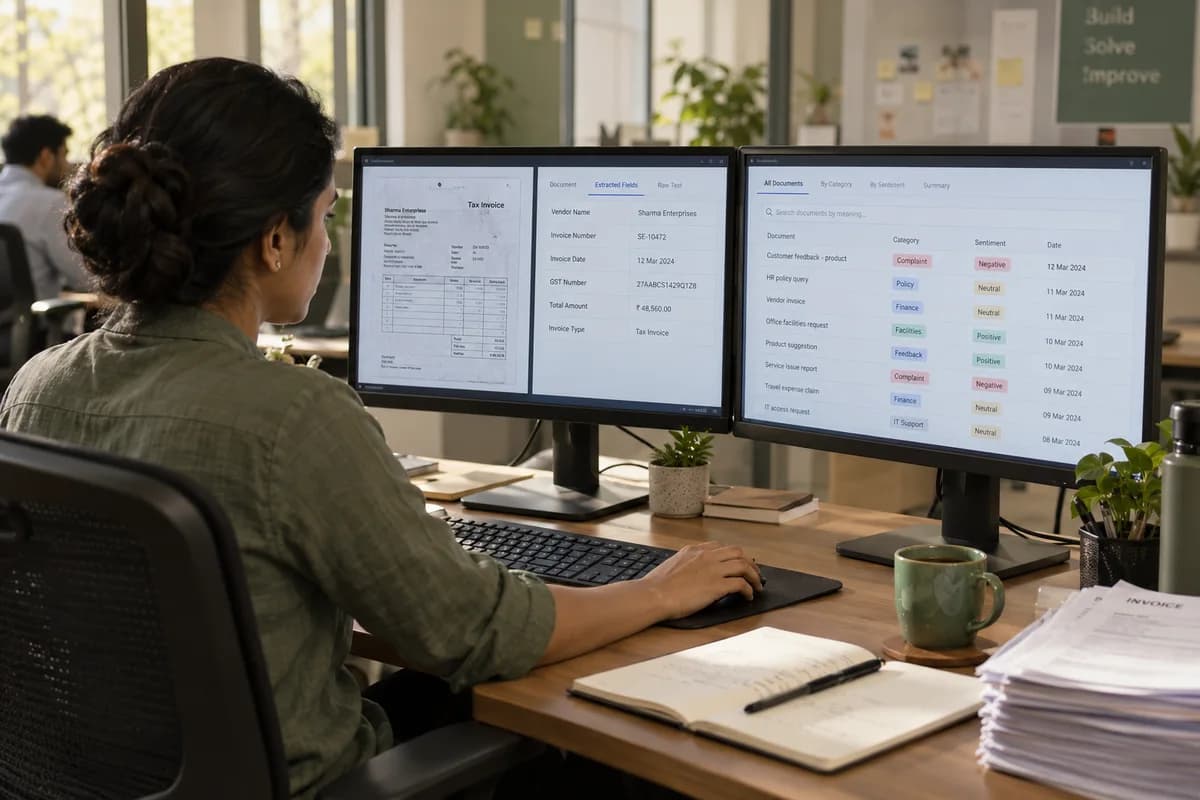
Which piece fits which problem
What it does poorly
Sarcasm is hard in any language. So is very short text, where a two-word remark carries meaning that only somebody working in that trade would catch. Handwriting is a reading problem before it is a language one. Anything where being nearly right is as bad as being wrong, such as deciding a claim, also suits poorly. For those, the design puts the output in front of a person and does not act on it.
Tested on your own records
Published accuracy figures come from clean datasets, which differ from a service register kept by several people over several years. A sample of your real text is run early and shown to the person who knows that text. The decision to continue rests on that result, not on a demonstration.
Frequently asked questions
Can natural language processing work on more than one language at once?
Yes, including records where two languages appear in one sentence. Accuracy differs by language, so it is measured and reported separately for each.
Can models run on our own servers?
In many cases, yes, using open models hosted on your infrastructure, which suits businesses that will not send records to an outside service. There is a trade-off in accuracy and hardware cost, and it is set out before you choose.
Is this only useful for chatbots?
No. Most of the value here is internal. Sorting complaints, reading documents and searching your own files rarely involve a chat window, and none of them need a customer-facing bot to be useful.
How accurate are these models on our data?
That is unknown until they are tried on it. A sample run comes first, before any figure is given. An accuracy figure quoted before your records are seen comes from someone else’s dataset.
Tell us what you need.
Share your requirements and one of our engineers will come back to you within one business day.
What happens after you share your requirements
- A senior engineer reads your answers. Nobody phones first.
- Within one business day you get a written note: what we understood, what we would start with, and the questions we still have.
- If it fits, a proposal follows with the order of work, what we need from you and what you receive at each step.
- No call is booked and nothing is paid until you have read the note. Your details stay with us.
Start with your requirements
Seven short steps that tell us what you need. A senior engineer reads them before anyone gets in touch.
Share your requirements