Sensor monitoring, alerts and local edge gateways for plants, cold rooms, facilities and vehicles
IoT and edge computing connects sensors, machines and vehicles to live dashboards and alerts you can read on a phone. It suits manufacturers, cold-chain distributors, facility operators and logistics teams. A gateway at each site keeps recording and applying its rules when the network is down. A dropped SIM or a dead router never leaves a gap in the temperature or runtime history. Share your requirements and we start with a site visit.
- Sensors selected after a site visit
- Local recording and rules continue during network outages
- Devices, SIMs and cloud accounts in the client’s name, with source code
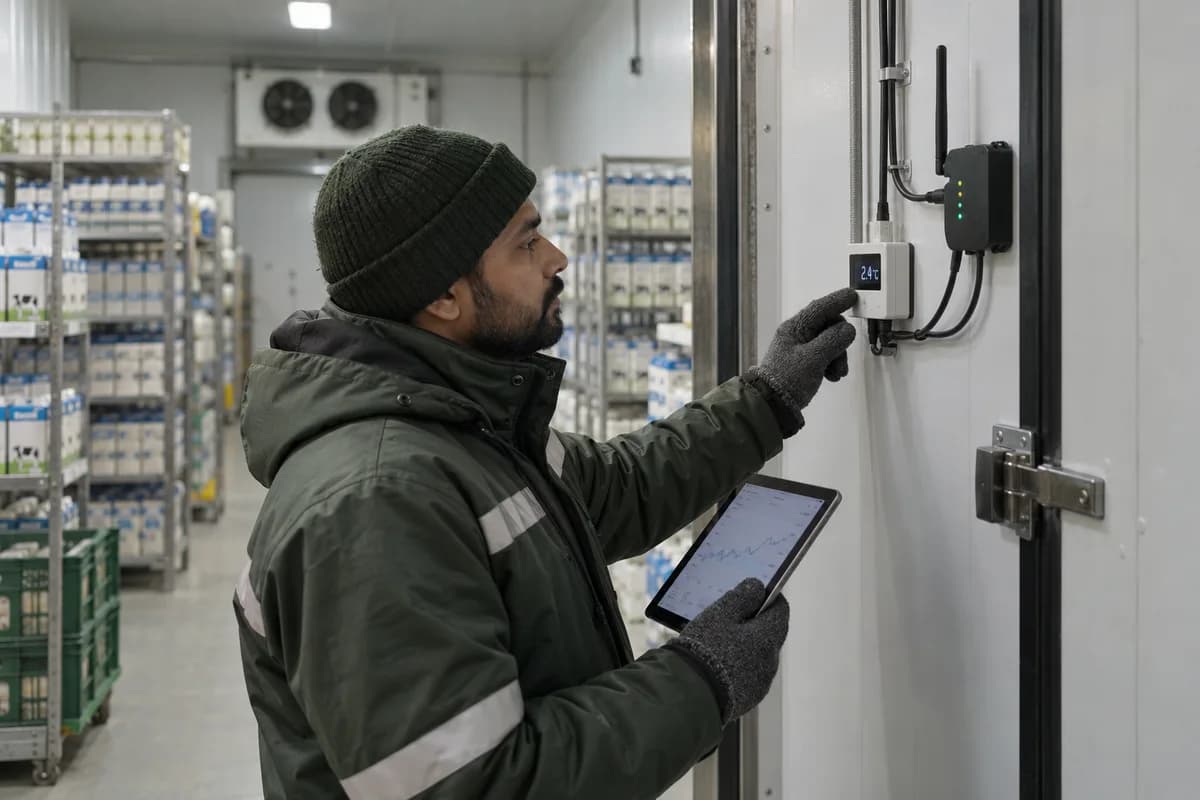
The work covers sites where physical conditions decide the day. Think of cold rooms and reefer vehicles in food and pharma distribution, and of motors, compressors and moulding machines on job-shop floors. Then add water tanks, pumps, generators and energy meters in factories. Apartment complexes, vaccine and reagent refrigerators in clinics and labs, and vehicles, containers and equipment that move between locations are included too. Some projects start with one sensor on one machine, to check that the reading can be trusted before anything larger is agreed. Others take over an earlier deployment where the connectivity or power arrangement failed, the dashboard went blank, and no readings have arrived since the day it was handed over.
Where Equipment Problems Go Unseen
Readings Taken Twice a Shift in a Register
A supervisor walks the site and writes temperature, pressure or level into a logbook at the start and end of the shift, so everything in between is unrecorded. A compressor that ran warm overnight leaves no trace. Neither does a chamber that sat above range for hours, and nobody finds out until the stock is spoilt or the motor fails.
Customers Seeing Failures First
A consignment is refused at delivery, a pharmacy questions a temperature record, or a client reports that maintained equipment has been down since morning. The supplier saw none of it happen. Credit notes follow. So do arguments about whose record is right.
No Record of Why a Machine Stopped
Output was short on a shift and the reasons are disputed: a power dip, a die change, a breakdown or an idle operator. Without a runtime record, the explanation rests on recollection. Each supervisor remembers the shift differently. The same loss recurs. Monthly output figures never show why.
Supplier Apps With Separate Logins
A generator, chiller or tracker came with its own app from the supplier, and each has a separate login. None sends alerts to the site’s own staff. Nothing exports history. No screen shows the whole site.
Maintenance on the Calendar
Servicing is scheduled by elapsed time, so healthy machines are opened and spares used early, and a bearing running hot still fails between two visits. Production halts. The calendar cannot see heat.
Monitoring That Stops With the Network
Connectivity at a plant, warehouse or farm is often unreliable, and when the link drops the dashboard freezes and no rule runs. Readings for that window are missing. The record has a hole where the fault was.
Site-Level Metering Only
One energy meter sits at the incomer and one diesel entry sits in the register, while nothing is measured at the motor, the chamber, the shift or the branch. An overloaded pump stays hidden. A leaking water line stays hidden too. So does a generator left running overnight, sometimes for months, until the diesel bill arrives and nobody can explain it.
None of this needs a full smart-factory programme. It needs a few trusted readings. It needs a defined rule for what counts as abnormal, and a named person who receives the alert on each shift.
Monitoring Built Around the Equipment and the Site
The work starts at the machine. No dashboard is designed first. We visit the site, confirm what can be measured and how, and select sensors and a gateway that suit the dust, damp, cold or heat. Only then are the application, alerts and local logic built, on readings already checked against the client’s own instruments. The first alert a supervisor receives is one worth acting on.
Verified Readings
Each sensor is installed, calibrated and compared with the existing gauge, meter or thermometer over several shifts, before any screen is designed. Alerts on an unverified reading lose the trust of the people who receive them. Staff soon mute the phone.
Local Operation Without the Cloud
The rules that matter run on the gateway at the site, so during an outage readings are stored locally and alarms and interlocks still act. Buffered history is back-filled in order once the link returns. Nothing goes missing.
Alerts Routed to Named People
Thresholds are set with the site’s supervisors, and alerts go to the named person on each shift, while an unacknowledged alarm escalates to the next contact on the list. The goal is few messages. Each one needs action.
What Changes When Equipment Reports Its Own Condition
Focus on business value before discussing technology.
Readings Across the Whole Shift
Conditions are captured at the interval chosen for each device, day and night, so an overnight excursion shows up in the morning review. Nobody finds it while loading the van.
Abnormal Conditions Flagged as They Develop
Rising temperature, unusual vibration, a level falling faster than normal or a door left open is flagged the moment it starts. The team acts before the compressor, bearing or pump fails.
Site Status From a Phone
An owner, plant head or facility manager can check any location, chamber, machine or vehicle from a phone, without ringing whoever happens to be standing nearby. One tap shows it.
Recording Through Connectivity Gaps
The gateway keeps recording and applying local rules through a network outage, then reconciles with the cloud afterwards. History stays continuous. Local alarms still sound while the link is dead, and buffered readings catch up in order.
Simple Actions Run Automatically
A pump stops at a set level, a valve closes on an abnormal reading, and a light and siren trigger at the panel. Every event is logged with its time and cause. The shift record writes itself.
Timestamped Records for Customers and Auditors
Readings, alarm history and acknowledgement details are stored for the retention period agreed with the client, so cold-chain disputes, warranty claims and compliance questions are answered from the record.
What IoT and Edge Computing Covers
Everything required from operational discovery to production deployment and long-term maintenance.
Feasibility and Site Assessment
We visit the plant, warehouse, facility or field location and list what needs measuring, checking power points, cable routes, panel space, mounting positions and network coverage on site. The report is blunt about what cannot be instrumented.
Device, Sensor and Protocol Planning
Selection covers temperature, humidity, level, flow, pressure, vibration, current and door sensors, energy meters, controllers and trackers. The written plan then records what connects to what, over which protocol, at what sampling interval, and from which power source.
Machine and Controller Integration
Readings are taken from existing PLCs, VFDs, energy meters, chillers, weighbridges and instruments over Modbus, OPC UA, BACnet, RS-485, 4-20 mA, pulse and dry-contact inputs. The control system that runs the machine stays untouched.
Edge Gateway Design and Local Logic
A gateway at the site polls devices, applies rules locally, buffers data through outages, drives local outputs and uploads when the link is available. Configuration keeps a cloud fault away from the plant.
IoT Application and Live Dashboards
A web and mobile application shows current values, trends, machine or chamber status and site-wise summaries. Role-based access gives a supervisor, a plant head and an owner each a view that suits the job, and nobody scrolls past someone else’s data.
Alerting, Escalation and Acknowledgement
Threshold, duration and rate-of-change rules raise alerts on WhatsApp, SMS, email or the app, routed by shift and location, and every acknowledgement is recorded. Silence escalates to the next name.
Automated Device Actions and Interlocks
Controlled outputs cover pumps, valves, fans, feeders and panel indications, with safety conditions and manual override built in. Every automatic action is logged, along with whoever changed the settings and the time they did it.
Telemetry Storage, History and Analytics
Time-series storage is sized for the sampling rate and retention period, and it supports trend charts, comparisons between machines, shifts and sites, and downtime and runtime summaries. CSV exports go to the client’s own analysts.
Condition-Based Maintenance Support
Running-hour counters, cycle counts and condition thresholds raise a service task when a machine reaches them, and a maintenance history is kept against each asset. Spares then follow actual wear, not the calendar.
Asset, Vehicle and Consignment Tracking
Location, geofence entry and exit, halt duration and in-transit conditions such as temperature or door status are brought into the same application as fixed-site equipment. One screen covers the cold room and the van.
Integration With Business Systems
Readings, alarms and runtime are pushed into the client’s ERP, maintenance software, accounting or reporting stack, so equipment data reaches production planning, billing and management reports. It does not sit in a separate tool.
Device Management, Security and Field Support
Scope includes remote configuration and firmware updates, device health and battery monitoring, and connectivity and credential renewals. Arrangements are also agreed for the day a cable is cut or a sensor drifts, since both will happen sooner or later.
Where Device Monitoring Is Used
Real-world business processes we configure and automate.
Cold-Chain Distribution With Chambers and Reefer Vehicles
A frozen-food and dairy distributor runs several cold rooms and a set of reefer vehicles, who note temperatures in a register. Sensors in each chamber and vehicle now report continuously, and a door left open alerts the supervisor, then the branch manager. Each consignment carries a temperature record.
Job-Shop Machine Runtime and Downtime Reasons
A moulding and machining unit bills by output and must explain why a shift fell short. Current sensors and controller signals record running, idle and stopped time for every machine. Operators pick a reason on a panel screen once a stoppage passes a set duration, and the shift report shows runtime, cycles and energy per machine.
Diagnostic Labs and Clinic Networks With Refrigerators
Reagents, samples and vaccines sit in refrigerators across several centres. Staff check them by hand. Battery-backed sensors alert the branch and the quality head on excursion or power failure, and an unbroken temperature history is kept for audit. The paper log sheet goes.
Facilities and Apartment Complexes With Water, Pumps and Generators
A campus or residential complex runs wells, tanks, pumps and a diesel generator. Level and flow sensors control pump start and stop, generator runtime and fuel level are logged, and block-wise consumption shows leaks and misuse before the monthly bill does.
Logistics Operators With Equipment and Consignments in Transit
A transport operator tracks vehicles on a supplier portal that shows position only. Trackers combined with door and temperature sensors report halts outside geofenced points, unplanned door openings and in-transit conditions, and that record settles detention charges, delay claims and temperature disputes.
Poultry Sheds and Greenhouses With Local Control
A farm depends on shed temperature, humidity, ventilation, and feed and water levels, at a location with unreliable internet. The gateway runs fan, fogger and feed rules locally and sounds a siren on site. The owner gets the day’s readings once the link returns.
Is This Service Right for Your Business?
We partner with established businesses that have outgrown manual processes and want reliable systems.
Temperature and Condition-Sensitive Businesses
Food, dairy, pharma, laboratory and hospital operations where stock value, patient safety or a customer contract depends on conditions being held and shown on paper.
Manufacturers and Processing Units
Plants and job shops that want machine runtime, downtime reasons, energy per machine and early warning of abnormal behaviour, while installed control systems stay exactly where they are.
Facilities, Campuses and Multi-Building Operators
Complexes, hotels, hostels, schools and industrial estates that manage water, pumps, generators, energy and equipment across several buildings and want one view of all of it.
Fleet, Equipment and Rental Operators
Businesses whose assets move or sit at customer sites. Location, usage hours, condition and misuse become visible without relying on a driver, an operator or a supplier portal to report them.
Agriculture, Poultry and Rural Sites
Farms, sheds, cold stores and pump houses with weak connectivity and unreliable power, where local automation matters more than a live cloud dashboard. Control comes first.
When Sensors Are Not Yet the Right Answer
A single machine in a room that a person passes every hour does not need sensors. Nor does equipment whose supplier already provides a portal showing the required data and alerting staff. Monitoring with nobody assigned to act on an alarm only lengthens the record of known problems. We say so during the site visit.
Enterprise Capabilities in Plain Business Terms
Continuous Telemetry
Readings arrive at an interval set per device, from a few seconds for fast-changing values such as current to longer cycles for stable ones such as room temperature. Battery life and SIM data usage set the balance.
Threshold and Duration Rules
Alarms fire on high and low limits, on how long a condition persists, and on how fast a value changes. A brief door opening is treated differently from a failing compressor. Duration decides.
Local Edge Processing
Rules, aggregation and control logic run on the site gateway, so decisions never wait for a round trip to the cloud and back over a weak mobile signal.
Offline Buffering and Back-Fill
Readings are stored on the gateway during connectivity loss and uploaded in timestamp order when the link returns, so history stays unbroken. No gap needs explaining to an auditor.
Device and Firmware Management
Configuration changes, threshold updates and firmware pushes reach installed devices remotely, and a log shows what changed and when. Nobody climbs a ladder or opens a panel just to change a setting, which matters for sensors mounted in cold rooms.
Connectivity Options and Failover
Each location can use Wi-Fi, wired LAN, a 4G SIM, LoRaWAN or a mix of them. A second path is added where a site cannot afford to go silent.
Device Health Monitoring
Alerts are raised when a sensor stops reporting, a battery runs low or a gateway loses power. Any physically implausible reading, such as a cold room at 60 degrees, raises one too, because it usually means a loose wire.
Controlled Outputs and Interlocks
Relay and controller outputs carry safety conditions and a manual override at the panel, and automatic actions are audited in full. A person can always take over.
Time-Series History and Export
Trend charts compare machines, shifts and locations side by side. Raw data can be exported as CSV for the client’s own team or an auditor.
Geofencing and Movement Rules
Entry, exit, halt duration and route deviation events are recorded for vehicles, containers and portable equipment such as generators and compressors on hire.
Role and Site-Based Access
Operators, supervisors, plant heads and owners each see and change only what their role and location allow.
Calibration and Drift Checks
Scheduled comparison against a reference instrument is supported, and a reminder is raised when a sensor is due for verification or replacement. Drift is caught early.
Our Structured 6-Step Delivery Process
A transparent path from your first conversation to a reliable production release.
- 01
Site Assessment and Feasibility
We visit the location with the client’s maintenance or operations person and examine the equipment, panels, cabling and network coverage. From the client we need site access, one person who knows the machines, and nameplate and controller details. Machines under warranty or a maintenance contract also need the equipment supplier’s written agreement before anything is attached.
- 02
Device, Protocol and Connectivity Plan
The plan lists every measurement point with its sensor or controller, protocol, sampling interval, power source and connectivity route, along with a bill of material. The client decides whether we procure the hardware or the client buys it directly, and confirms power points, mounting permissions and any SIM arrangement.
- 03
Edge and Application Design
We design the gateway logic, dashboards, alert rules and automatic actions. The client then signs off thresholds with supervisors, names who receives which alert on which shift, and confirms the retention period and who may change settings.
- 04
Installation and Field Commissioning
Sensors, gateway and wiring go in, and the devices come online. Anything touching a running machine needs a shutdown slot. Panel work needs the client’s electrician present, and heights, cold rooms or restricted areas need safe access arranged beforehand, with someone who holds the key.
- 05
Calibration, Parallel Run and Acceptance
Every reading is compared against existing gauges and the manual log over several shifts, and alert thresholds are tuned so real events fire and noise does not. Offline behaviour is tested by pulling the link on purpose, and the client names who accepts the results before the paper register is retired for good.
- 06
Handover, Training and Ongoing Support
Handover covers the source code, device inventory, wiring and configuration documents, and an operator runbook that a new shift supervisor can follow without calling us. Supervisors are trained on responding to alerts. Owners learn to read trends. The client names a site owner for the devices and decides on spares, while support can continue for device health, connectivity renewals, calibration and new measurement points.
What You Receive Upon Project Completion
Everything required to run, maintain, and expand your software without vendor lock-in.
Connects With the Systems You Already Rely On
We build bridges between your software so you don't have to replace functional existing tools.
Sensors and Instruments
- Temperature and humidity probes
- Level, flow and pressure sensors
- Vibration and current sensors
- Door, motion and tamper contacts
- Energy and water meters
Controllers and Industrial Protocols
- Modbus RTU and TCP
- OPC UA
- BACnet
- RS-485 and RS-232
- 4-20 mA and pulse inputs
- PLC, VFD and chiller controllers
Connectivity
- Wi-Fi and wired Ethernet
- 4G and LTE SIM
- LoRaWAN
- Bluetooth Low Energy
- Site VPN links
Business Systems
- QuickBooks, Xero and Zoho Books
- ERP and maintenance software
- Custom portals and databases
- Reporting and BI tools
Alerting Channels
- WhatsApp Business API
- Transactional SMS
- Mobile push notifications
- Panel sirens and indication lamps
Selected for Reliability, Speed, and Longevity
Technology chosen to match your operational scale and long-term maintainability.
Edge and Devices
Telemetry Backend
IoT Cloud Platforms
Applications and Dashboards
Cloud Storage and Operations
Why Business Owners Choose GullySystem
Site Survey Before Quotation
Panel space, cable routes, power availability, machine access and network coverage shape the cost of a deployment, and none of them shows up on a requirement list. They are found standing at the equipment.
Readings Verified Before Dashboards
Every sensor is checked against the client’s own gauge or meter across several shifts. If a value cannot be measured reliably at that point, we say so and propose another way, perhaps a different probe position.
Edge First, Cloud Second
Alarms and control rules live on the gateway. Monitoring continues through a broken link, a slow network or a cloud outage, because the equipment keeps running when the internet does not.
Standard, Replaceable Hardware
We favour standard, widely available devices bought in the client’s name over locked proprietary units, so a failed sensor is replaceable from a local supplier without waiting on GullySystem. Spares stay local.
No Changes to the Control System
Safety and control stay with the equipment. We read from controllers and add non-invasive sensors, and any output we drive is agreed in writing, interlocked and open to manual override.
Field Support After Commissioning
Sensors drift, cables get cut during housekeeping, batteries run down and SIMs expire. Support exists because installed devices need attention across their whole working life, long after commissioning day is forgotten by everyone.
Flexible Engagement Options
Choose an engagement model that matches your operational scope, budget, and timeline.
Pilot on One Machine or Site
A single chamber, machine, pump house or vehicle is instrumented and run alongside the manual log for a few shifts. A wider rollout is decided only after the data has held up in the client’s own conditions of dust, heat and patchy signal.
Fixed-Scope Deployment
Suited to a bounded requirement such as a set of cold rooms or a group of machines. Scope is fixed by a measurement plan, bill of material and acceptance criteria that the client signs.
Phased Site Rollout
The first phase covers the site or asset class where a failure costs the most. It is stabilised in production. The next location follows once the team responds to alerts comfortably and no longer needs to call us.
Managed Monitoring and Device Support
For businesses running devices across several sites. Retainer support watches device health, renews connectivity and credentials, flags calibration dates, rolls out firmware updates and adds new measurement points, leaving your site teams free of that upkeep.
Frequently Asked Questions
Straightforward answers to the questions owners ask before getting started.
What does IoT and edge computing mean for a business like ours?
It means placing small sensors on the equipment that matters and sending the readings to a dashboard the team can open from anywhere. A named person gets the alert. Edge computing is the part that runs at the site, where a gateway keeps recording and acting even when the internet is down.
Do you supply the hardware, or do we buy the devices ourselves?
Either. We recommend that devices are bought in the client’s name, and the assessment specifies the sensors, gateway and connectivity. The client can buy them from the supplier or ask us to procure them and invoice them with the work. Locked hardware is avoided.
Which machines, sensors and protocols can you connect to?
Most industrial and facility equipment can be read, either from its controller or through an added sensor. Routes include Modbus RTU and TCP, OPC UA, BACnet, RS-485, 4-20 mA, pulse and dry-contact signals. Sensors cover temperature, humidity, level, flow, pressure, vibration, current and doors, alongside energy meters and GPS trackers, and each route is confirmed on site. Nothing is assumed.
Can you monitor old equipment, or machines still under warranty or a maintenance contract?
Usually yes. Older machines without a digital interface are handled with external sensors, clamp-on current sensors, contact-based inputs or a separate energy meter. None of these changes how the machine runs. For a machine under warranty or a maintenance contract, the client obtains the supplier’s consent before anything is fitted, and the installation stays non-invasive.
Will the system keep working when the internet drops or power fails?
Yes, for an internet outage. The gateway stores readings locally. It keeps evaluating alarm rules and drives local outputs such as a siren, lamp, pump or valve, then uploads buffered history in order when the link returns. Power cuts are different. Battery backup is planned for the gateway and critical sensors. The power event is logged as an alert.
Will this predict breakdowns before they happen?
It shows when a machine is behaving abnormally. Rising temperature, increased vibration, longer cycle times or higher current draw are visible as they develop, and thresholds on them give early warning without a long history. Failure prediction is a later step. It needs a record of that machine running normally, plus its past failures, and that only accumulates once data has been collected over months.
How is our device and site data kept secure?
Devices connect to the cloud over encrypted connections with per-device credentials, so one compromised sensor cannot impersonate the rest. The gateway makes outbound connections only and needs no open inbound ports on the client’s network, and credentials are stored outside the code and can be rotated. Dashboard and settings access is role-based and logged. Control outputs are kept separate from monitoring. A signed NDA can cover the work first.
Can we start with a pilot on one machine or one site?
Yes. A pilot instruments one chamber, machine, pump house or vehicle and runs alongside the existing manual log, so the readings can be compared. It tests the data and the team’s response before wider spending is approved. It needs site access, a person who knows the equipment, a power point near the installation, and agreement on thresholds and alert recipients.
What drives the cost of an IoT solution?
Cost depends on the site and splits into hardware and work. The drivers are measurement points and locations, whether existing controllers can be read or new sensors are needed, and cabling and panel work. Connectivity per location, with recurring SIM charges, also counts, as do monitoring versus control, retention period, and the support and calibration wanted afterwards. Hardware and software get separate cost lines.
What decides how long the work takes?
Field conditions matter more than software. The factors are hardware lead time for the selected sensors and gateway, how soon a shutdown window is available, and the cabling and panel work at each point. The number of sites, any equipment supplier involvement for controller access, and the length of the parallel run with the manual log also matter. The site assessment turns these into a dated schedule.
Can the readings reach our existing systems, and do we own the data and the source code?
Yes to both. Telemetry, alarms and runtime can be pushed into an ERP, maintenance software, accounting system or reporting stack, and raw data can be exported on demand or on a schedule. The client receives the source code for the gateway logic and the application, plus the device inventory and wiring documents. Cloud and connectivity accounts are created in the client’s business name, with GullySystem access scoped and revocable at any time.
Who looks after the devices after installation, and what support and training is provided?
Devices need an owner on the client side and a support arrangement on ours. Supervisors are trained on what each alert means and what to do about it, and owners on reading trends and changing thresholds. A short written runbook is included. Support covers device health monitoring, failure investigation, renewals, firmware updates, calibration reminders and added measurement points. Cleaning a probe or replacing a damaged cable is normally done by the client’s maintenance staff, since they are already on site.
Can we just buy an off-the-shelf smart sensor or monitoring app instead of a custom IoT setup?
Yes, where one standard measurement is all that is needed. A plug-in energy meter with its own app, or a generic temperature logger, covers that case at lower cost. A custom setup fits when several machines or sites must report into one dashboard, or when the equipment is too old or specific for a consumer device. It also fits when recording and alerting must continue through an outage, or when readings must reach an ERP or maintenance records. Where a ready-made sensor covers the need, we say so. Cheaper is better there.
Read before you decide.
Practical notes on the questions this service raises, not product marketing.
What Is IoT and How Can SMBs Use It?
A plain explanation of IoT for small and mid-sized businesses: what it is, where it pays off, and how to start with a small, bounded pilot.
IoT Use Cases for Manufacturing Businesses
Four practical groups of manufacturing IoT use cases, how to match each to a decision, and how to choose a feasible first pilot.
How to Monitor Equipment Remotely
A practical approach to remote equipment monitoring: defining thresholds, choosing sensors, designing alerts, and handling outages and ownership.
How IoT Can Support Predictive Maintenance
How IoT sensor data feeds predictive maintenance, what a model really needs to learn from, and why most small firms should begin with condition-based checks.
Let’s Build the Right Software for Your Business
Tell us about your current operational challenge, spreadsheet bottleneck, or software requirement. An experienced engineer will review your workflow and reply within one business day.
- No obligation consultation
- Senior engineer reviews your brief
- Your operational details stay 100% confidential
Start with your requirements
Seven short steps that tell us what you need. An engineer reads them before getting in touch.
Share your requirementsRelated Practices & Services
Data Engineering and Business Intelligence
Turn months of telemetry into production, energy and maintenance reports that management can act on, without anyone retyping a figure from a logbook.
AI and Intelligent Automation
Apply pattern detection to accumulated machine history, but only once there is enough of it to be worth analysing.
API and System Integration
Carry readings, alarms and runtime into your ERP, maintenance and accounting systems, so they stop living in a separate tool. One record remains.
Cloud and Managed Infrastructure
Hosting, storage and monitoring sized for continuous device data and multi-site access.