Barcodes and Labels for Pathology labs
Connect scannable labels with the correct items and variants.
Does this function belong in your operation?
Use when physical items benefit from scanning or printed identification.
An item needs identification at receipt, counting or sale.
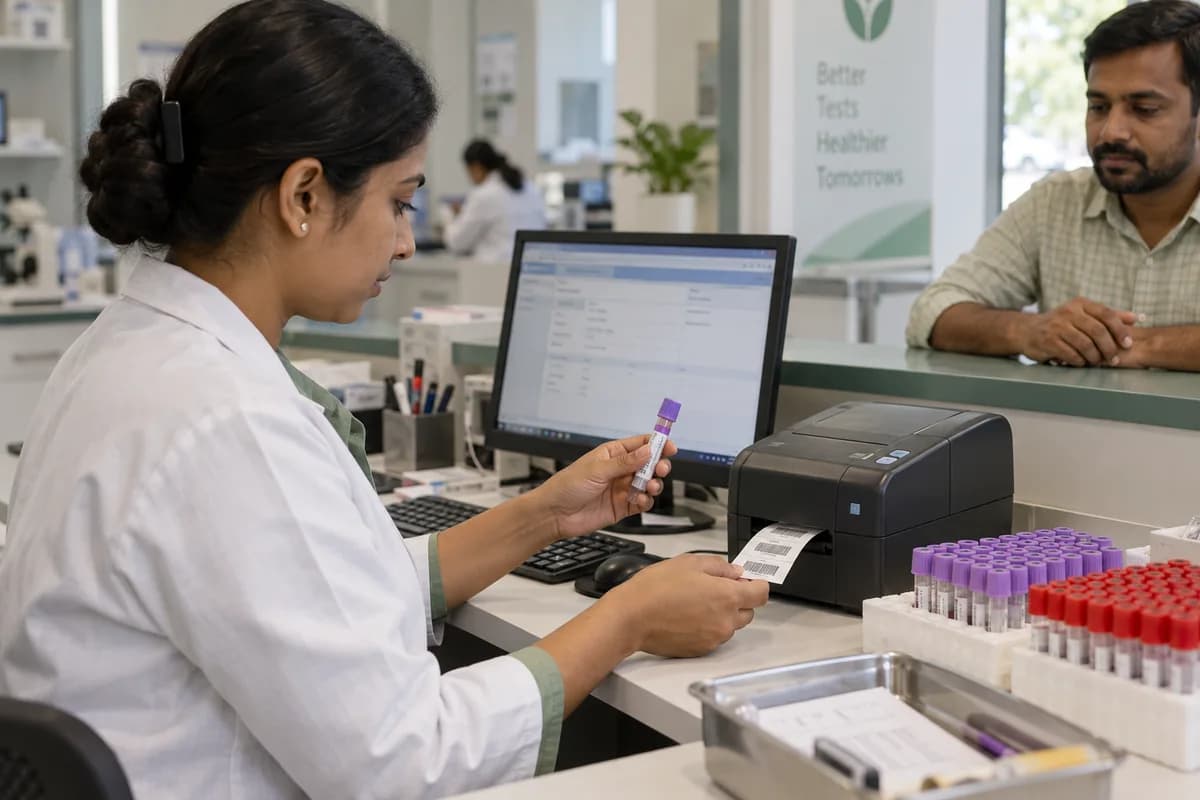
A tube for a lipid profile and a tube for a blood count carry different labels for the same patient. Scanning the label at the analyser sends the result to the right patient. Mix-ups at the rack are caught.
Bring the records the workflow depends on.
- Item and variant codes
- Barcode formats
- Printer and scanner requirements
Outputs to check
- Item-code and label definition
- Printed-label batch record
- Scan-validation exception list
Follow the barcodes and labels workflow.
Use this sequence to compare your current process with the proposed module. Agree the owner, permission and exception at each step.
Who uses the module, and who approves?
Keep responsibilities distinct even when one person holds more than one role.
Decide how exceptions are handled.
These business rules belong in configuration and testing. A normal transaction alone does not demonstrate that the workflow is ready.
Can this work independently?
Labels need an item or asset identifier and compatible printing and scanning arrangements. Billing, receipt and counting systems use the scanned value to select a record. Printing a code does not create a stock movement, establish authenticity or satisfy every product-labelling requirement.
Systems and records it connects with
- Product management: Item identifiers, units and controlled variant definitions.
- Point of sale billing: Counter sales, tender records and authorised returns.
- Stock tracking and alerts: Item-location quantities and authorised stock movements.
- Label and thermal printers: Agreed label formats and hardware-tested print output.
Configure, test and introduce the workflow.
- We look at items, current labels and your printer. You supply a stock list. You get back a note on which codes exist and which are missing.
- Codes are agreed on paper. You approve how item and variant codes are built before any printing. A sample label is cut to size. A few stickers come back to hold against real stock.
- Counter staff scan a small batch at billing and at a rack count. Slow scans get noted. So do wrong codes. Remaining items are labelled in groups while the unlabelled list shrinks on screen. Training at each counter closes the work.
Check the result before rollout.
Apply these checks to a sample from the agreed workflow, then repeat with an exception. Keep the expected result beside the test record.
- Codes retrieve the correct variant.
- Duplicate active codes are detected.
- Printed labels are readable on the agreed hardware.
How the business operates.
A neighbourhood pathology lab handles walk-in patients, home collection, samples from partner collection centres and work sent by nearby nursing homes.
The records that hold the operation together.
- Patient registration and test orders. Register patients with age, sex, referring doctor and the tests or profiles ordered, and find a returning patient by phone number.
- Sample collection and barcodes. Print a barcode for every container at collection, record the sample type and time, and mark rejected samples with a reason.
- Home collection visits. Book home visits by area and time slot, assign each to a phlebotomist, and see which samples have reached the lab.
- Collection centres and B2B accounts. Give each collection centre, referring hospital and corporate client its own rate list, credit terms and a statement it can read for itself.
Operational bottlenecks to check
Tube labels are handwritten
A name in marker on a sample tube is easy to misread at a busy bench. One swap means two wrong reports.
Report status lives at the bench
A doctor calls to ask whether a report is ready, and the desk has to walk in and ask a technician. The caller waits on hold.
How work flows across this business
This module sits within a wider operating process. Use the sequence to identify the other teams and records affected by a change.
1. Registration
The patient is registered at the desk, at a collection centre or at home, with the referring doctor and the tests or profiles ordered.
2. Collection and barcode
Each container gets a printed barcode linked to the patient and the tests. Rejected samples are marked with the reason and a recollection is booked.
3. Worklists and results
Samples arrive on each department’s worklist. Technicians enter results, and values outside the lab’s reference range are flagged as they are typed.
4. Pathologist sign-off
The pathologist reviews the results, the flags and the patient’s earlier values, then signs the report or sends a test back for a re-run.
5. Report delivery
Only a signed report is released. It is printed, emailed or sent through the lab’s own WhatsApp Business account where that is set up.
6. Billing and dues
Walk-in patients pay at registration, while collection centres, hospitals and corporate accounts are billed on their agreed rates and settled against a ledger.
Industry reports to connect with
- Samples received by source and department
- Reports pending sign-off and delivery
- Rejected samples and recollections
- Collections by mode, test and centre
Questions before implementation.
When should pathology labs consider barcodes and labels?
Use when physical items benefit from scanning or printed identification. An item needs identification at receipt, counting or sale.
What should we bring to the requirements discussion?
Bring anonymised examples of Item and variant codes; Barcode formats; Printer and scanner requirements. Show who creates, checks and changes each record. Use only records from an activity that meets the suitability conditions above.
Does this replace our existing business software?
The starting point is your current system and the gap you need to close. Connect scannable labels with the correct items and variants. Configuration, a connected module or a custom build are evaluated against that gap before a replacement is proposed.
What is outside this module?
Industry numbering standards and mandatory product-label requirements need separate confirmation.
How are scope, price and rollout decided?
The proposal follows a review of your records, user roles, branches and existing software. Data migration, connections, training and support are scoped separately where needed. Codes retrieve the correct variant. Use this check when reviewing the first working version.
Related functions for pathology labs.
Discuss barcodes and labels for your business.
Tell us which workflow needs attention and which systems your team uses. The next step is a requirements discussion and a written scope.
What happens after you share your requirements
- We review your brief and the systems you already use.
- We clarify the workflow, missing information and the work to consider first.
- The proposed scope sets out the deliverables, responsibilities and dependencies.
- Review the scope and commercial terms before deciding whether to proceed.
Start with your requirements
Describe your current process, the people involved and the change you need. Start with the details you know; we can clarify the rest together.
Share your requirements