Business solutions for Transformer manufacturers
Explore software for work such as “Tracking tender notices and filing complete documents on time”. Review each business function below, including when it fits and what to check before implementation.
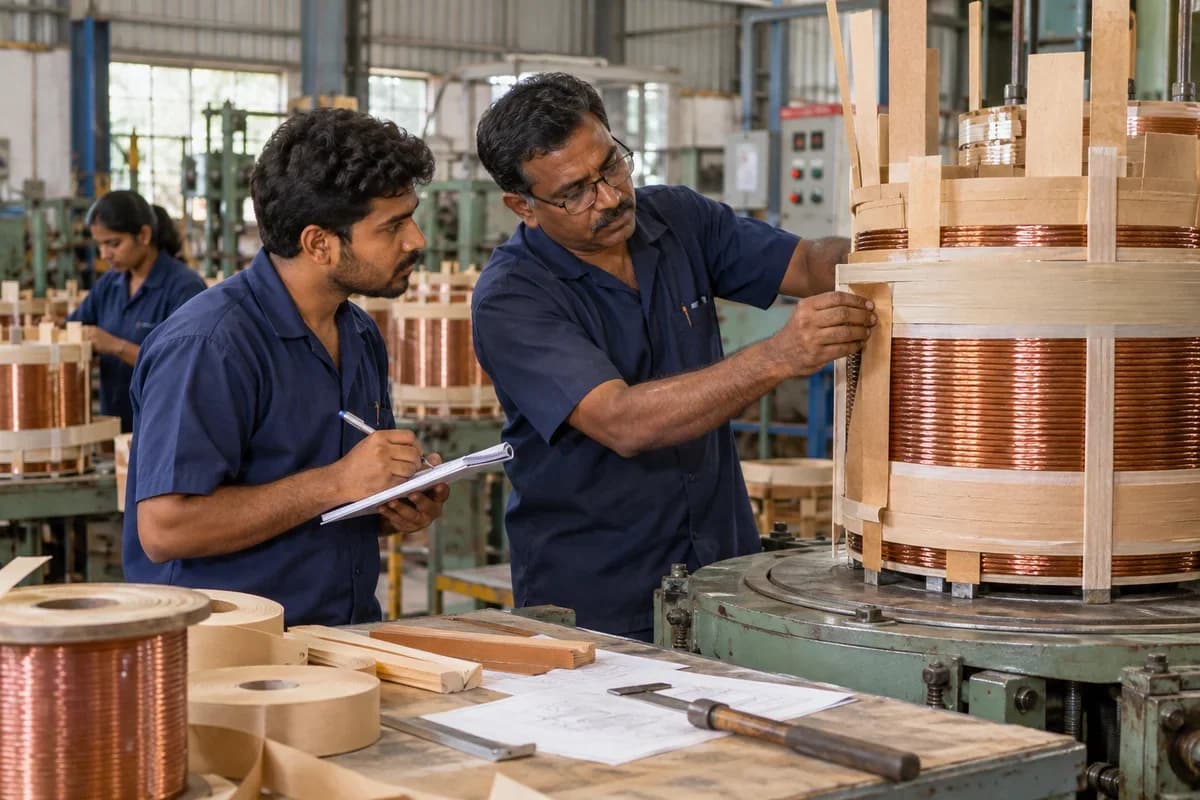
How the business operates.
A transformer order starts as a tender with a kVA rating, voltage ratio, vector group, impedance and loss limits. You price core steel, winding copper or aluminium, insulation, oil and tank, then commit to no-load and load loss figures that the customer can penalise. The design sheet comes next. It fixes core dimensions, turns per coil and the tap range, and the shop cuts every lamination and orders the oil from it.
The records that hold the operation together.
- Transformer tenders. Cost a unit from core steel, winding copper, insulating oil and tank fabrication, and keep each revision of the offer that went to the buyer.
- Loss commitment register. Store the no-load loss, load loss and impedance limits promised to each buyer, beside the tender that made the promise.
- Design sheet control. Hold core, coil and tap data per unit, with each buyer comment round and the released revision.
- Core steel lots. Receive CRGO coils by lot and weight, and book cut laminations and slitting scrap to each core.
- Winding wire and insulation. Track copper strip, round wire, kraft paper and pressboard by reel, with consumption per coil.
- Build stage board. Show which units are in cutting, stacking, winding, drying, tanking or oil filling. Late ones stand out.
- Drying and oil bay schedule. Plan vacuum oven cycles and oil filling slots across the units that need them.
- Routine test entry. Enter ratio, vector group, winding resistance, loss and impedance readings and compare each with its commitment.
Operational bottlenecks to check
Loss limits are quoted, then forgotten
The tender commits to no-load and load loss limits, but the bay works from the design sheet alone. A unit passes routine tests and still sits above the figure quoted to the buyer. The penalty arrives with the invoice.
Core steel is not traced to a unit
Silicon steel coils arrive by lot and weight, get slit and cut, and the offcut is counted by eye. Months later, a unit with high core loss cannot be tied to the coil it came from.
Winding wire runs out mid-order
Copper strip, round wire and insulating paper are drawn from open reels with no booking per unit. A section stops when a reel ends. Nobody saw it coming, and the unit loses its place on the bay.
Test readings are copied between sheets
Ratio, vector group, winding resistance, no-load loss and impedance are written on a bench sheet, retyped into a report and typed again onto the plate. A transposed digit survives all three.
Inspection calls are booked by phone
Utility and third-party inspectors are asked to attend by telephone, and the date lives in someone’s diary. Finished units wait in the yard, tanks filled and bushings fitted, for a visit nobody confirmed.
Follow the work across teams.
This is a planning flow. Confirm the steps, owners and approval rules against your actual operation.
Roles and responsibility boundaries.
Reports your managers need.
- Units by build stage and rating
- Promised against measured losses per unit
- Core steel and wire consumed by order
- Inspector bookings and results
- Units waiting on material
- Repairs open by buyer
Connections to scope
- Accounting export
- Label printer
- Drawing file storage
Confirm data access, record ownership and the exchange method for each connection. Inclusion here does not mean every connection is available in a standard package.
Setup decisions and adoption risks.
Use these requirements to plan phases, data migration and user training. Agree the release sequence after reviewing your current systems.
Limitations to settle before implementation
- A shop that only repairs and rewinds small units may prefer a lighter job register.
- Dealers who buy finished transformers and resell them need stock and invoicing, not a build record.
Modules to consider first.
These functions connect to the operating model above. Confirm each one against the work your business actually runs.
Choose the operation you want to improve.
Use these activities to explain your scope. Your business does not need every function in the directory.
- Tracking tender notices and filing complete documents on time
- Building trade relationships with electrical contractors and dealers
- Showing test facilities, standards and past supply clearly
- Replying to enquiries with a usable price range
- Keeping a record of every tender and bid outcome
- Being found for transformer searches in your state
Explore the business functions.
Production, stock, fleet and recurring billing functions apply only where your business runs those activities. Read the suitability conditions on each page.
Manufacturing
Batch and Serial Tracking
Trace goods using batch identifiers or individual serial numbers.
View workflow and suitability →Production Planning
Plan manufacturing quantities against demand, materials and capacity.
View workflow and suitability →Quality Control
Record specified inspections and the disposition of checked goods.
View workflow and suitability →Work Order Management
Track a production job from material issue to completed output.
View workflow and suitability →
Finance & Accounting
Field Service
Inventory Management
Platform
Start with the problem your team can describe.
Bring a sample record and show where information is copied, missed or waiting for approval. Scope the first useful change from there.
What happens after you share your requirements
- We review your brief and the systems you already use.
- We clarify the workflow, missing information and the work to consider first.
- The proposed scope sets out the deliverables, responsibilities and dependencies.
- Review the scope and commercial terms before deciding whether to proceed.
Start with your requirements
Describe your current process, the people involved and the change you need. Start with the details you know; we can clarify the rest together.
Share your requirements