Find Out What the Bill Is Actually Paying For Before You Start Cutting
GullySystem works through your AWS, Azure or Google Cloud bill line by line, tags what belongs to whom, and reduces it through right-sizing, reserved capacity, storage tiers and switching off what nobody uses, with the performance measured before and after so nothing is cut blind.
- We measure performance before anything is reduced
- Nothing is deleted without an owner confirming it
- The savings land on your bill, in your own cloud account
We work on cloud bills for SaaS teams whose hosting cost is growing faster than their customer numbers, for businesses that lifted servers into the cloud unchanged and wondered why it cost more, and for companies whose invoice nobody can explain because a consultant set it up and left. The work is unglamorous: tagging, measuring, right-sizing and turning off what nobody uses.
Can Anyone in Your Company Explain Last Month’s Cloud Bill?
The Bill Goes Up and Nobody Knows Which Line Moved
It was forty thousand, then fifty-two, then sixty-one. The invoice lists services rather than purposes, so the increase is noticed at renewal and never traced to what caused it.
Servers Sized for a Launch That Never Came
Instances were chosen for the traffic somebody hoped for. Two years on, processor use sits in single digits all day and the same machines are still being paid for every hour.
Staging and Test Running Through Every Night
Environments nobody touches after seven in the evening run at full size through nights, weekends and the whole of a festival week, because switching them off was never automated.
Snapshots and Disks From Servers That No Longer Exist
Every backup ever taken, every volume detached from a machine that was replaced in 2023. Storage accumulates silently because nothing ever fails when you keep too much of it.
Everything Sits in the Most Expensive Storage Tier
Logs from four years ago, old customer uploads and one-time reports sit in the tier designed for data read constantly. Nobody has opened them since they were written.
The Consultant Who Set It Up Has Gone
Resources have names like test-2 and final-new, with no tags and no documentation. Nobody is willing to switch anything off because nobody knows what depends on it.
Somebody Cut Costs and Broke Production
A previous attempt resized a database on a Friday without measuring anything. The application slowed, orders failed, and the saving was reversed along with everyone’s appetite for trying again.
Cutting a cloud bill without measuring first is guesswork with an outage attached. What works is knowing what each rupee is buying, which resources have an owner, and how much headroom each workload genuinely needs.
Measure, Attribute, Then Reduce What Is Genuinely Spare
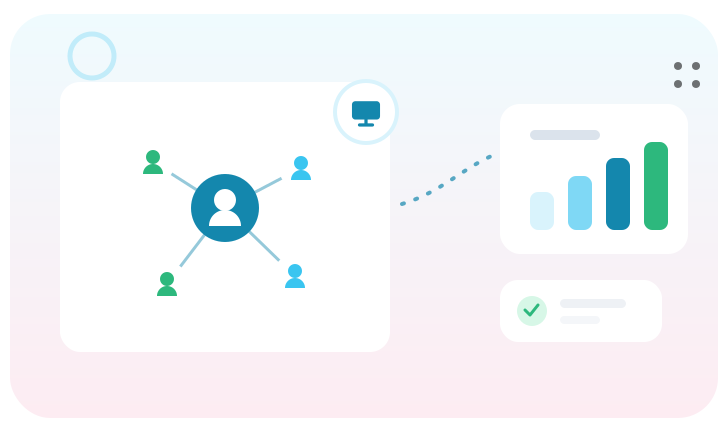
We start by making the bill readable: every resource tagged to a service and an owner, so spending can be attributed instead of argued about. Then we measure actual use over a representative period. Changes come in order of risk, starting with what nobody is using at all, and performance is compared before and after each one.
Attribution Before Reduction
Until every resource is tagged to a purpose and an owner, a cost review is guesswork. Tagging is dull, it takes a week, and it is what makes everything afterwards possible.
Risk-Ordered Changes
Unused resources first, then schedules, then storage tiers, then right-sizing, then commitments. The safest savings are taken before anything touches a production workload.
Performance Measured Both Sides
Response times, queue depth and error rates recorded before a change and watched after it. A saving that slows the application is not a saving, and we would rather find that out ourselves.
What Changes After a Cost Review
Focus on business value before discussing technology. Here is what your team accomplishes in week one.
The Bill Can Be Explained Line by Line
Spending attributed to services, environments and customers, so a rise is traced to a cause the same week rather than noticed at renewal.
You Stop Paying for Idle Hours
Test and staging environments run during working hours and stop afterwards, which removes a large share of the bill without touching anything a customer uses.
Machines Match the Work They Actually Do
Instances and databases moved to sizes chosen from measured use with headroom for peaks, instead of the size somebody picked during the first week of the project.
Old Data Costs What Old Data Should
Logs, backups and archives moved to cheaper tiers by lifecycle rules, while the data your application reads every minute stays where it is.
Steady Workloads Bought at a Lower Rate
Reserved capacity or savings plans applied only to the baseline that genuinely runs all year, after right-sizing rather than before it.
You Know What One Transaction Costs to Serve
Infrastructure cost per order, per tenant or per user, tracked over time, so growth in the bill can be compared against growth in the business.
What Cloud Cost Optimisation Includes
Everything required from operational discovery to production deployment and long-term maintenance.
Bill and Usage Analysis
Your invoice broken down by service, resource, environment and region, with the largest items explained in business terms and the month-on-month increases traced to their cause.
Tagging and Cost Attribution
Every resource tagged to a service, environment, owner and where relevant a customer, with tagging rules enforced so new resources arrive labelled rather than anonymous.
Baseline Performance Measurement
Response times, throughput, error rates, processor, memory, disk and network use recorded over a representative period, including your busiest day, before anything is changed.
Idle and Orphaned Resource Cleanup
Unattached disks, old snapshots, unused addresses, load balancers with no targets, forgotten test environments and duplicated backups, listed with an owner and removed after confirmation.
Environment Scheduling
Development, test and staging shut down outside working hours and restarted automatically, with exceptions for anything that genuinely needs to run through the night.
Compute Right-Sizing
Instance families and sizes chosen from measured use with real headroom for peaks, including moving to newer generations that cost less for the same capacity.
Database and Managed Service Review
Database instance sizes, storage settings, backup retention, read replicas and managed services checked against actual load, which is where over-provisioning usually hides.
Storage Tiering and Lifecycle Rules
Objects moved automatically to cheaper tiers as they age, retention set for logs and backups, and duplicate copies of the same data found and removed.
Reserved Capacity and Savings Plans
Commitment analysis after right-sizing: what baseline genuinely runs all year, which commitment type suits it, and what should deliberately stay on demand.
Data Transfer and Network Cost Review
Egress charges, cross-zone traffic, gateway costs and content delivery configuration examined, since transfer is the line that most often surprises people.
Architecture Changes Where They Pay
Where the saving needs a design change rather than a setting: caching, spot capacity for batch work, serverless for spiky loads, or consolidating environments that duplicate each other.
Budgets, Alerts and Ongoing Governance
Budgets per environment, alerts on anomalies, a monthly review of new spending, and rules so a resource created in a hurry does not quietly run for a year.
Where the Bill Usually Comes Down
Real-world business processes we configure and automate.
SaaS Product: Hosting Growing Faster Than Customers
The bill had doubled while accounts had grown by half. Tagging per tenant showed that three trial accounts on shared infrastructure were generating most of the database load. Right-sizing followed the measurement, a commitment was taken only on the steady baseline, and cost per tenant became a number the founders watch monthly.
Distributor: Servers Lifted Into the Cloud Unchanged
Physical machines were replicated one for one into instances of the same size, running day and night. Measured use was in single digits outside billing hours. The application servers were right-sized, the database moved to a managed service with measured storage, and the overnight batch shifted to a schedule that did not need capacity held all day.
Agency: Nine Client Environments, Four Still Billing
Staging and demo environments had been created per client project and never removed. Four belonged to engagements that ended over a year earlier. Tagging by client made this visible in a fortnight, the dead environments were archived and deleted with the account managers confirming, and new projects now carry an expiry tag.
E-Commerce Brand: Storage That Only Ever Grew
Product images, order exports and application logs going back four years all sat in the standard tier. Lifecycle rules moved anything older than ninety days to cheaper storage and archived logs beyond a year. The images the site actually serves stayed where they were, behind a content delivery network that also cut the transfer charges.
Manufacturer: A Database Sized for a Migration That Ended
A large database instance had been provisioned for a one-time data migration and was never reduced afterwards. It had been running at that size for eleven months. We measured a fortnight of real load, resized during a planned window, and watched query times on both sides of the change to confirm nothing had been lost.
Startup: Where There Was Nothing Worth Cutting
A small team with a modest monthly bill asked for a cost review. The environment was already small, mostly managed services, and a day of work would have saved less than the review cost. We told them so, set up budget alerts and tagging so growth stays visible, and suggested they call again when the bill had a few more digits.
Is This Service Right for Your Business?
We partner with established businesses that have outgrown manual processes and want reliable systems.
Businesses Whose Cloud Bill Keeps Rising
Where the invoice has grown steadily and nobody can point at what caused it, usually because nothing is tagged and the bill lists services rather than purposes.
Companies That Lifted Servers Into the Cloud
Physical machines copied into instances of the same size, running the same way, which is the most common reason a cloud migration costs more than the data centre it replaced.
SaaS Teams Watching Margin
Where hosting is a real share of revenue and the question is what it costs to serve one customer, not just what the total bill was.
Businesses Whose Cloud Was Set Up and Abandoned
A consultant configured it, left no documentation, and now nobody is willing to switch anything off because nobody knows what depends on it.
Teams With Many Environments
Development, test, staging, demo and per-client environments that multiply easily and are never cleaned up, because creating one is a click and removing one is nobody’s job.
When a Review Is Not Worth It
If your monthly bill is small and the environment is mostly managed services already, a review will cost more than it saves. Turn on budget alerts, tag what you create, and call somebody when the bill has grown a digit. The same applies if your real problem is that the application is slow or unreliable, because performance work and cost work pull in different directions and the performance question should be settled first. We would rather tell you to wait.
Enterprise Capabilities in Plain Business Terms
Cost Attribution by Tag
Spending broken down by service, environment, team and customer, with tagging rules enforced on new resources.
Usage Measurement Over Time
Processor, memory, disk, network and request metrics gathered across a representative period including peak days.
Right-Sizing Recommendations
Instance and database sizes proposed from measured use, with the headroom for peaks stated rather than assumed.
Idle Resource Detection
Unattached volumes, old snapshots, unused addresses, empty load balancers and forgotten environments identified with owners.
Scheduled Start and Stop
Non-production environments switched off outside working hours automatically, with an easy way to bring one up when needed.
Storage Lifecycle Rules
Automatic movement to cheaper tiers by age, with retention applied to logs, backups and exports.
Commitment Planning
Reserved instances and savings plans analysed against the genuine baseline, with coverage deliberately kept below full usage.
Spot and Burstable Capacity
Interruptible or burstable capacity used for batch, build and test workloads that can tolerate it.
Data Transfer Analysis
Egress, cross-zone and gateway traffic examined, with content delivery and routing changes where they reduce it.
Budgets and Anomaly Alerts
Per-environment budgets with alerts when spending deviates, so a runaway resource is caught in days rather than at month-end.
Unit Cost Tracking
Infrastructure cost per order, per tenant or per user, tracked over time so growth is compared against the business.
Before and After Evidence
Performance and cost recorded either side of each change, so the result is shown rather than claimed.
Our Structured 6-Step Delivery Process
A transparent path from your first conversation to a reliable production release.
Billing Review and Access
We take twelve months of billing data and read-only access to the accounts. From you we need billing access, a list of which environments matter, and an honest statement of what nobody understands any more.
Tagging and Attribution
Every resource tagged to a service, environment and owner. From you we need people who can identify the resources nobody recognises, because deleting something unexplained is how outages happen.
Baseline Measurement
Performance and usage recorded over a representative period. From you we need to know when your peaks are, since a review run during a quiet fortnight produces recommendations that fail in your busy month.
Findings and a Ranked Plan
A written report of every opportunity with the estimated saving, the risk and the effort against each. From you we need decisions on what may be switched off and what must stay regardless of cost.
Implementing in Order of Risk
Unused resources first, then schedules and storage, then right-sizing in planned windows, then commitments. From you we need change windows for anything touching production, and a way back agreed in advance.
Verification and Governance
Performance compared against the baseline, savings confirmed on the next bill, budgets and alerts set. From you we need an owner for monthly cost review, because a bill left unwatched drifts back within a year.
What You Receive Upon Project Completion
Everything required to run, maintain, and expand your software without vendor lock-in.
Connects With the Systems You Already Rely On
We build bridges between your software so you don't have to replace functional existing tools.
Cloud Platforms
- Amazon Web Services
- Microsoft Azure
- Google Cloud
- DigitalOcean
- Indian region hosting
Cost and Billing Tools
- AWS Cost Explorer and Budgets
- Azure Cost Management
- Google Cloud Billing reports
- Cost and usage report exports
Monitoring
- Amazon CloudWatch
- Azure Monitor
- Prometheus and Grafana
- Application performance monitoring
Infrastructure Tooling
- Terraform
- Kubernetes
- Docker
- Auto scaling groups
- Managed database services
Reporting and Alerts
- Email and Slack alerts
- Metabase and Power BI dashboards
- Scheduled cost reports
- Anomaly notifications
Selected for Reliability, Speed, and Longevity
Technology chosen to match your operational scale and long-term maintainability.
Analysis
Measurement
Automation
Compute Options
Storage
Why Business Owners Choose GullySystem
We Measure Before We Cut
A baseline across a representative period, including your busiest day, comes before any change. Most failed cost exercises are a resize done on a Friday with no data behind it.
Safest Savings First
Resources nobody uses, then schedules, then storage tiers, then production right-sizing. A good share of the reduction usually arrives before anything a customer touches is altered.
Nothing Is Deleted Without an Owner Saying Yes
Every candidate for removal is listed and confirmed by someone who knows what it was for. An unexplained resource is a question, not a saving.
Deliberately Conservative Commitments
Reserved capacity is taken only on the baseline that genuinely runs all year, and after right-sizing rather than before. Over-committing locks in the mistake you were trying to fix.
Evidence on Both Sides
Performance and cost recorded before and after each change. If a change hurt response times, we find it and reverse it rather than letting you discover it through complaints.
We Will Tell You Not to Bother
On a small bill, a review costs more than it saves. Budget alerts and a tagging habit are the right answer, and we would rather say that than sell an engagement worth less than its fee.
Flexible Engagement Options
Choose an engagement model that matches your operational scope, budget, and timeline.
Cost Assessment
Billing analysis, tagging, baseline measurement and a written report with saving, risk and effort against each opportunity, for you to act on with your own team or with us.
Optimisation Project
Changes made in order of risk, in planned windows, with performance verified against the baseline and savings confirmed on the following bill.
Architecture Redesign
For workloads where the saving needs design change: caching, spot capacity for batch, serverless for spiky loads, or consolidating environments that duplicate each other.
Ongoing Cost Governance
Budgets and anomaly alerts watched, new spending reviewed, commitments managed as they expire and unit cost tracked, so the bill does not drift back over a year.
Frequently Asked Questions
Straightforward answers to the questions owners ask before getting started.
How much can we expect to save?
We will not give you a percentage before looking, and anyone who does is quoting a brochure rather than your account. What we can say is where the savings usually sit: environments running out of hours, resources nobody has used in months, storage that never moved to a cheaper tier, and machines sized for traffic that never arrived. Some accounts are already tight and the honest finding is that there is little to take. The assessment tells you the number for your account, with the risk against each item.
Will cutting costs slow our application down?
Not if performance is measured on both sides of every change, which is the whole discipline. We record response times, throughput, error rates and resource use across a representative period, including your busiest day, before anything is altered. Changes to production are made in planned windows with a way back agreed in advance, and the metrics are watched afterwards. Where a change does affect performance, we reverse it and say so. The failures in this work come from resizing on a hunch.
Where should we start?
With tagging, which nobody enjoys and everything else depends on. Until each resource carries a service, an environment and an owner, a cost review is guesswork, and the first question about any resource is what it is for. Tagging usually takes a week and immediately reveals the easy items: environments belonging to finished projects, disks attached to nothing and duplicated backups. After that the order is idle resources, schedules, storage tiers, right-sizing and finally commitments.
Should we buy reserved instances or a savings plan?
Probably, but not yet and not for everything. Committing before right-sizing locks in the oversized machines you were about to fix, which is the most common expensive mistake in this work. The sequence that works is to right-size first, watch the settled usage for a while, then commit on the baseline that genuinely runs all year and deliberately leave the variable portion on demand. Full coverage looks efficient on a spreadsheet and hurts the moment your architecture changes.
Why did moving to the cloud cost more than our own servers?
Usually because the servers were copied rather than redesigned. A physical machine sized for peak load, replicated as an instance of the same size running every hour of the year, costs more than the hardware did, because you were previously paying for capacity once and are now renting it continuously. The cloud pays back when capacity follows demand: scheduled environments, autoscaling, managed services sized to actual load and storage that ages into cheaper tiers. That is a design change, and it is where the real reduction lives.
Is it safe to delete old snapshots and unused disks?
Only after someone confirms what each one is, which is why we never do it from a script. The list goes to the people who own those services, with what it is attached to and when it was last touched. Anything unexplained stays. Where there is doubt, resources are stopped rather than deleted for a period, so recovery is quick if something turns out to matter. Retention rules are then set so the same accumulation does not start again the following year.
Can you work in our cloud account, or do we move to yours?
Yours, always. We are added with the access needed and nothing more, starting with read-only for the assessment and gaining change permissions only for the implementation. The savings land on your bill directly, you keep the relationship with the provider, and you keep any commitments we recommend. Arrangements where a vendor resells you cloud capacity through their own account make it very hard to leave and very hard to verify what you are paying for.
What about data transfer charges?
They are the line that surprises people most, because they do not appear in a resource list and nobody remembers agreeing to them. Traffic leaving the cloud, traffic between availability zones, gateway charges and backups copied to another region all accumulate quietly. The usual fixes are a content delivery network in front of public assets, keeping chatty components in the same zone, compressing what crosses boundaries, and checking whether cross-region replication is genuinely required or was switched on because it sounded prudent.
How do we stop the bill creeping back up?
By making it somebody’s job once a month, with tooling behind them. Budgets per environment with alerts, anomaly detection so a runaway resource is caught in days rather than at month-end, tagging rules that reject untagged resources, and expiry tags on anything created for a temporary purpose. Beyond the tooling, the habit that matters is a short monthly look at what changed and why. Accounts that are reviewed stay reasonable. Accounts nobody looks at drift back within a year.
What does a cost review cost, and how is it priced?
The assessment is a fixed piece of work, priced from the size and complexity of the account: how many services, how many environments, how much is tagged already and whether the architecture is documented. Implementation is quoted separately once the findings are known, because the effort depends on which items you choose to act on. We do not work on a share of savings, since it creates an incentive to cut deeper than is wise and to claim credit for reductions that would have happened anyway.
Do you work with Azure and Google Cloud as well as AWS?
Yes, and the method is the same on all three: attribute the spend, measure real usage, remove what is idle, schedule what is not needed around the clock, tier the storage, right-size, then commit. What differs is the vocabulary and the specific tools, such as savings plans against committed use discounts, and how each provider charges for transfer and managed services. We also work with smaller providers, and with businesses running a mix, which usually needs the tagging discipline more than a single-provider account does.
Should we move back off the cloud to save money?
Occasionally that is the right answer and we will say so. A steady workload with predictable load, no need for elasticity and a team able to look after hardware can be cheaper on rented dedicated servers. But the comparison has to be honest: hardware replacement, redundancy, backups, network, security patching and the people to do all of it, against a cloud bill that has actually been optimised first. Most businesses that raise this have an unoptimised bill rather than a cloud problem, and the review settles the question either way.
What should we measure before cutting anything?
Enough to know what spare capacity you genuinely have, over a period that includes a bad day. Processor and memory use at peak rather than on average, since averages hide the hour that matters. Disk input and output, and queue depth. Network transfer in and out. Application response times and error rates. Cost per environment and, where it makes sense, cost per order or per tenant. Two weeks is usually a fair window, but if your business has a season, measure through it or wait for it, because a recommendation made in a quiet month will fail in your busy one.
Let’s Build the Right Software for Your Business
Tell us about your current operational challenge, spreadsheet bottleneck, or software requirement. An experienced engineer will review your workflow and reply within one business day.
- No obligation consultation
- Senior engineer reviews your brief
- Your operational details stay 100% confidential
Discuss Your Requirement
Fill out this brief form and we’ll get back to you within one working day.
Related Practices & Services
Cloud Engineering and Managed Infrastructure
The hosting, environments, backups and monitoring underneath, run properly rather than only priced properly.
Performance Engineering
When the application is slow as well as expensive, finding the real bottleneck instead of paying for a bigger server.
DevOps, Deployment and Reliability
Pipelines, environments as code and autoscaling, so capacity follows demand rather than sitting idle all year.
Technology Strategy and Product Consulting
Where the bill is a symptom of an architecture decision, a written view on what to change and in what order.