Production Planning for Solar inverter manufacturers
Plan manufacturing quantities against demand, materials and capacity.
Does this function belong in your operation?
Use when the business manufactures, assembles or prepares physical products.
Confirmed demand needs a production schedule.
Orders for string and hybrid models are planned against board supply, burn-in chamber slots and test bench time. A delayed control board shifts the plan. Planners see which dispatch dates are exposed.
Bring the records the workflow depends on.
- Demand and due dates
- Material availability
- Production capacity and calendars
Outputs to check
- Demand-linked production schedule
- Material and capacity exception list
- Released-work requirement record
Follow the production planning workflow.
Use this sequence to compare your current process with the proposed module. Agree the owner, permission and exception at each step.
Who uses the module, and who approves?
Keep responsibilities distinct even when one person holds more than one role.
Decide how exceptions are handled.
These business rules belong in configuration and testing. A normal transaction alone does not demonstrate that the workflow is ready.
Can this work independently?
Planning needs demand, material definitions and capacity assumptions. These can be entered independently, but order, stock and work-order links keep the plan aligned with actuals. Releasing a plan does not issue material or record completed output; those execution steps need their own records.
Systems and records it connects with
- Bill of materials: Approved component quantities and production-definition versions.
- Work orders: Released production jobs, material issues and output records.
- Stock: Item-location quantities and authorised stock movements.
- Purchase orders: Authorised supplier commitments and open line balances.
Configure, test and introduce the workflow.
- Walk us through machines, ovens or lines and the shifts they run. A written map of capacity comes back.
- Tell us which items repeat daily. A set of standing quantities is returned for approval. Sales orders and stock arrive from your existing records. A trial plan appears for a sample day.
- Overlap for a while. The floor uses the screen while the whiteboard stays up, and differences are noted.
Check the result before rollout.
Apply these checks to a sample from the agreed workflow, then repeat with an exception. Keep the expected result beside the test record.
- Planned quantities reconcile with demand.
- Shortages are visible before release.
- Capacity assumptions are recorded.
How the business operates.
An inverter is a small power plant in a box, sealed against dust and heavy rain and expected to run unattended on a roof for years. Electrolytic capacitors, IGBT modules, Hall-effect current sensors and the DSP board arrive from different suppliers in different lots. Parts change when a supplier revises a datasheet. A unit trips in the field after a year. Which parts did it contain?
The records that hold the operation together.
- Inverter model master and bills of materials. Record every model’s rating, control and gate driver boards, IGBT modules, heatsink, enclosure and nameplate labels. Earlier revisions are kept whenever the list is altered.
- Component and board lot receiving. Log lots of power modules, DC link capacitors and populated boards, including deliveries from an outside board assembler, with supplier and stores bin.
- Kits and work orders. Release a work order for a quantity of units and issue a kit to match. Any shortfall of boards or enclosures is shown to stores before the kit is picked.
- Assembly station tracking. Record operator, station and torque wrench check against each serial as it passes through IGBT mounting and busbar wiring.
Operational bottlenecks to check
Firmware images drift across a pallet
Units on one pallet carry different builds because the flashing station was updated mid-shift. Nobody can say which unit holds which. Support guesses from the label.
Component lots are not captured
Film capacitors and gate-driver chips come off open reels and trays. When a field failure points to one part, the affected serials cannot be listed.
How work flows across this business
This module sits within a wider operating process. Use the sequence to identify the other teams and records affected by a change.
1. Order and work order
A buyer’s order names the model, kilowatt rating, phase and quantity. The planner issues a work order, which pulls a kit against the bill of materials.
2. Receiving and kitting
Control boards, IGBT modules, DC link capacitors, inductors and enclosures are received by lot. Stores issue a kit and record which lots went to which work order.
3. Assembly
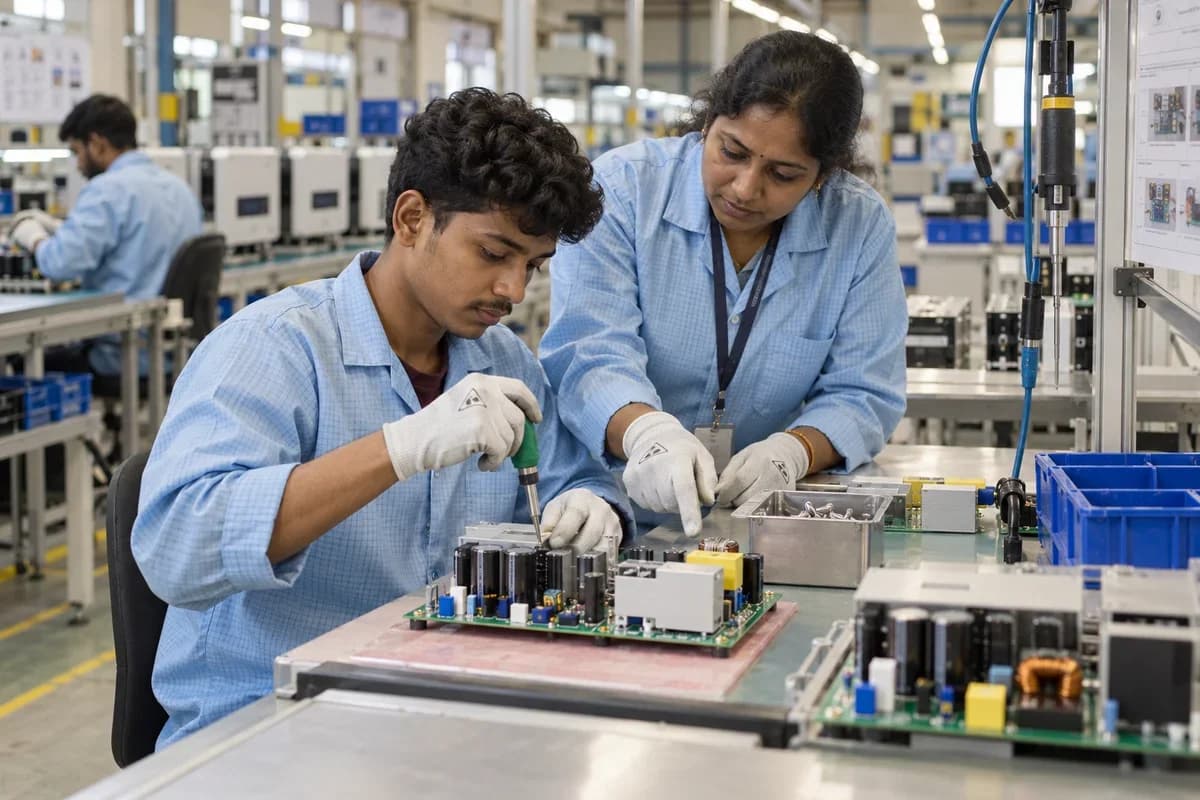
Operators bolt the IGBT stack to the heatsink with thermal paste, wire the unit and torque the busbar terminals. Operator and station are recorded against the serial.
4. Flashing and burn-in
The firmware image and grid-code parameter set are flashed and logged. The unit then runs at rated load in the rack, and hours and heatsink temperatures are saved.
5. Test and labelling
Output voltage, efficiency points, residual current trips, insulation resistance and RS485 communication are checked against model limits. Passing units get the rating label with its serial.
6. Dispatch and warranty
Scanning a carton at the dock checks it against the sales order, and the buyer receives the inverter serials packed inside. A warranty record opens with the dispatch and commissioning dates.
Industry reports to connect with
- Units by model through burn-in and final test
- Firmware version installed, by serial and date
- Failure codes by model and component lot
- Returns and repairs by serial and visit count
Questions before implementation.
When should solar inverter manufacturers consider production planning?
Use when the business manufactures, assembles or prepares physical products. Confirmed demand needs a production schedule.
What should we bring to the requirements discussion?
Bring anonymised examples of Demand and due dates; Material availability; Production capacity and calendars. Show who creates, checks and changes each record. Use only records from an activity that meets the suitability conditions above.
Does this replace our existing business software?
The starting point is your current system and the gap you need to close. Plan manufacturing quantities against demand, materials and capacity. Configuration, a connected module or a custom build are evaluated against that gap before a replacement is proposed.
What is outside this module?
Production output depends on actual materials, equipment and execution. The plan records assumptions and revised decisions as those conditions change.
How are scope, price and rollout decided?
The proposal follows a review of your records, user roles, branches and existing software. Data migration, connections, training and support are scoped separately where needed. Planned quantities reconcile with demand. Use this check when reviewing the first working version.
Related functions for solar inverter manufacturers.
Discuss production planning for your business.
Tell us which workflow needs attention and which systems your team uses. The next step is a requirements discussion and a written scope.
What happens after you share your requirements
- We review your brief and the systems you already use.
- We clarify the workflow, missing information and the work to consider first.
- The proposed scope sets out the deliverables, responsibilities and dependencies.
- Review the scope and commercial terms before deciding whether to proceed.
Start with your requirements
Describe your current process, the people involved and the change you need. Start with the details you know; we can clarify the rest together.
Share your requirements