Business solutions for Wiring harness manufacturers
Explore software for work such as “Getting audited and added to OEM and Tier 1 vendor lists”. Review each business function below, including when it fits and what to check before implementation.
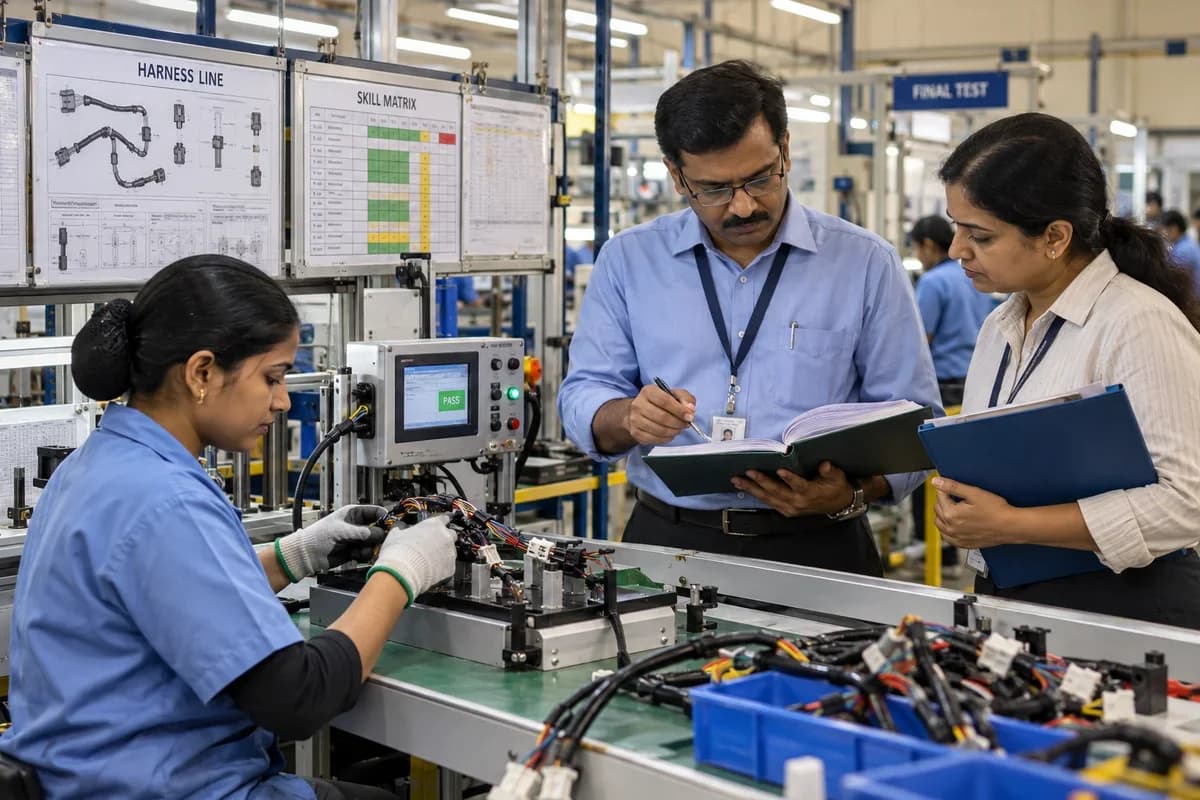
How the business operates.
A harness for one vehicle model can exist in dozens of variants, each with a different count of circuits, connectors and clips. Drawings are revised, and the floor must build to the revision that is live on the day, not the one printed last month. Old copies cause trouble.
The records that hold the operation together.
- Harness family and variant master. Keep each harness family with its variants, circuit lists, connector housings, seals and label formats in one place, so that a customer pull always selects the right pinout. Variants never mix.
- Drawing revision control. Hold the live drawing and earlier revisions for each harness family, and issue only the current one to cutting and to the formboard stations. Superseded sheets stay on file.
- Wire reel and terminal stock. Book reels, terminals, connector housings and seals by lot with reorder levels, and issue them to orders against the cut list so the lot is known at the machine.
- Cut list planning. Turn customer pulls into cut leads by colour, gauge and length, and schedule them across the cut-and-strip and crimping machines by applicator and due date.
- Crimp quality records. Log applicator changes, crimp height and pull force readings against limits set by your quality staff, and hold a batch at the press whenever a reading fails. Operators see the hold at once.
- Assembly kitting. Prepare connector, seal, clip, grommet and tape kits for each variant, and issue them to the formboard stations with a checklist that the kitter signs.
- Formboard assembly tracking. Follow each harness number through the assembly stations, with operator, formboard and time noted at every stop, so a slow board shows up within the shift.
- Electrical test and repair. Store continuity and insulation results for each harness number, with failure code, repair note and retest result, so repeat defects on one circuit become visible. Patterns surface.
Operational bottlenecks to check
Variant lists are copied between files
Each vehicle option changes the circuits in a harness. The list of what goes on each formboard is retyped from a drawing by hand, and an old copy stays in use on a second line for weeks.
Wire reels and terminal lots are not traced
Reels of different colours and terminal lots from several suppliers feed the same machines. After crimping, nothing on the cut lead says which reel or terminal lot it came from, so a pull test failure has no origin.
Crimp checks are recorded on paper
Crimp height and pull force are checked after an applicator change. The strip of paper stays at the machine. It rarely reaches a quality review, and it is thrown away when the board is full. History is gone.
Tester results do not carry a harness number
Electrical testers pass or fail a harness and show a count. Failures are repaired by name, and the reason is not collected, so the same open circuit keeps returning on the same variant.
Cut length shortages stall assembly lines
Assembly waits for one missing lead colour. Cutting is not planned from the formboard schedule, so trolleys arrive incomplete. Lines sit idle.
Follow the work across teams.
This is a planning flow. Confirm the steps, owners and approval rules against your actual operation.
Roles and responsibility boundaries.
Reports your managers need.
- Harnesses built by family and variant
- Crimp check results by applicator and terminal lot
- Test failures by circuit and line
- First-pass yield by variant
- Reel and terminal lot usage
- Pulls against despatch by customer
- Field faults by serial
Connections to scope
- Tester file import
- Accounting export
Confirm data access, record ownership and the exchange method for each connection. Inclusion here does not mean every connection is available in a standard package.
Setup decisions and adoption risks.
Use these requirements to plan phases, data migration and user training. Agree the release sequence after reviewing your current systems.
Limitations to settle before implementation
- A small electrician who rewires vehicles one at a time will find a job tracker closer.
- A maker of printed circuit boards would find Manufacturing Production Management Software a better match.
Modules to consider first.
These functions connect to the operating model above. Confirm each one against the work your business actually runs.
Choose the operation you want to improve.
Use these activities to explain your scope. Your business does not need every function in the directory.
- Getting audited and added to OEM and Tier 1 vendor lists
- Looking for customers outside the top one or two
- Prototype and sample enquiry responses
- Presenting capability with real parts, equipment and tests
- Keeping a ready audit document set
- Quoting with a clear component price validity
- Following every RFQ until it is won or closed
- Being found for harness and cable assembly searches
Explore the business functions.
Production, stock, fleet and recurring billing functions apply only where your business runs those activities. Read the suitability conditions on each page.
Manufacturing
Batch and Serial Tracking
Trace goods using batch identifiers or individual serial numbers.
View workflow and suitability →Bill of Materials
Define the materials and quantities needed for a manufactured item.
View workflow and suitability →Production Planning
Plan manufacturing quantities against demand, materials and capacity.
View workflow and suitability →Quality Control
Record specified inspections and the disposition of checked goods.
View workflow and suitability →Work Order Management
Track a production job from material issue to completed output.
View workflow and suitability →
Helpdesk
Human Resources
Inventory Management
Start with the problem your team can describe.
Bring a sample record and show where information is copied, missed or waiting for approval. Scope the first useful change from there.
What happens after you share your requirements
- We review your brief and the systems you already use.
- We clarify the workflow, missing information and the work to consider first.
- The proposed scope sets out the deliverables, responsibilities and dependencies.
- Review the scope and commercial terms before deciding whether to proceed.
Start with your requirements
Describe your current process, the people involved and the change you need. Start with the details you know; we can clarify the rest together.
Share your requirements