Computer Vision for Counting and Label Checks
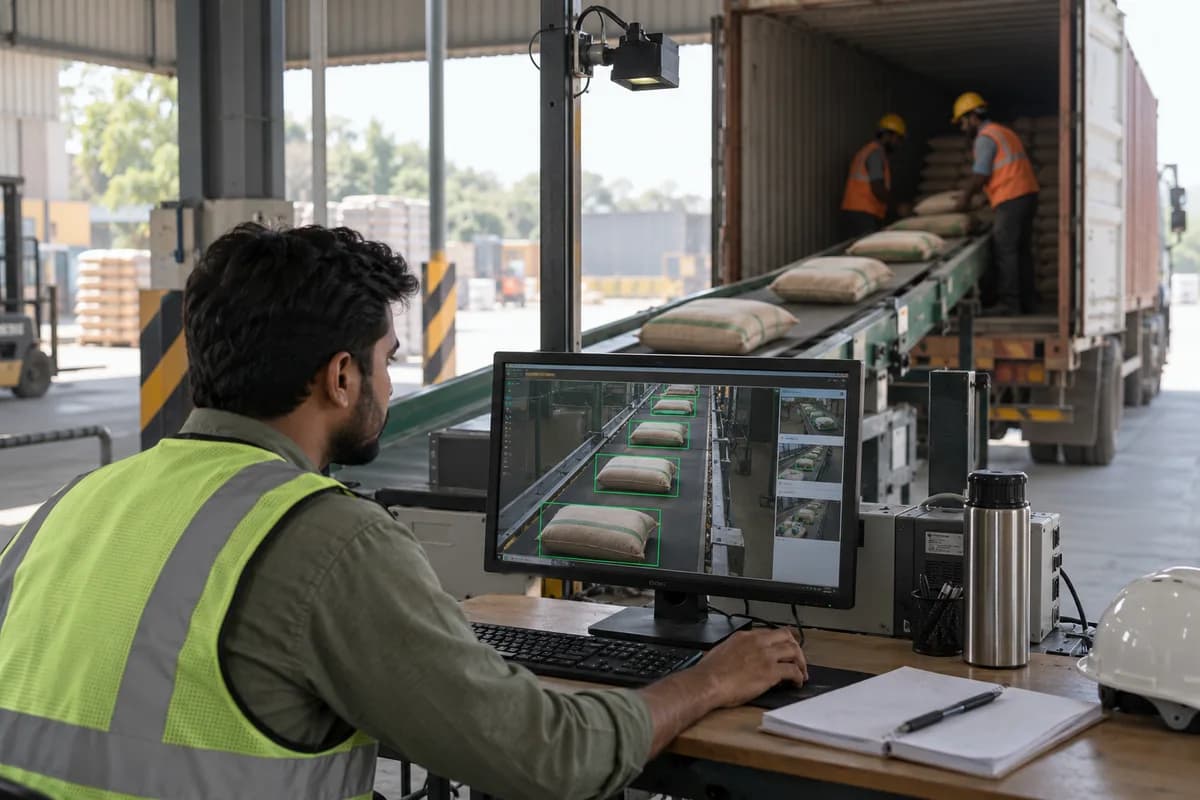
Computer vision applications read images and video to do what a person does by looking. Typical uses are counting sacks on a loading bay, checking a label and validating a site photograph.
Checks businesses ask for
- Counting bags, cartons or pipes as they are loaded or stacked
- Reading a number plate at a weighbridge or a gate
- Confirming the correct label and batch code is on a pack
- Checking that a field engineer’s photograph shows the work claimed
- Watching whether safety gear is worn in a defined area
What decides whether it will work
Lighting, angle and consistency decide it, in that order. A camera fixed above a conveyor with even light, looking at pieces that arrive in the same position each time, is a solvable problem. A phone photograph taken at whatever angle the person chose, in uneven light and at different distances, is a much harder problem. We ask for a few hundred real images before quoting. A demonstration on clean pictures says little about your yard.
When we will say no
If your sample images do not show the object or the defect reliably, then no amount of model training will fix that. Sometimes a camera moved half a metre or an added light makes the check feasible. Sometimes a person should keep doing it. We say so.
Frequently asked questions
How many sample images does computer vision need?
The effort follows the count of categories being identified and how varied the cases within each one are. A few hundred per category is a reasonable starting point, and rare events need more effort to collect.
Can this run without an internet connection?
Yes. It can run on a small device at the site, which suits warehouses and plants with poor connectivity. No cloud link is needed. Results sync when a connection returns, and the device needs maintenance on the floor.
What hardware is needed?
Usually ordinary cameras fixed in position, plus a modest machine nearby to run the checks. That is all. Existing CCTV can sometimes be used, though camera position and resolution often turn out to be the limit.
Who owns the trained model and the images?
You do. Your images are not added to any shared dataset. The trained model and its labelled samples are handed over with the rest of the work, so nothing stays locked with us.
Tell us what you need.
Share your requirements and one of our engineers will come back to you within one business day.
What happens after you share your requirements
- A senior engineer reads your answers. Nobody phones first.
- Within one business day you get a written note: what we understood, what we would start with, and the questions we still have.
- If it fits, a proposal follows with the order of work, what we need from you and what you receive at each step.
- No call is booked and nothing is paid until you have read the note. Your details stay with us.
Start with your requirements
Seven short steps that tell us what you need. A senior engineer reads them before anyone gets in touch.
Share your requirements