Station kitting and line-side feed for vehicle makers
Station kitting issues a kit to each station for each unit, drawn from the variant bill and from released supplier lots. Line-side bins are refilled to a minimum level. Seats and wheels arrive in the order they are fitted. No station waits on a harness, a tailgate hinge or a box of M10 flange bolts.
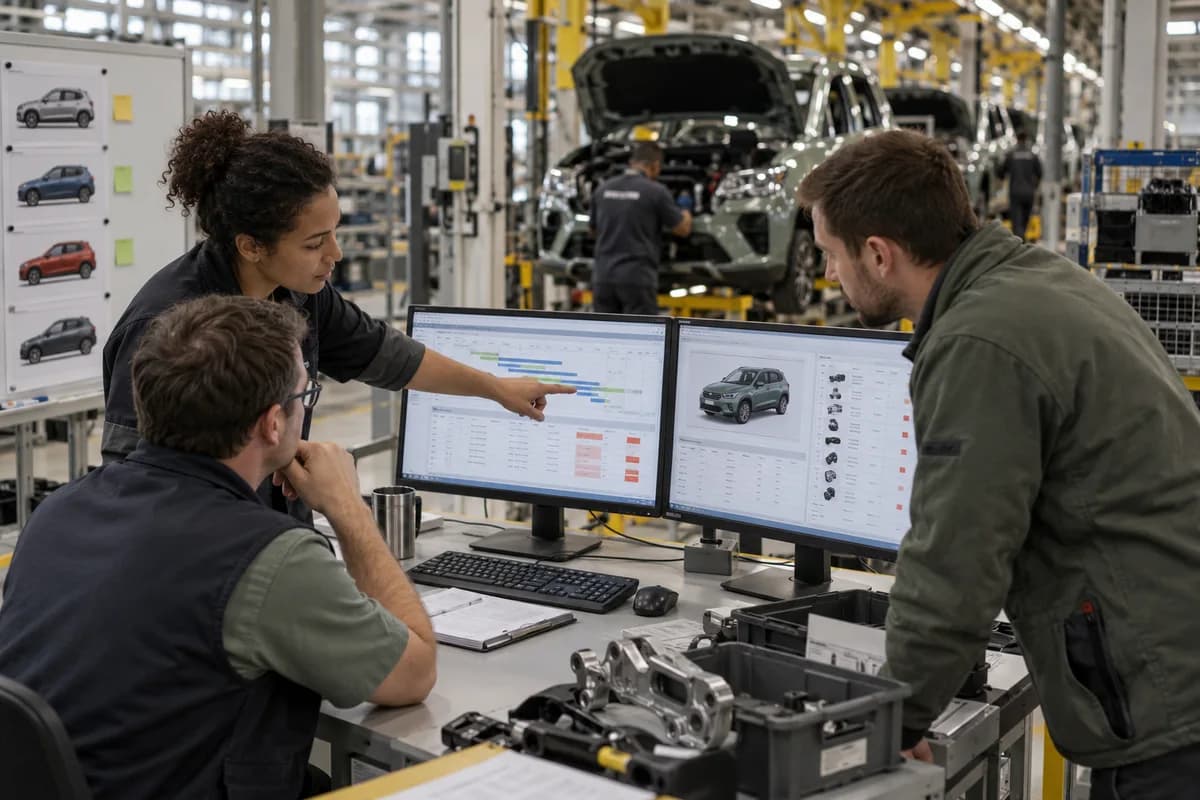
What a kit and a line-side bin record
Kitting records two kinds of thing. A kit is a set of parts for one unit at one station. A bin holds loose parts for a run of units. Four records describe them, and stores keeps all four. Each has a clear owner.
A shift on the line with kits and bins
Kitting is a daily rhythm between the stores and the stations. A storekeeper builds, a supervisor watches and an operator fits. These four moments show kitting at work. Each one keeps a station from waiting. Read them as one shift.
Who works from kits and what each person sees
Four roles live in the kitting record. Stores builds and issues. The line fits. Planning and quality watch from the side. Each sees the same kit through a different need, and none needs to phone another to ask.
Decisions to settle before kitting starts
Kitting copies the way your line already works, so a few choices come from you. Settle these four with stores and the line supervisors before the first live kit is issued. A short workshop is enough.
How kitting connects to the rest of the plant
Kitting sits between stores and the line, so it depends on both. It takes released lots from goods inward and gives parts to the stations that fit them. Here are the links a storekeeper uses. Each one is a record that kitting reads or writes.
- Variant bills decide which parts go into each kit
- Build orders release the unit that calls for a kit
- Goods inward supplies the released lots to draw from
- Station checks scan the part labels that kits carry
- Warranty and recall traceability joins kit lots to chassis numbers
Where kitting and line feed stop
Kitting tells stores what to issue and when a bin needs a refill. It does not move a trolley or drive a conveyor. Buying decisions, such as how much to order, stay with purchase and the buyer. Counting stock physically stays with stores. A garage building one kit car a month, with one team, can run on a stock sheet and a parts shelf.
Frequently asked questions
What triggers a refill of a line-side bin?
Stock in the bin falling to its minimum level triggers it. The refill is due from that point, before the bin runs out. Stores sees which bins are due. A box of M10 flange bolts is refilled in good time.
Which parts go in bins rather than kits?
You decide, station by station. Bulky or sequenced parts, such as seats and wheels, suit a kit. Small fixings, such as M10 flange bolts, suit a bin. The choice is recorded, so stores and the line follow one rule.
What if a part is short when a kit is due?
The shortage shows before release. The order waits, unless the planner accepts it knowingly. Stores and the station supervisor can then see which part is missing and for which unit. Nobody learns of it at the station.
Does a kit change when the engineering revision changes?
It follows the chassis number named in the change. Before that unit, the kit carries the old stabiliser bracket. From that unit, it carries the new one. The change names a unit, not a date. Stores and stations switch together.
Can the plant see which lot went into a kit?
Yes, each kit is drawn from released lots, and the lot is remembered. At the station, scanning the part label joins that lot to the chassis number. A recall query later starts from that lot.
How this feature fits the system.
Auto Manufacturer Management Software: the parts that work with this feature, the trades that use it and the ways to put it in place.
Variant parts master and bills of materials
Each model, trim, engine and market has its own bill, from subframe to wiper arm. A build order reads only the parts that its variant needs.
Bill of MaterialsBuild orders and slot planning
Dealer orders become build orders in weekly slots. Short axles, seats or glazing for a slot show before the order is released to stores.
Production PlanningStation checks and torque records
Each unit carries a work order through body shop, paint and trim lines. An operator closes a station only after its nutrunner checks are recorded.
Work Order ManagementTell us what you need.
Tell us what your team does today, where work gets stuck and what you want to change.
What happens after you share your requirements
- We review your brief and the systems you already use.
- We clarify the workflow, missing information and the work to consider first.
- The proposed scope sets out the deliverables, responsibilities and dependencies.
- Review the scope and commercial terms before deciding whether to proceed.
Start with your requirements
Describe your current process, the people involved and the change you need. Start with the details you know; we can clarify the rest together.
Share your requirements