Build orders and weekly slot planning for car makers
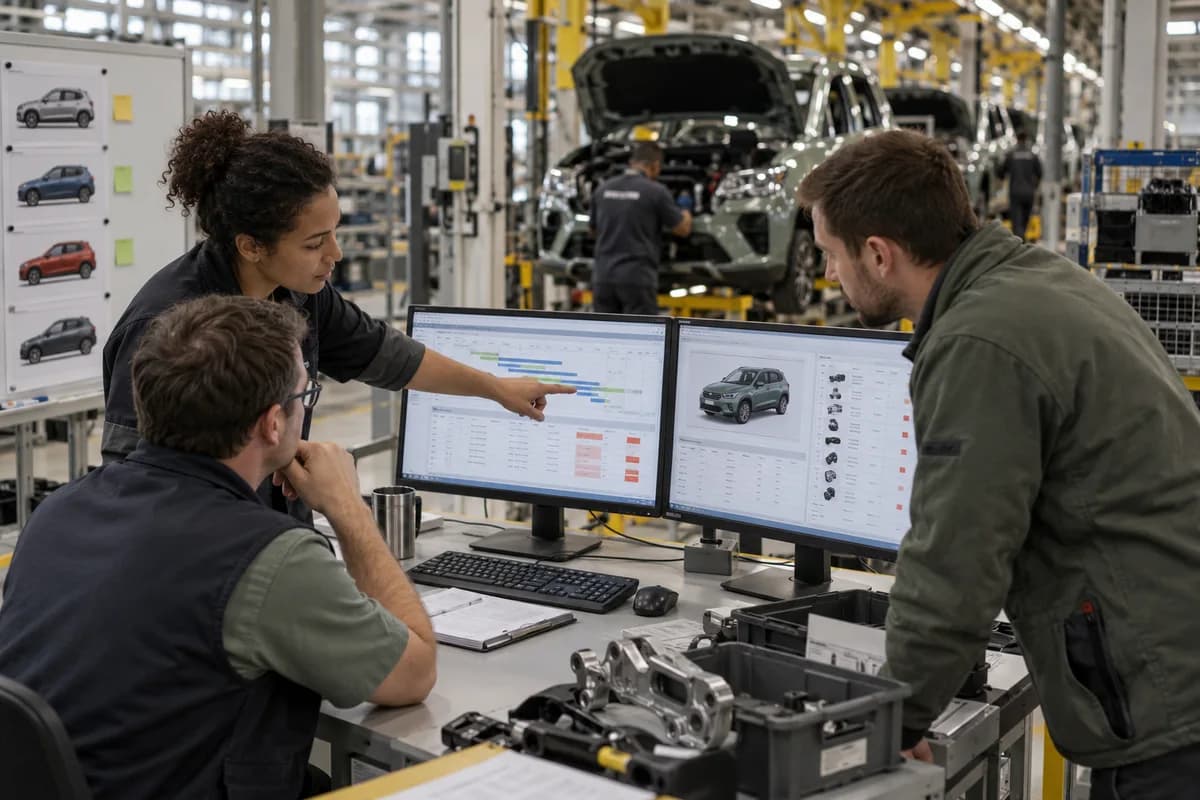
Build orders and slot planning turn dealer and fleet orders into units on the line. Orders are grouped by variant and market, placed in a weekly slot, and carries its colour and sunroof choice. Planners see short axles, seats, harnesses and glazing before release, while stores wait for the order to be released.
What a build order and its slot record
A build order is the plan for one unit. It starts as a dealer or fleet order and becomes a record that stores, the line and dispatch all follow. Four things sit on it from the start. Each is kept for that one unit.
A working week in vehicle planning
Planning sits between the sales desk and the shop floor. A week of it is mostly orders arriving, slots filling and shortages being argued over. These four moments show how the feature is used. Each is one person with one decision.
Who uses build orders and what each person sees
Four roles touch a build order. Each sees the same order through a different window. Planning writes it, and the others act on it. Here is what each person looks at first.
Decisions to settle before slot planning starts
Slot planning follows the rules of your plant. Write them down first. Settle these four with planning, stores and sales before the first live order is placed, and review them once the first slots are full.
How build orders connect to the plant
A build order reads the variant bill, asks stores for kits and ends as a unit awaiting a dealer. It touches nearly every other feature on its way. These are the hand-offs a planner relies on. Each one is a place where a missing record would stall an order.
- Variant bills tell the order which parts it needs
- Supplier schedules are set against the slot dates
- Station kitting issues kits once the order is released
- Goods inward adds the lots that clear a shortage
- Dealer allocation matches finished units back to the order
Where build order planning stops
Slot planning decides what is built and in which week. Running the line is a different job. Welding robots, paint booth conveyors and nutrunner controllers need programmable logic controller (PLC) and line control equipment, which this does not replace. Demand forecasting is not part of it, and prices and dealer terms stay with sales. A garage building one kit car a month can plan on a sheet.
Frequently asked questions
Can two orders for the same variant share a slot?
Yes, two orders can share a slot. Every order is its own record with its own colour and sunroof choice. A slot holds every order the line can take. The slot plan reads them together by variant, so crowding is easy to spot.
What does the planner see when a part is short?
Each order names the short part and the variant it affects. Shortages for the slot are counted before release. That gives a planner three choices. Move the order, chase purchase or accept the gap knowingly.
Can an order be released with a shortage?
Yes, if the planner accepts the shortage. The release is then a recorded choice. Stores and the line can see that the order went ahead short, and which part was missing when it was released.
Does it schedule the robots and conveyors?
No, it plans orders and weekly slots. Machine-level control of welding robots, paint booth conveyors and nutrunner controllers needs PLC and line control equipment. This system sits alongside that equipment and does not replace it.
How do dealer orders enter the system?
The sales desk keys them in. A link to your dealer ordering system can bring them in instead, if that link is scoped. Either way each order lands with its variant, market, colour and sunroof choice attached.
How this feature fits the system.
Auto Manufacturer Management Software: the parts that work with this feature, the trades that use it and the ways to put it in place.
Variant parts master and bills of materials
Each model, trim, engine and market has its own bill, from subframe to wiper arm. A build order reads only the parts that its variant needs.
Bill of MaterialsBuild orders and slot planning
Dealer orders become build orders in weekly slots. Short axles, seats or glazing for a slot show before the order is released to stores.
Production PlanningStation checks and torque records
Each unit carries a work order through body shop, paint and trim lines. An operator closes a station only after its nutrunner checks are recorded.
Work Order ManagementTell us what you need.
Tell us what your team does today, where work gets stuck and what you want to change.
What happens after you share your requirements
- We review your brief and the systems you already use.
- We clarify the workflow, missing information and the work to consider first.
- The proposed scope sets out the deliverables, responsibilities and dependencies.
- Review the scope and commercial terms before deciding whether to proceed.
Start with your requirements
Describe your current process, the people involved and the change you need. Start with the details you know; we can clarify the rest together.
Share your requirements