Engineering change control for vehicle assembly
Engineering change control takes a change to a part, such as a stabiliser bar bracket, through design, quality and purchase sign-off. That change names the chassis number from which it applies. Until every sign-off is recorded, it stays blocked from the line. Then stores and stations switch at the same unit.
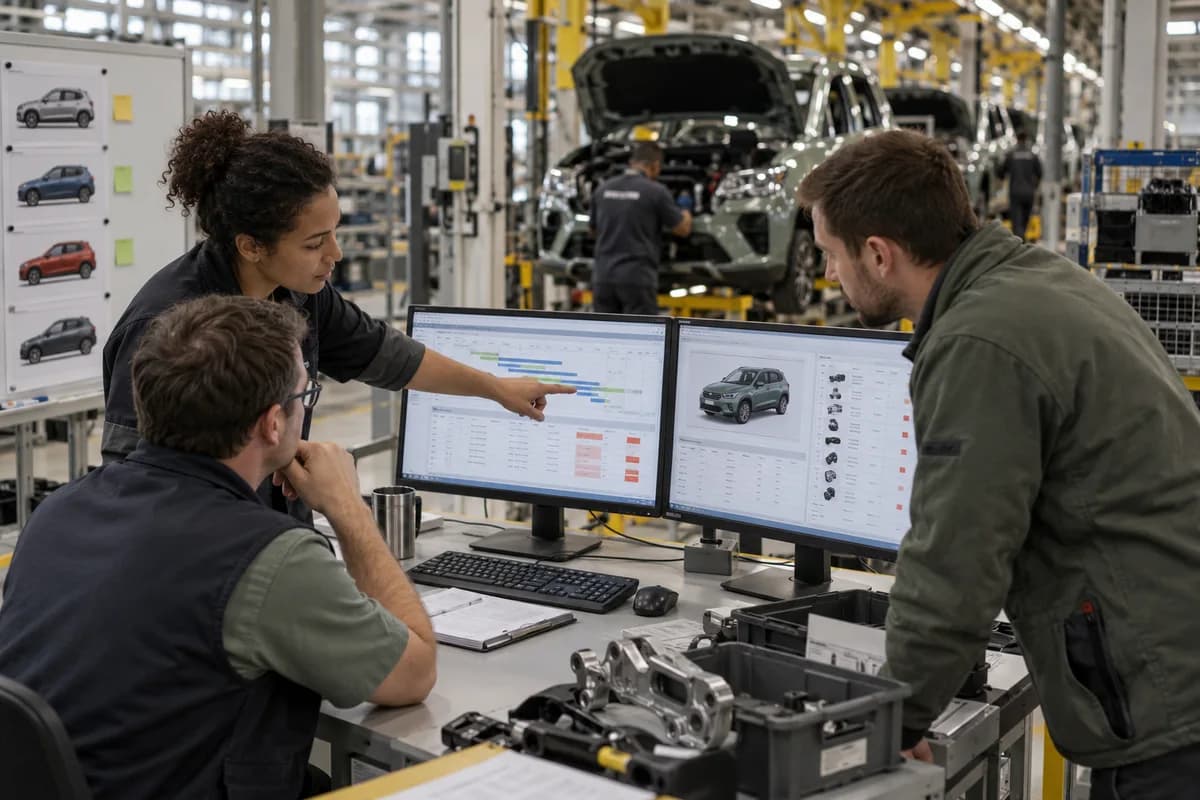
What an engineering change record keeps
A change is a record with an owner, a part and a start point. It does not move until it is signed. Four things sit on it, and together they tell stores and the line exactly what changes and when.
A change from request to first unit
Several hands handle a change before the first unit carries it. A designer raises it, two functions sign, planning picks the start unit and the line switches. These four moments follow one bracket. It travels from request to the first car.
Who works from a change and what each sees
A change touches a handful of roles, and each needs a different part of it. Planners need the start unit. Stores needs the bin. The line needs the instruction. Quality needs the sign-off and the trace.
Decisions to settle before change control starts
Change control is a rule about who may do what, so the plant must write the rule first. Agree these four with design, quality, purchase and planning before the first change is raised. Each takes a short meeting.
How change control connects to the plant
Each change reaches every place that uses the part. It starts in the parts master, passes through approval and then switches the kit and the instruction at one unit. These are the links a planner and a storekeeper rely on. Each is a record that follows the change.
- The variant parts master takes the new revision
- Station kitting changes the kit and bin at the start unit
- Station checks show the new instruction from that chassis number
- Supplier schedules and part approval carry the revised part’s sample
- Warranty and recall traceability records which units got which revision
Where engineering change control stops
Change control routes a change, records its sign-offs and sets the start unit. It does not design the part or judge whether the change is right. It is not a drawing system. It can link to one. Type approval and any regulatory conclusion stay with your compliance staff and an adviser. A garage building one kit car a month can use a drawing register.
Frequently asked questions
What stops old and new brackets mixing on the line?
The start chassis number. Earlier units are kitted with the old bracket, and later ones take the new bracket. Stores and stations switch together, so nobody on the shop floor has to guess which bin is current.
Can a change be approved but not yet applied?
Yes, once design, quality and purchase have signed, the change can wait for its start chassis number. Until a start unit is attached, the line carries on with the old revision. Stores keeps the old bin.
Who has to sign a change?
Three functions sign. Design, quality and purchase each add a name to the change record. Your plant may add a second signer for a safety part. Approval ends only when every required signature is present.
Does it connect to our drawing system?
Where your design and drawing revision system can be linked, it is connected during implementation. Otherwise the drawing is attached by hand. The link widens the scope. That link is quoted separately in the itemised quotation.
Can we see which cars carry which revision?
Yes, each unit’s chassis number sits against the start number of every change. A query about a revised driveshaft or bracket returns the units before the switch and the units after it. Both lists come from the record.
How this feature fits the system.
Auto Manufacturer Management Software: the parts that work with this feature, the trades that use it and the ways to put it in place.
Variant parts master and bills of materials
Each model, trim, engine and market has its own bill, from subframe to wiper arm. A build order reads only the parts that its variant needs.
Bill of MaterialsBuild orders and slot planning
Dealer orders become build orders in weekly slots. Short axles, seats or glazing for a slot show before the order is released to stores.
Production PlanningStation checks and torque records
Each unit carries a work order through body shop, paint and trim lines. An operator closes a station only after its nutrunner checks are recorded.
Work Order ManagementTell us what you need.
Tell us what your team does today, where work gets stuck and what you want to change.
What happens after you share your requirements
- We review your brief and the systems you already use.
- We clarify the workflow, missing information and the work to consider first.
- The proposed scope sets out the deliverables, responsibilities and dependencies.
- Review the scope and commercial terms before deciding whether to proceed.
Start with your requirements
Describe your current process, the people involved and the change you need. Start with the details you know; we can clarify the rest together.
Share your requirements