Chain of custody for environmental samples
Chain of custody records who held each environmental sample, from the moment of collection to the receipt desk. Samplers log time, place, preservative and condition on a tablet or phone, and every handover carries the names, the time and a signature. Receipt staff and reviewers can read the trail later.
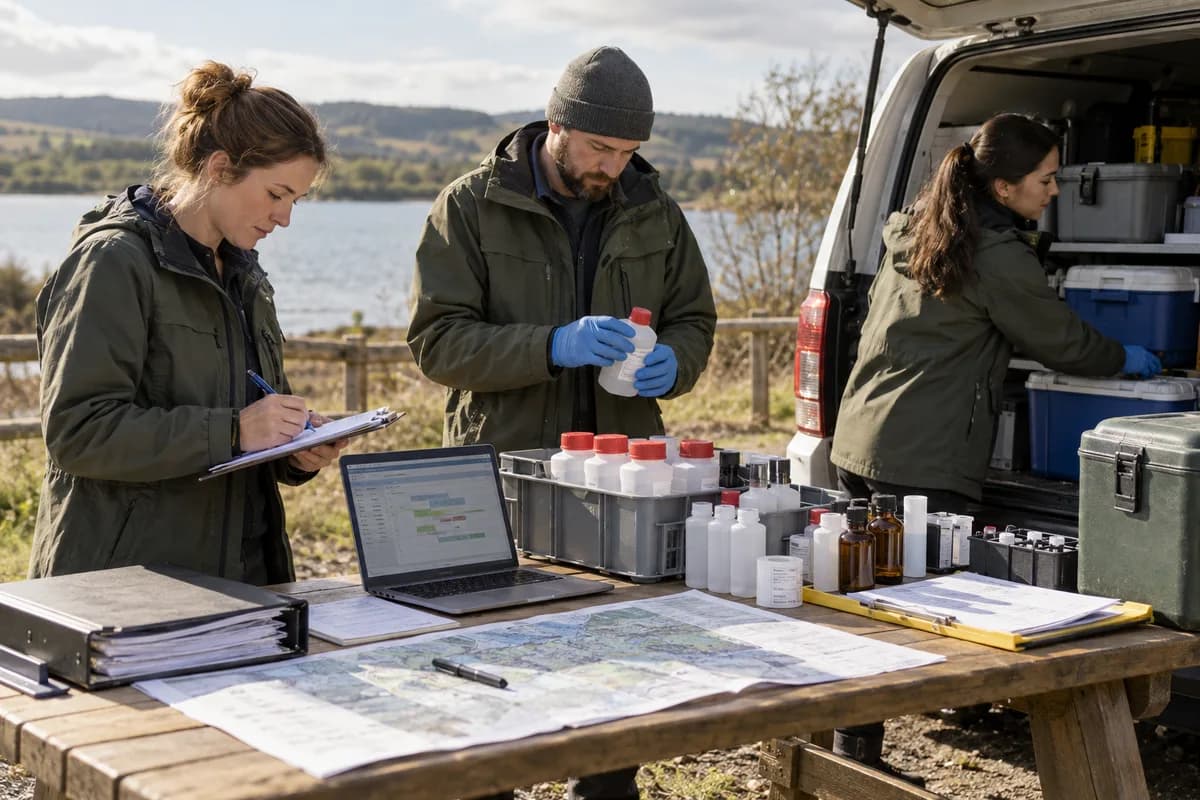
What the custody record captures for each sample
A custody record starts at the sampling point and ends at the receipt desk. It is built in the field, one entry at a time, and it stays attached to the sample through analysis and reporting. A gap is visible. It is not filled in later from memory.
A custody trail from riverbank to bench
Custody is easiest to follow as a journey. The moments below take one set of samples from the field to the receipt desk. Each one names the person holding the samples and the entry that person makes at that moment. Nothing waits for the office.
Who writes and who reads custody records
Custody is written by the people nearest the sample and read by the people furthest from it. Each adds or checks one part of the trail.
Decisions to settle before custody goes digital
Four decisions set how strict and how quick the custody record is. Settle them with the samplers, not only in the office. They know where a tablet is awkward to use. Samplers should be in the room.
How custody links to receipt and the bench
The custody record begins as a visit on the sampling schedule and ends when the receipt desk accepts the bottles. From there it stays on the sample record. Receipt adds its own checks, the batch picks up the laboratory number, and the certificate file can show the trail. Each step reads what came before.
- Starts from the visit on the sampling schedule
- Passes collection details to sample receipt and labelling
- Reads holding times from the test menu
- Supplies the trail to analytical batches
- Stays on the sample record for audit
Where chain of custody stops
Custody records what happened to a sample. It does not prove that a sample was representative, that a sampling method was followed or that a legal standard of evidence was met. Those questions stay with the laboratory’s procedures, the client and an adviser. Seals, locks and secure storage are physical controls handled by your staff. A single-site laboratory with one sampler can use a paper form.
Frequently asked questions
Can a custody entry be corrected after signing?
Your staff decide who may correct one. A correction carries the name of the person and the time, so the change can be questioned later. Samplers cannot quietly overwrite a colleague’s handover on the record.
What happens if a handover is missing?
The gap shows on the record. Receipt staff note it when they accept the samples, and the manager decides whether to test, flag the result or ask the client to resample. That decision stays with people.
Does custody cover samples sent to a partner laboratory?
Yes, as one more handover. The sample leaving is recorded with who sent it and when. What the partner does afterwards sits in its own records. The sample out and the report back are tracked under partner tests.
Can custody show the temperature of the cool box?
Receipt records the arrival temperature. If a sampler reads a temperature in the field, it can be entered as a condition note on the custody record. Continuous logging inside the box is not part of this feature.
Who can see the custody trail for a certificate?
Staff with access see the whole trail. It sits on the sample record. A client sees where a sample stands through its own login. Whether a client receives the full custody entries with the certificate is for the laboratory to set.
How this feature fits the system.
Environmental Testing Laboratory Management Software: the parts that work with this feature, the trades that use it and the ways to put it in place.
Sampling schedules
Each field round is placed against the samplers who will drive it, with the sites, bottle sets and visit dates visible to the whole team.
Technician SchedulingAnalytical batches and controls
Every sample receives a laboratory number and travels in a batch, so any result can be followed back to its bottle, analyst and run.
Batch and Serial TrackingSample receipt and labelling
Labels printed at the receipt desk carry the laboratory number for the bottle and each aliquot drawn from it.
Barcodes and LabelsTell us what you need.
Tell us what your team does today, where work gets stuck and what you want to change.
What happens after you share your requirements
- We review your brief and the systems you already use.
- We clarify the workflow, missing information and the work to consider first.
- The proposed scope sets out the deliverables, responsibilities and dependencies.
- Review the scope and commercial terms before deciding whether to proceed.
Start with your requirements
Describe your current process, the people involved and the change you need. Start with the details you know; we can clarify the rest together.
Share your requirements