Manama · CountriesManama’s banks, payment firms and advisers work under close regulation and short reporting cycles.
Manama has long been a Gulf banking centre. The Financial Harbour, Seef and the Diplomatic Area hold banks, insurers and advisers, while the old souq trades gold and textiles. Fintech firms test products under the central bank’s rules. Small companies here buy services from the whole region.
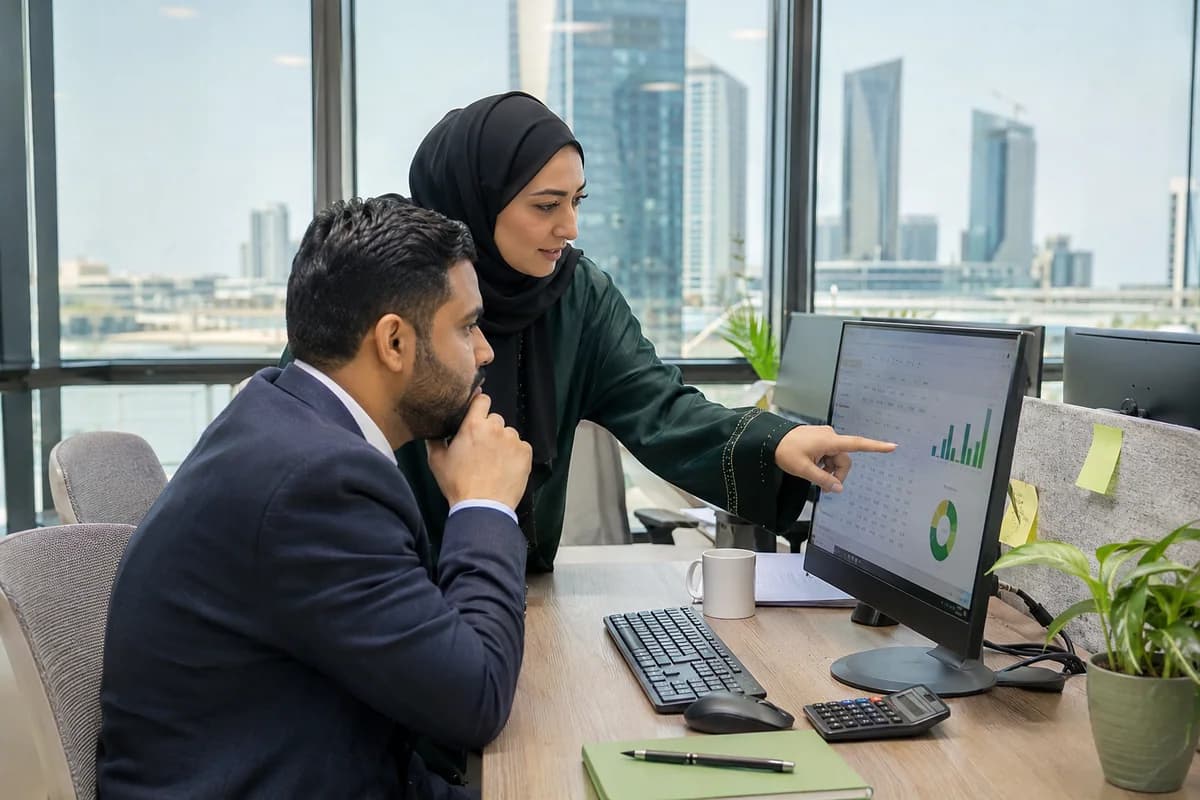
The island is small. Its firms sit close together. A bank, a law office, an audit firm and a payment start-up may share one tower in the Financial Harbour, so regulators are near and reports are frequent.
Seef holds malls, hotels and offices, and Juffair serves residents and visiting naval families with restaurants and shops, while Manama Souq keeps gold, cloth and household traders. Mina Salman and Khalifa Bin Salman Port handle cargo, Sitra holds workshops and industrial yards, and aluminium and petroleum products matter to the national economy, so smaller suppliers serve them. Paperwork runs in Arabic and English.
The districts, business parks and markets that matter in Manama.
How Manama businesses pick and use software.
Payment and lending firms must match every transaction to a ledger, and they want reconciliation reports that run each morning and list the exceptions.
Advisory and legal offices bill by time. They want timesheets, matters and invoices to reflect the same hours.
Where Manama businesses lose time and money.
Reconciliations take the first hour of every day
Bank files and ledger entries are compared by eye. A matching run lists only the items that do not agree.
Client files for compliance are scattered
Identity papers, forms and approvals sit in inboxes, and one client record with dated documents answers a reviewer quickly.
Hours worked are not billed in full
Time is remembered at week end and some is lost. Daily entry on a phone captures it.
Souq traders cannot see credit exposure
Dues are known by the owner alone. A statement per buyer with ageing lists the overdue.
What we would build for Manama businesses.
Usually in this order, starting with whatever the audit ranks first.
Cybersecurity and Application Security
Access, data exposure and recovery reviewed, including what happens when someone leaves or loses a device.
Learn moreAPI and System Integration
Connections between existing tools, with record ownership, duplicate handling and reconciliation agreed for each flow.
Learn moreSaaS Product Development
Turning a system that works for one business into a product other businesses can subscribe to.
Learn moreGlobal Compliance and Localisation
Software has to change for each country. Currency tables, VAT and sales tax codes, invoice layouts, translation files, storage regions and consent records are built as configuration that your team can edit without code changes. The legal question stays with your adviser.
Learn moreQA and Software Testing
Testing on the phones, browsers and patchy networks your customers and staff actually use.
Learn moreReady products that fit Manama businesses.
Each one is adapted to how your business works before it goes live, and anything your trade needs that it lacks is added then. You are not paying to build the basics again.
Payment Service Provider Management Software
Merchant onboarding, rate cards, settlement batches, reserves, refunds, partner reconciliation and chargeback handling for payment service providers.
Learn moreBank Reconciliation Software
Statement import, automated matching, part payments and bank charges, an exception list with reasons, month-end sign-off, the bank reconciliation statement and an audit trail.
Learn moreHow the work runs from Bengaluru for Manama.
- 1
The audit, by call
A screen-share and a look at the sheets, accounting reports and WhatsApp groups your team uses. No travel needed.
- 2
A written proposal
Scope, what we build first and the cost, agreed in writing before anything starts.
- 3
Build in short rounds
Working screens shared every few weeks. Your team tests them from your own office.
- 4
Go-live, in person when it helps
For data migration and training we can come to Manama. Travel is agreed in advance.
- 5
Support online
Fixes, changes and hosting handled remotely by the same team that built it.
The work we have published.
We don’t claim Manama clients we don’t have. These are systems our team built; the way we work is the same wherever you are.
PetSeva: matching owners to the right vet, at any hour
A two-sided veterinary platform where vets are searchable by specialisation and bookable outside clinic hours. It now carries more than 2,000 veterinary doctors.
Read the case study Paying guest accommodationSAM Atithi Pavathi: bed-level occupancy as the source of truth
PG management software where allocation, rates and invoices are derived from bed-level occupancy and not maintained in parallel spreadsheets.
Read the case study School transport servicesSAM Tours: school transport on a single ledger
Registration, fee collection, routing and finance write to the same records, closing the gap between journeys run and fees collected.
Read the case study Microfinance and Self Help GroupsVikasa RDO: making SHG loan recovery auditable
Loan proposals, recoveries and commissions sit on one record, with a person attached to every state change, so a business handling a bank’s money can show where each rupee went.
Read the case studyMake the scope specific to your business.
Work through a real example from your operation and agree the handoffs, controls and support the project needs.
Seef district
What becomes available when a booking is moved or cancelled?
Use “Seef district” to move a booking, then cancel a second example. Check the released slot, the person or resource still assigned, and any amount left to settle before accepting the revised schedule.
Background reading: ERPNext: appointment records
Questions Manama owners ask before they call.
Can software be built for a fintech that must satisfy the central bank?
The software follows the rules your compliance officer sets out, and audit logs run from the first release. Licensing and regulator talks remain with you and your advisers.
Where is our data kept?
We agree the hosting region with you at the start and write it down, and some clients ask for in-country hosting, so we plan for that.
What happens after I share my requirements?
We review your brief and clarify the work with you. We then look at the software, spreadsheets and WhatsApp groups your business runs on today and write down what works, what slows your team down and what is missing. A demo login, a screen-share or a few screenshots are enough. You get a short written summary ordered by priority, with no obligation to hire us afterwards.
How much will the software cost?
We don’t publish a price, because it depends on what the system has to do. That first review settles the scope, and the cost goes into a written proposal before any work starts.
Industries we build for in Manama.
Elsewhere in Bahrain.
Tell us what your Manama business runs on today.
Send a short note on the spreadsheets, software or WhatsApp groups your team depends on. We reply the same working day.
What happens after you share your requirements
- We review your brief and the systems you already use.
- We clarify the workflow, missing information and the work to consider first.
- The proposed scope sets out the deliverables, responsibilities and dependencies.
- Review the scope and commercial terms before deciding whether to proceed.
Start with your requirements
Describe your current process, the people involved and the change you need. Start with the details you know; we can clarify the rest together.
Share your requirements