Job cards, bays, spares and coupon services.
Each bike has one record. The job card carries the registration number, engine and chassis number, odometer reading, rider complaint, approved estimate, parts fitted and the mechanic who turned the spanner. Counter sales, coupon services, pickup rounds and reminders connect to that card, so the advisor, the mechanics and the cashier read one story.
- Labour rates and packages entered as you quote
- Rider list, registration numbers and open balances migrated
- Gate checklist and reminders worded with your head mechanic
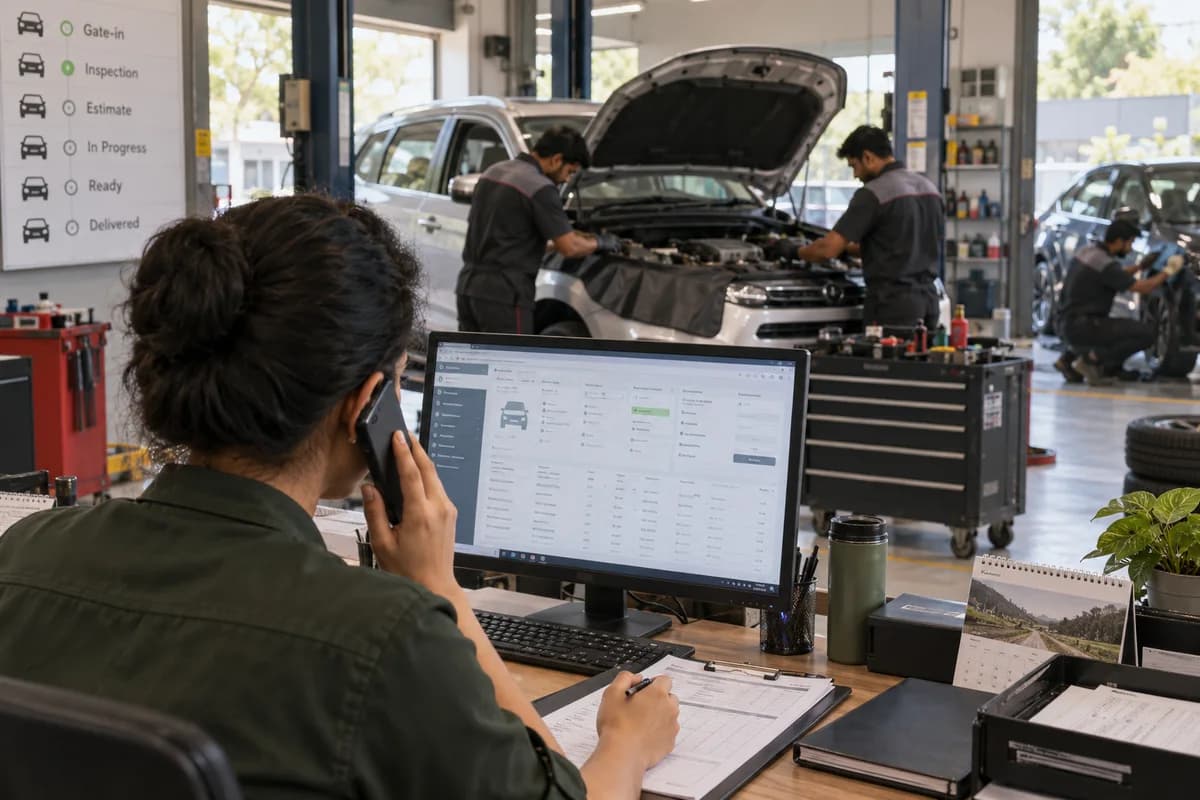
Bike Service Workshop Management Software starts at the gate and follows a bike through inspection, bay work, spares and billing. A history is kept under the registration number, with odometer readings, parts fitted and every line the rider approved, while maker coupon visits are listed apart from paid jobs. Service reminders reach the rider ahead of the due date.
What goes wrong before the software.
How the work flows through it, step by step.
- 1
Gate and job card
The rider arrives and the advisor opens a card. Odometer and fuel level are noted, and the complaint is recorded with any scratches, loose mirrors or accessories seen at the gate, so no later argument starts from nothing.
- 2
Inspection and estimate
The mechanic records what the lift shows, such as chain slack, worn tyres and thin brake shoes, and the estimate then adds labour rates and the parts needed. It goes to the rider for approval by message or call, with the time noted.
- 3
Bay and repair
The card goes to a bay and a mechanic. Spares are issued to it from the counter, and extra work found on the lift is added as a separate line that needs its own yes from the rider.
- 4
Wash and ride test
The bike is washed and test ridden. The tester notes the result on the card, and the advisor checks it against the complaint before calling the rider, so a returning noise is caught in the yard.
- 5
Billing and delivery
The bill is printed straight from the job card, with labour, spares and engine oil each on a line of their own. Payment is posted. The bike leaves.
- 6
Reminder and follow-up
A reminder goes out as the next service nears. Free coupon visits drop onto the manufacturer claim list as they are closed, so the month-end claim is raised from that list and nobody tallies coupon numbers from paper.
What is inside.
Every module can be switched on, left out or changed to match how your team already works.
The business modules it is built from.
Each one is also available on its own, or inside a system built for you.
- Job Cards
The card holds registration, odometer, complaint and gate checklist, and every part and labour line is added to it as the mechanic works.
- Estimate/Quotation Management
Estimates are priced from the workshop’s own labour rates and spares list, and extra work found on the lift needs its own recorded yes.
- Technician Scheduling
Each card sits in a bay with a named mechanic, and the board shows whether the bike waits for a part, a wash or an approval.
- Stock Tracking and Alerts
Chain sets, pads, plugs, filters and oil are tracked by size or litre, issued to cards or counter sales, and flagged when low.
- Service Reminders
A reminder is scheduled from the last logged odometer reading and the service date, then sent to the rider before the next service falls due.
- Invoice Management
An invoice is raised straight from the closed card, with labour, parts and oil as separate lines, and payment is posted against it.
- AMC and Service Contracts
Coupon services and prepaid service plans are held per bike with their intervals, so what is still owed to the rider stays visible.
How we would put it in.
Setup, data migration, integrations and anything built on top.
Every part of the system, by area.
Take the modules you need. Each one works on its own or inside a larger system built for you.
- Applicant Tracking (5)
- CRM (8)
- Finance & Accounting (10)
- Helpdesk (4)
- Human Resources (13)
- Inventory Management (5)
- Project Management (7)
- Manufacturing (6)
- Procurement (4)
- Sales and Distribution (6)
- Field Service (5)
- Statutory and Compliance (4)
- Retail and POS (4)
- Bookings and Appointments (3)
- Subscriptions (2)
- Assets and Fleet (4)
- Platform (6)
- Analytics (2)
- Documents (1)
- All business solutions
One system, each person sees their part.
Owner’s view
Read bikes in the shop, coupon claims pending, spares below reorder level and takings by day, then see which mechanic closed how many cards. One bay may sit idle waiting for a rider’s reply.
Service advisors
Open cards at the gate and quote the rider. Approvals are recorded, a call goes out when the bike is ready, and a rider’s earlier visits sit beside the new card, so nothing is promised from memory.
Mechanics
Your bay’s bikes show with complaint and parts issued. Add findings from the lift, then mark the job ready for wash once the torque wrench is back on the board and the chain is set.
Parts counter
Issue parts to cards, sell over the counter and receive stock from the dealer, with low sizes of chain, pads and oil together on one list. A single call to the dealer covers them all.
Cashier’s desk
Raise the invoice from the card. The takings sheet for the day matches the cards closed, so any gap is visible before the shutter comes down.
The numbers the owner asks for.
- Bikes in the shop by bay and waiting reason
- Coupon services by interval, with claim status per maker
- Estimate approvals pending, with the age of each request
- Spares issued per job card against counter sales
- Labour hours billed per mechanic per week
- Riders overdue for service by date and by odometer reading, with phone number and last mechanic
- Pickup rounds by rider with return times
Who this is built for.
- Authorised and independent motorcycle service centres
- Scooter and moped workshops that also sell oil and spares over a parts counter
- Workshops that handle both petrol and electric two-wheelers
- Dealer service bays running coupon services for one maker
- Multi-branch bike service chains with a common rider list
When it is not the right choice.
- A one-person roadside mechanic who repairs a few punctures a day can work from a notebook, because nothing here would be used.
- A garage whose bays hold only cars and light vans, with no motorcycle or scooter trade at all, is better served by Garage Management Software.
Adapted to your business before it goes live.
You are not handed a login and left to it. The product is set up around your records, your people and the tools you already use.
Works alongside
- SMS
- Card and wallet payments
- Accounting export
Questions owners ask before a demo.
Does it cover scooters and electric two-wheelers?
Yes. Make, model and fuel type sit on every card, so an electric scooter’s card can hold battery and charger notes where a petrol bike holds oil and plugs. Checklists are set with your head mechanic.
How does it deal with free service coupons?
Each coupon service is marked with its number and interval, and those cards total apart from paid work while claim status is tracked per bike. Your dealer contact agrees the format a maker expects.
Can an estimate be approved by the rider on a phone?
Yes. The estimate goes out by message and the rider’s reply is recorded on the card with the time, and the advisor can note a phone call in the same place.
How are spares tied to a job?
A part is issued to a job card or sold at the counter, and each issue lowers stock for its size or grade. Oil sold by the litre is handled in litres. A returned part is credited back to stock.
Will the pickup rider see the round on a phone?
Yes. The pickup rider sees each address and bike. Collection and return are marked on the phone. The office can read where every bike stands.
Do reminders depend on the date or the odometer?
Both. A reminder can be set for a date, for a distance since the last logged reading, or for whichever comes first. The wording is your own. Chosen riders can be skipped.
Can we move our existing rider list?
Yes. Riders, phones and plates come in from a sheet. Your office compares a sample of cards with the paper ones before going live, and open balances are checked rider by rider.
What happens if the workshop has more than one branch?
Each branch runs its own bays and counter. The rider list and bike histories are shared, so a bike serviced at one branch is known at another, and a coupon visit is never claimed twice.
What does it cost?
Branches and users decide most of it, since a small workshop and a chain with a central spares store need different set-up. Bays, the coupon rules for each maker, and the pickup rounds also count. Moving the rider list in adds work. The quotation comes after the counter has been observed, and prices each part separately.
Can invoices go to our bookkeeper?
Yes. Invoices, receipts and balances export for your accountant. The export layout is agreed in the first workshop and written into the quotation as its own item.
How long until the workshop is writing job cards on it?
Rider volume and the number of bays set the pace. The workshop would start on bike and rider records, job cards with the gate inspection, estimates with approvals, and the bay board. Spares counter, coupon log, pickup rounds and reminders join later. Dates for each step are set in your proposal.
What does the workshop need to hand at the outset?
Pull together the rider and registration list, labour rates, service packages, the gate checklist and the spares stock sheet. Sample job cards, estimates, coupon claims and invoices let us shape the screens. Advisors, mechanics, the parts counter and the cashier each need a single contact for queries and checking screens.
Wondering what it would cost? Share your requirements and an engineer will come back with a scope.
Built for.
The trades this product is set up for. Pick yours to see how the work runs there.
Related products.
See Bike Service Workshop Management Software set up around your records.
Tell us how you run things today. An engineer reads it and writes back with what fits as it is, what would need changing, and what we would start with.
What happens after you share your requirements
- A senior engineer reads your answers. Nobody phones first.
- Within one business day you get a written note: what we understood, what we would start with, and the questions we still have.
- If it fits, a proposal follows with the order of work, what we need from you and what you receive at each step.
- No call is booked and nothing is paid until you have read the note. Your details stay with us.
Start with your requirements
Seven short steps that tell us what you need. A senior engineer reads them before anyone gets in touch.
Share your requirements