Clinic accounts and price lists for an orthotics laboratory
Clinic accounts and price lists give an orthotics laboratory one record for every clinic, podiatrist and delivery address. Each account holds its price for every device type, its discount and its payment terms. The order desk, the invoice clerk and the owner read the same figures. A new clinic is a single form.
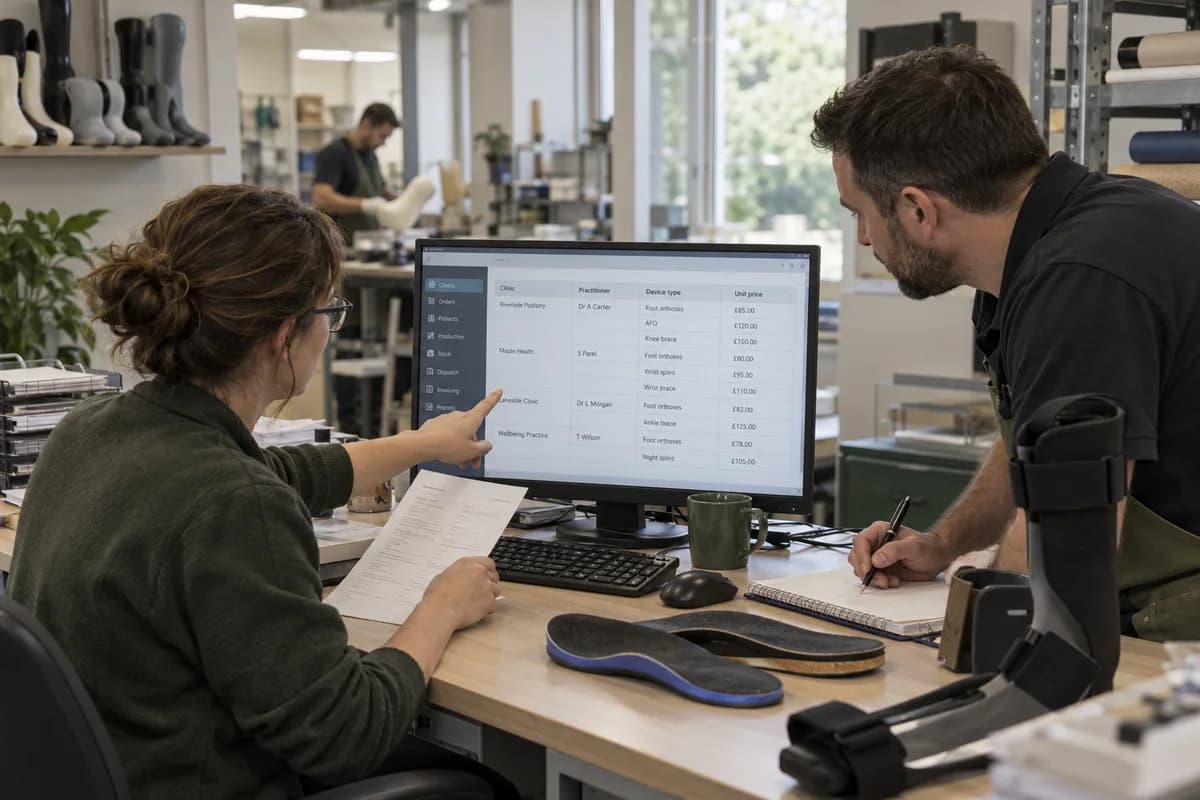
What each orthotics clinic account records
An account is more than a name. In an orthotics laboratory it carries the agreed price of each device, the terms that clinic pays on and every place a parcel may go. Staff read it before they quote, raise an order or send a statement.
A week of clinic accounts at the laboratory
Clinic accounts are opened, read and corrected at small moments through a working week. Each moment below belongs to one person in the laboratory. None needs a spreadsheet, and none leaves a price to memory or to a half-remembered email. Four of them follow.
Who reads clinic accounts and what they see
Each person opens the same account but meets a different part of it. The laboratory decides which parts when GullySystem sets the product up. Four roles follow. Each has its own view of a clinic.
Decisions to settle before clinic accounts go live
A few choices shape how accounts behave, and they are easier to settle before the first record than after the hundredth. GullySystem enters the answers when it sets up the laboratory. Bring the four below to the first meeting.
How clinic accounts feed orders and billing
Here is the first record in the chain, and other features read from it. A prescription order takes its clinic and podiatrist from the account. An invoice takes the price, discount and terms. A statement ages the balance by those terms. The portal opens onto the same account.
- Prescription orders take clinic and podiatrist from the account
- Invoices read device price and discount line by line
- Statements age balances using the stored payment terms
- Clinic ordering portal logins attach to the same account
- Dispatch picks a delivery address from the account
Where clinic accounts stop in an orthotics laboratory
Accounts store agreements. They do not make them. Prices and discounts are the owner’s commercial decisions, and the accountant decides how a late payment or a write-off is treated in the books. A laboratory with a few clinics on one shared price list can keep them in a spreadsheet. The case for a system begins when the list grows or the terms start to differ.
Frequently asked questions
Can one clinic have several podiatrists and addresses?
One account covers them all. The clinic holds each podiatrist who sends prescriptions and each delivery address. Orders bill to the clinic, the prescription names the podiatrist, and the parcel goes to the address picked at dispatch.
What if two clinics share the same price list?
Each clinic still has its own account. Enter the same prices on both at set-up. When one agreement changes later, edit that clinic alone, and the other stays exactly as agreed. Neither account disturbs the other.
Can a clinic’s discount differ from its price list?
The discount is held beside the prices, as a separate figure on the account. Both are visible together. List prices can stand while a discount sits on top. The invoice shows how they combine for each device, so the desk can explain every line.
How do we handle a clinic that changes its name?
Edit the trading name on the existing account. Orders and invoices stay attached to the same record, so the clinic’s history stays whole. Keep a note of the former name if the desk still hears it on calls.
Do clinics see their own price list?
In the ordering portal a clinic sees only its own patients’ devices and prices. Other clinics stay out of view. You decide which prices appear. Anything further comes from the order desk, which holds the full agreement and can quote it.
How this feature fits the system.
Orthotics Manufacturing Management Software: the parts that work with this feature, the trades that use it and the ways to put it in place.
Clinic accounts and price lists
Each clinic and podiatrist is a separate record, so a device is billed to the right account at that clinic’s agreed price.
Contact & Account ManagementPrescription orders
Every prescription becomes a numbered order from receipt to dispatch, with scans and clinical notes attached and its status visible to the order desk.
Order ManagementDevice specifications and bills of materials
Each device type lists its blank, sheet, cover, strap and adhesive quantities, so a work order reserves the right material without retyping.
Bill of MaterialsTell us what you need.
Tell us what your team does today, where work gets stuck and what you want to change.
What happens after you share your requirements
- We review your brief and the systems you already use.
- We clarify the workflow, missing information and the work to consider first.
- The proposed scope sets out the deliverables, responsibilities and dependencies.
- Review the scope and commercial terms before deciding whether to proceed.
Start with your requirements
Describe your current process, the people involved and the change you need. Start with the details you know; we can clarify the rest together.
Share your requirements