Abidjan · CountriesAbidjan is the lagoon port where Ivorian cocoa, cashew and rubber are traded, processed and shipped.
Abidjan spreads around a lagoon on the Gulf of Guinea. Its port serves the whole region. Exporters, grinders, forwarders and food factories fill the industrial zones along the water, and the firms among them write in French and bill in CFA francs. Our Bengaluru desks write the stock and export-paper software they use.
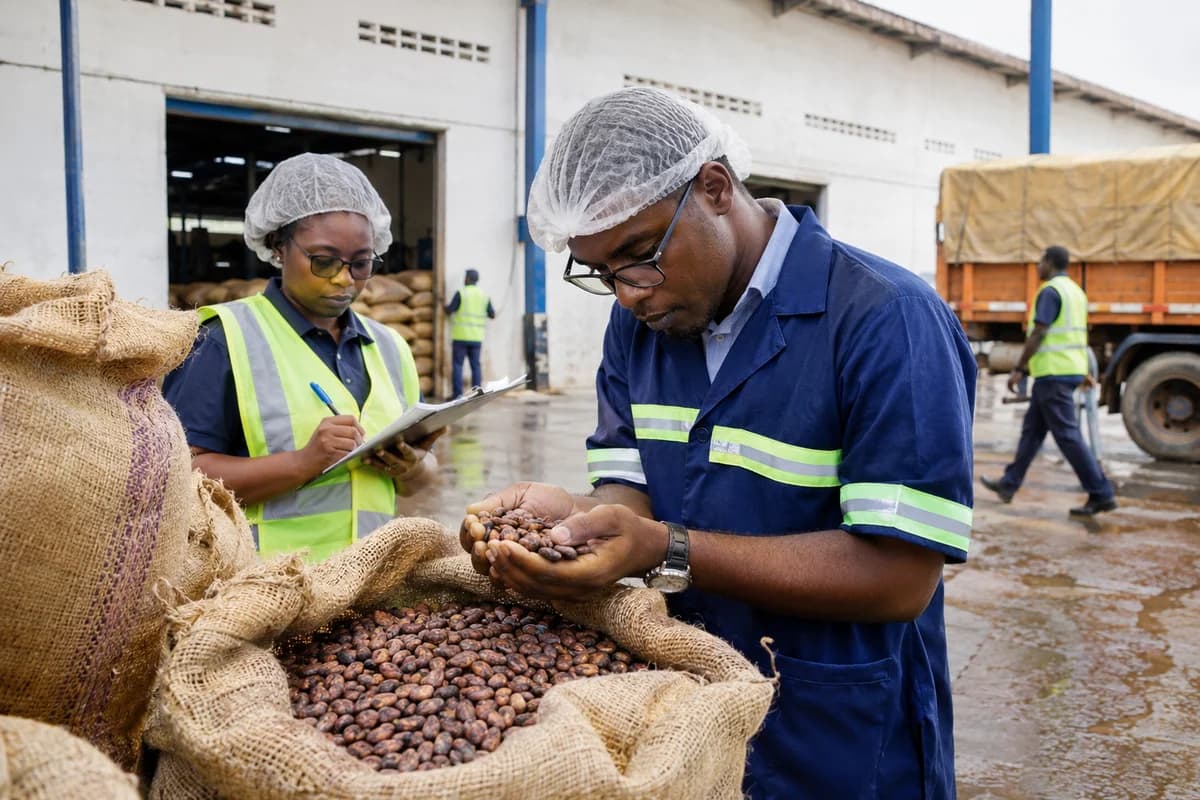
Trucks arrive from the interior. Cocoa, cashew and rubber ride in the back, and each load must show weight, grade and papers that match the shipping line’s booking before the port gate lets it through.
We sit in Nagarbhavi, hours ahead of the lagoon. No one on our staff has moved to the city. We read a message sent before your lunch in our afternoon. Cocoa leaves from here. A bag that misses its weighing slot at the port waits for the next one. The exporter who cannot show the lot, the grade and the buyer on one sheet loses a day arguing over it. Lagoon traffic slows every crossing. A trader who books a truck, a bonded stack and a shipping line separately has three confirmations to chase before the lot can move.
The districts, business parks and markets that matter in Abidjan.
How Abidjan businesses pick and use software.
Export traders and forwarders who must tie bags, containers and shipping papers together for every consignment.
Food makers and distributors who buy raw material in bulk and sell small packs to shops across the country.
Where Abidjan businesses lose time and money.
A container leaves with the wrong paper
Lot numbers on the booking, the weighbridge slip and the invoice come from three different people. Retyping one by hand plants an error. It surfaces at the quay, where each day of delay is charged.
Prices move between purchase and sale
A trader pays growers in francs. The buyer abroad pays in dollars. Between the two payments the rate moves, so a margin that looked fair at purchase can shrink by the time the cargo is invoiced. Each side is stored with its own rate.
Shops owe money for months
A distributor sells on credit and keeps the balances in one ledger. A statement for each shop, sent on a fixed day every month, brings old debts into view before they turn into arguments.
What we would build for Abidjan businesses.
Usually in this order, starting with whatever the audit ranks first.
ERP, CRM and Business Software Implementation
One record of stock, orders, customers and accounts, set up so your team opens it every day.
Learn moreGlobal Compliance and Localisation
Software has to change for each country. Currency tables, VAT and sales tax codes, invoice layouts, translation files, storage regions and consent records are built as configuration that your team can edit without code changes. The legal question stays with your adviser.
Learn moreAPI and System Integration
Connections between existing tools, with record ownership, duplicate handling and reconciliation agreed for each flow.
Learn moreReady products that fit Abidjan businesses.
Each one is adapted to how your business works before it goes live, and anything your trade needs that it lacks is added then. You are not paying to build the basics again.
Freight Forwarder Management Software
Rate sheets, quotations, job files, house bill drafts, milestones, buying and selling charges, vendor bills and agent statements for freight forwarders.
Learn moreFood Ingredient Manufacturer Management Software
Sample requests, customer formulations, specifications, blend batches, laboratory results, certificates of analysis and shipments for food ingredient makers.
Learn morePlantation Company Management Software
Field blocks, weighment, muster, piece-rate wages, agrochemical store, factory lots and sale contracts for tea, coffee and rubber plantation companies.
Learn moreHow the work runs from Bengaluru for Abidjan.
- 1
The audit, by call
A screen-share and a look at the sheets, accounting reports and WhatsApp groups your team uses. No travel needed.
- 2
A written proposal
Scope, what we build first and the cost, agreed in writing before anything starts.
- 3
Build in short rounds
Working screens shared every few weeks. Your team tests them from your own office.
- 4
Go-live, in person when it helps
For data migration and training we can come to Abidjan. Travel is agreed in advance.
- 5
Support online
Fixes, changes and hosting handled remotely by the same team that built it.
The work we have published.
We don’t claim Abidjan clients we don’t have. These are systems our team built; the way we work is the same wherever you are.
PetSeva: matching owners to the right vet, at any hour
A two-sided veterinary platform where vets are searchable by specialisation and bookable outside clinic hours. It now carries more than 2,000 veterinary doctors.
Read the case study Paying guest accommodationSAM Atithi Pavathi: bed-level occupancy as the source of truth
PG management software where allocation, rates and invoices are derived from bed-level occupancy and not maintained in parallel spreadsheets.
Read the case study School transport servicesSAM Tours: school transport on a single ledger
Registration, fee collection, routing and finance write to the same records, closing the gap between journeys run and fees collected.
Read the case study Microfinance and Self Help GroupsVikasa RDO: making SHG loan recovery auditable
Loan proposals, recoveries and commissions sit on one record, with a person attached to every state change, so a business handling a bank’s money can show where each rupee went.
Read the case studyMake the scope specific to your business.
Work through a real example from your operation and agree the handoffs, controls and support the project needs.
A container leaves with the wrong paper
Which observation would change the proposed scope?
For “A container leaves with the wrong paper”, observe someone completing the task with a representative example. Record where they stop, ask another person or re-enter information, then choose the smallest change whose result the team can verify.
Background reading: GOV.UK: researching user needs
Questions Abidjan owners ask before they call.
Can an Abidjan exporter keep lot numbers from weighbridge to invoice?
Yes. A lot number keyed at the weighbridge follows the cargo to the packing list, the booking sheet and the invoice, so the exporter, forwarder and shipping line read one figure.
Can the paperwork be printed in French?
Yes. Delivery notes, packing lists and invoices print in French, English or both. Switching takes one click.
What happens after I share my requirements?
We review your brief and clarify the work with you. We then look at the software, spreadsheets and WhatsApp groups your business runs on today and write down what works, what slows your team down and what is missing. A demo login, a screen-share or a few screenshots are enough. You get a short written summary ordered by priority, with no obligation to hire us afterwards.
How much will the software cost?
We don’t publish a price, because it depends on what the system has to do. That first review settles the scope, and the cost goes into a written proposal before any work starts.
Industries we build for in Abidjan.
Elsewhere in Ivory Coast.
Tell us what your Abidjan business runs on today.
Send a short note on the spreadsheets, software or WhatsApp groups your team depends on. We reply the same working day.
What happens after you share your requirements
- We review your brief and the systems you already use.
- We clarify the workflow, missing information and the work to consider first.
- The proposed scope sets out the deliverables, responsibilities and dependencies.
- Review the scope and commercial terms before deciding whether to proceed.
Start with your requirements
Describe your current process, the people involved and the change you need. Start with the details you know; we can clarify the rest together.
Share your requirements