Stock, export and field software for Ivorian cocoa, cashew, rubber and port businesses, supported from Bengaluru.
Ivory Coast grows cocoa, coffee, cashew, rubber and palm oil, and most of it leaves through the port of Abidjan. Business speaks French. Prices are set in CFA francs, and export deals are written in dollars or euros. Our team in Bengaluru builds stock, trip and export-paper software for the exporters, processors and hauliers in between.
Working with a team in India from Ivory Coast.
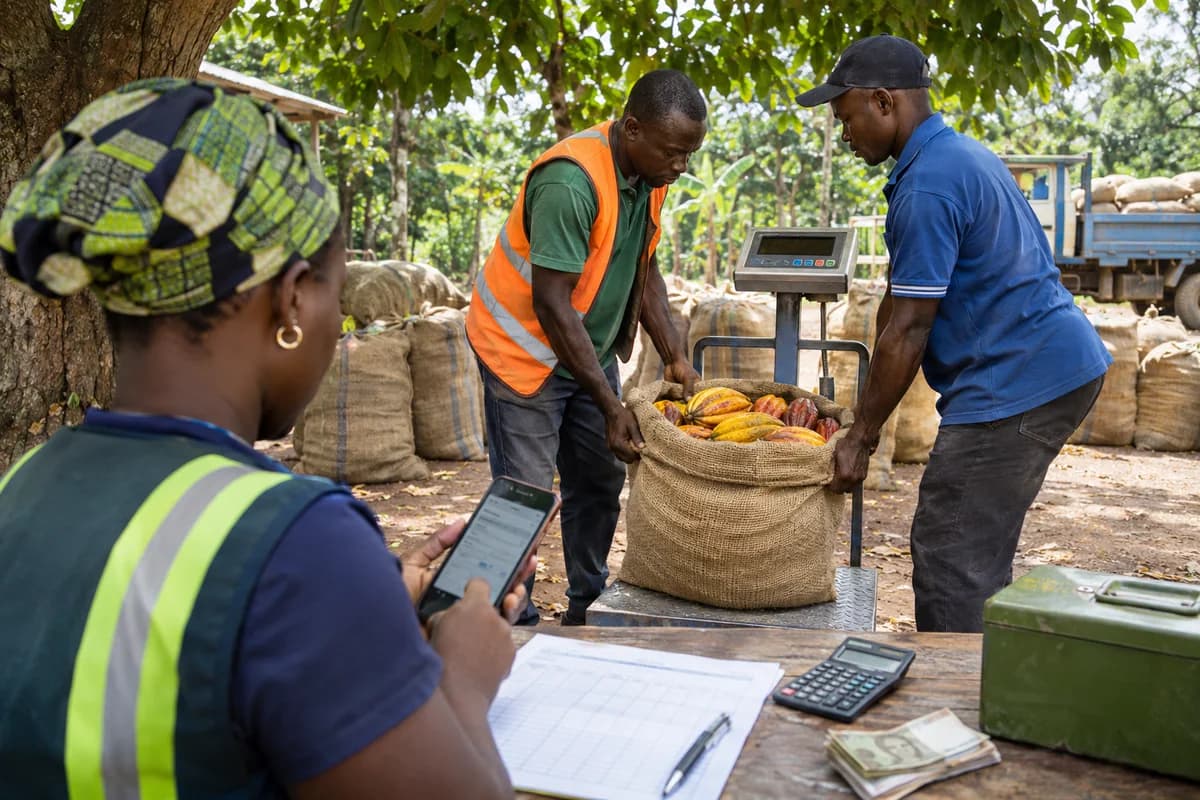
Crops come out of the ground in thousands of small lots. A buyer at a village collection point weighs the bags, pays the growers in cash or by mobile money, and sends a truck to a warehouse near the coast. The weights must still agree when the cargo reaches the quay. Few do.
Nobody of ours is posted in the country. The work is done in Nagarbhavi, Bengaluru. We have no Ivorian customers or partners to name. Each quote starts by saying so, because a firm choosing software from a distance deserves to hear it before anything else.
What changes when your business is in Ivory Coast.
Hours, money, language and data are decided with you at the start, not discovered later.
What the software has to fit.
The filing cycles, payment habits and licences a small business there already works around.
Trades we write for in Ivory Coast.
Products that fit them.
Capabilities often asked for.
Cities we write software for in Ivory Coast.
What we would build for Ivory Coast businesses.
Usually in this order, starting with whatever the audit ranks first.
ERP, CRM and Business Software Implementation
One record of stock, orders, customers and accounts, set up so your team opens it every day.
Learn moreGlobal Compliance and Localisation
Software has to change for each country. Currency tables, VAT and sales tax codes, invoice layouts, translation files, storage regions and consent records are built as configuration that your team can edit without code changes. The legal question stays with your adviser.
Learn moreWeb and Mobile Application Development
Web and mobile apps for customers, field staff and dealers, built to work on ordinary phones.
Learn moreAPI and System Integration
Connections between existing tools, with record ownership, duplicate handling and reconciliation agreed for each flow.
Learn moreMake the scope specific to your business.
Work through a real example from your operation and agree the handoffs, controls and support the project needs.
Electronic invoices and TVA
Can you explain the balance from its original documents?
Select a partly settled example in “Electronic invoices and TVA”. Ask for the invoice, allocated receipts and remaining balance to be shown together before agreeing the opening figures.
Background reading: ERPNext: outstanding invoices
Questions from businesses in Ivory Coast.
Is there a team in Ivory Coast?
No. All our people sit in Bengaluru. When a task needs someone on your premises, we tell you at the first call and do not promise it.
Can invoices and delivery notes be printed in French?
Yes. They print in French, English or both. A French reader at your firm should check every trade term and unit of weight on a sample before the first live run goes to a customer.
Does the phone app work where the signal is weak?
Yes. It stores weighing entries on the handset and sends them when the signal returns, so a buyer at a remote collection point can keep working all day without a signal.
Can the software feed the tax directorate’s electronic invoice system?
We can send the data once your accountant gives us the layout and the access details. Tax rulings remain theirs.
Can one report show cocoa bought in francs and sold in dollars?
Yes. Each lot keeps the rate of its purchase and the rate of its sale. The margin is shown in the currency you choose.
Tell us what you run.
Share your requirements and an engineer will read them before getting in touch, at an hour that suits your day.
What happens after you share your requirements
- We review your brief and the systems you already use.
- We clarify the workflow, missing information and the work to consider first.
- The proposed scope sets out the deliverables, responsibilities and dependencies.
- Review the scope and commercial terms before deciding whether to proceed.
Start with your requirements
Describe your current process, the people involved and the change you need. Start with the details you know; we can clarify the rest together.
Share your requirements