Jagdalpur · LocationsJagdalpur’s forest produce, tribal crafts and Bastar Dussehra crowds create a trade unlike any other city’s.
Jagdalpur is the main town of Bastar, a forested region in southern Chhattisgarh. Weekly haats bring tendu leaf, mahua, tamarind and lac to the town, and crafts such as dhokra metalwork and wood carving are sold to visitors drawn by Bastar Dussehra and the falls. Tourists arrive in waves. GullySystem works here remotely from Bengaluru.
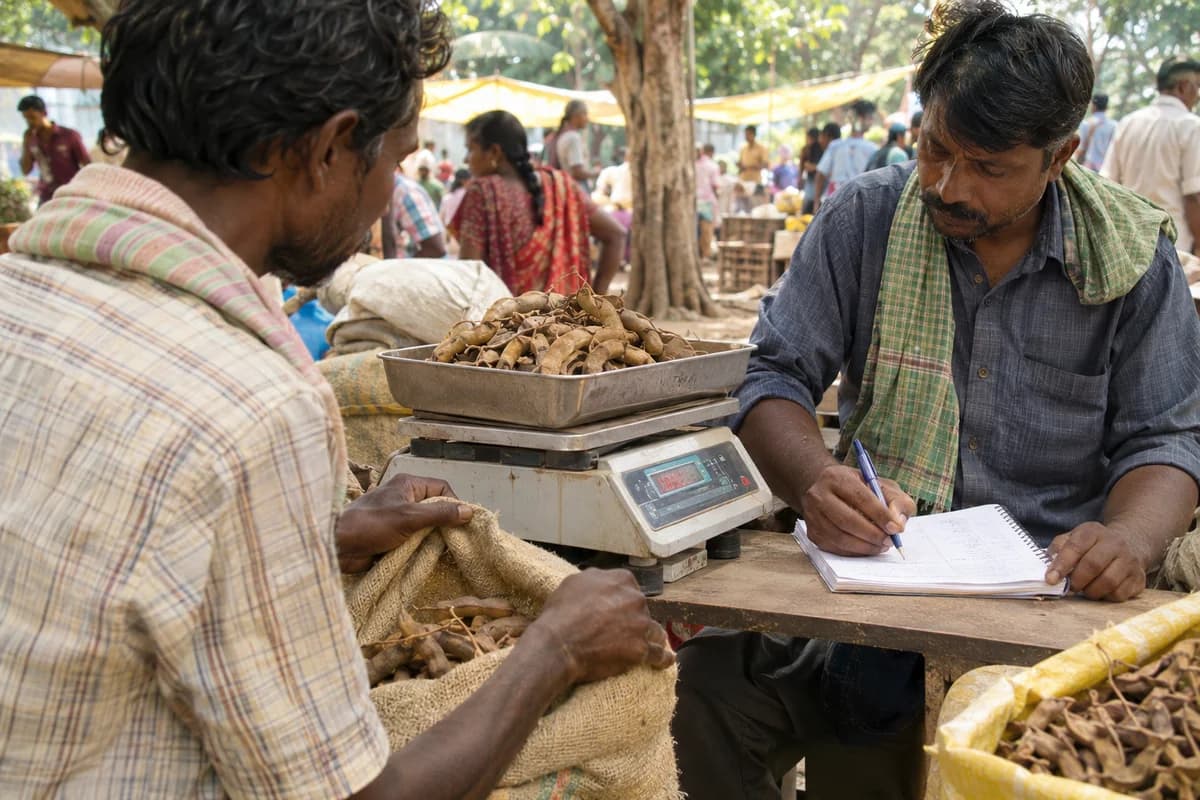
Bastar trade begins in the forest. Gatherers bring tamarind, mahua flowers, lac and other produce to weekly markets, where small traders weigh, buy and resell it. Cash is the norm. Paper bills are rare.
Crafts and tourism add another layer. Artisans make metal figures and wooden pieces, while guesthouses and guides host visitors during Bastar Dussehra and the cooler months, when every room and every driver is spoken for.
The areas, estates and markets that matter in Jagdalpur.
How Jagdalpur businesses pick and use software.
A forest produce trader wants purchase entries by gatherer and lot, with simple screens that work offline at the haat.
A craft cooperative wants each artisan’s work, advance and sale tracked so payments are fair and visible.
Where Jagdalpur businesses lose time and money.
Haat purchases are cash and memory
Weights and rates are said aloud and paid on the spot. Totals are rebuilt later from scraps of paper, at night, when the trader is tired and the haat is long over.
Artisans take advances against future work
Cooperatives pay in advance for pieces not yet made, sometimes weeks before the artisan starts work on them. Matching is slow.
Dussehra week outgrows the guesthouse register
Rooms are full for days and bookings arrive from more than one source. Overbooking is common.
Drivers and guides are booked informally
Visitors are matched to drivers by phone. A tour operator cannot easily see who is free.
What we would build for Jagdalpur businesses.
Usually in this order, starting with whatever the audit ranks first.
Web and Mobile Application Development
Web and mobile apps for customers, field staff and dealers, built to work on ordinary phones.
Learn moreBusiness Process Automation
Approvals, reminders and reports triggered by agreed rules, with exceptions assigned to a responsible person.
Learn moreData Engineering and Business Intelligence
Dashboards that answer the owner’s Monday questions without anyone building an Excel sheet first.
Learn moreReady products that fit Jagdalpur businesses.
Each one is adapted to how your business works before it goes live, and anything your trade needs that it lacks is added then. You are not paying to build the basics again.
SHG Management System
Member passbooks, savings to the corpus, meeting attendance, inter-loaning, group bank loans, repayment schedules, reminders and group accounts for self help groups and the NGOs behind them.
Learn moreHerbal Product Manufacturing Software
Botanical intake, formulations, batch records, certificate of analysis release, expiry-tracked stock, grower records and distributor orders for herbal product makers.
Learn moreTour Operator Management Software
Itineraries, group departures, vendor bookings, vouchers, per-passenger costing, guest payments and vendor payables for tour operators running fixed departures and custom trips.
Learn moreHow the work runs from Bengaluru for Jagdalpur.
- 1
The audit, by call
A screen-share and a look at the sheets, accounting reports and WhatsApp groups your team uses. No travel needed.
- 2
A written proposal
Scope, what we build first and the cost, agreed in writing before anything starts.
- 3
Build in short rounds
Working screens shared every few weeks. Your team tests them from your own office.
- 4
Go-live, in person when it helps
For data migration and training we can come to Jagdalpur. Travel is agreed in advance.
- 5
Support online
Fixes, changes and hosting handled remotely by the same team that built it.
The work we have published.
We don’t claim Jagdalpur clients we don’t have. These are systems our team built; the way we work is the same wherever you are.
PetSeva: matching owners to the right vet, at any hour
A two-sided veterinary platform where vets are searchable by specialisation and bookable outside clinic hours. It now carries more than 2,000 veterinary doctors.
Read the case study Paying guest accommodationSAM Atithi Pavathi: bed-level occupancy as the source of truth
PG management software where allocation, rates and invoices are derived from bed-level occupancy and not maintained in parallel spreadsheets.
Read the case study School transport servicesSAM Tours: school transport on a single ledger
Registration, fee collection, routing and finance write to the same records, closing the gap between journeys run and fees collected.
Read the case study Microfinance and Self Help GroupsVikasa RDO: making SHG loan recovery auditable
Loan proposals, recoveries and commissions sit on one record, with a person attached to every state change, so a business handling a bank’s money can show where each rupee went.
Read the case studyMake the scope specific to your business.
Work through a real example from your operation and agree the handoffs, controls and support the project needs.
Haat purchases are cash and memory
Which observation would change the proposed scope?
For “Haat purchases are cash and memory”, observe someone completing the task with a representative example. Record where they stop, ask another person or re-enter information, then choose the smallest change whose result the team can verify.
Background reading: GOV.UK: researching user needs
Questions Jagdalpur owners ask before they call.
Can purchases at a village haat be recorded without internet?
Yes. The phone keeps each entry safe and sends it up once the signal returns. Screens can use Hindi labels and a few large buttons.
Can a craft cooperative track advances to artisans?
Yes. Each artisan has an account for advances, delivered pieces and payments, so balances are clear to both sides.
What happens after I share my requirements?
We review your brief and clarify the work with you. We then look at the software, spreadsheets and WhatsApp groups your business runs on today and write down what works, what slows your team down and what is missing. A demo login, a screen-share or a few screenshots are enough. You get a short written summary ordered by priority, with no obligation to hire us afterwards.
How much will the software cost?
We don’t publish a price, because it depends on what the system has to do. That first review settles the scope, and the cost goes into a written proposal before any work starts.
Industries we build for in Jagdalpur.
Tell us what your Jagdalpur business runs on today.
Send a short note on the spreadsheets, software or WhatsApp groups your team depends on. We reply the same working day.
What happens after you share your requirements
- We review your brief and the systems you already use.
- We clarify the workflow, missing information and the work to consider first.
- The proposed scope sets out the deliverables, responsibilities and dependencies.
- Review the scope and commercial terms before deciding whether to proceed.
Start with your requirements
Describe your current process, the people involved and the change you need. Start with the details you know; we can clarify the rest together.
Share your requirements