Rooms, guests and deposits, on one calendar.
A homestay is a home with a few rooms let out, and the host is also the cook, cleaner and front desk. The software holds each room and dorm bed in one calendar, with guest register entries, advance deposits, breakfast counts and the final bill sitting beside each stay. Nothing lives in a diary on the kitchen shelf.
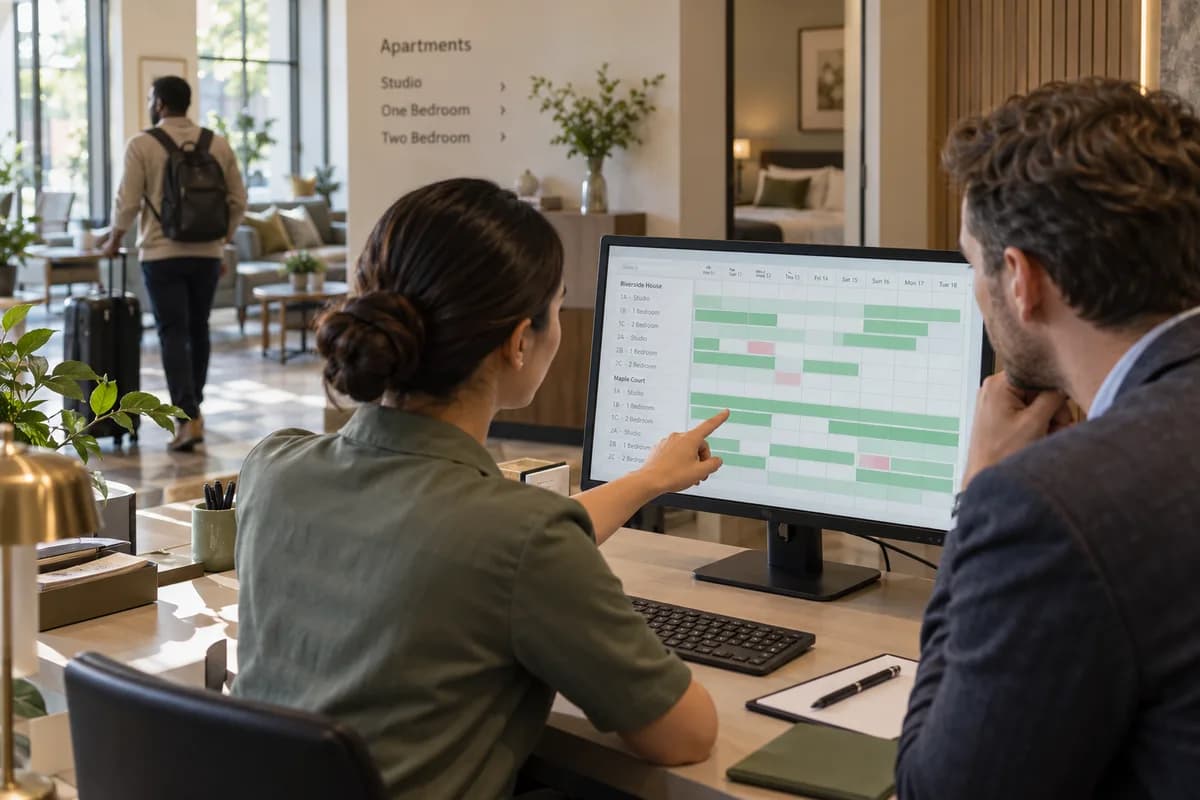
Most guesthouses run on a wall calendar, a phone full of messages and a register the host fills in after the guests have gone upstairs. Loose cards pile up in a biscuit tin. Double bookings are rare but costly. The promised deposit, still unpaid when the guests arrive, is the part everybody forgets until the bill is added up on the last morning.
Stay software for small lodgings keeps the room calendar, the guest register and the bill in one place that a host can open from a phone between chores. A host who answers guests from the verandah can still see which room is free.
Enquiries arrive by phone, message, email and listing sites, each asking for dates, a room type and a price, and the host checks the wall calendar. An advance holds the room. On arrival the guest fills a registration card, hands over an identity document, and is shown to the room with a key and a wifi password. Breakfast hours are explained at the door. An extra bed is priced then.
Through the stay the host or a helper cooks, cleans, washes linen and arranges taxis and local tours, while extra meals and laundry are written on slips. On the last morning the bill is added up from memory and the slips, the deposit is deducted and the room is turned around by noon.
What goes wrong for homestays and guesthouses without a proper system.
What we would build for homestays and guesthouses.
Named the way your team already talks about the work. We start with whichever part the audit shows is costing you most.
A requirements checklist for homestays and guesthouses.
What to cover, which reports to ask for and what to put to every vendor, ready to print or save as a PDF.
A product already built for homestays and guesthouses.
It is adapted to how your business works before it goes live, and anything your trade needs that it lacks is added then.
Homestays and Guesthouse Management Software
Room and bed calendar, enquiries, guest register, deposits, meals, extras, housekeeping and bills for homestays and guesthouses.
Other products in the same sector as homestays and guesthouses.
The business modules homestays and guesthouses use most.
Each one is also available on its own, or inside a system built for you.
- Resource and Room Booking
- Online Booking Portal
- Contact & Account Management
- Estimate/Quotation Management
- Receipts Management
- Invoice Management
- Task Management
- Multi-Currency Support
- All business solutions
All solutions by area
- Applicant Tracking (5)
- CRM (8)
- Finance & Accounting (10)
- Helpdesk (4)
- Human Resources (13)
- Inventory Management (5)
- Project Management (7)
- Manufacturing (6)
- Procurement (4)
- Sales and Distribution (6)
- Field Service (5)
- Statutory and Compliance (4)
- Retail and POS (4)
- Bookings and Appointments (3)
- Subscriptions (2)
- Assets and Fleet (4)
- Platform (6)
- Analytics (2)
- Documents (1)
Where AI can help homestays and guesthouses.
Each one reads records you already keep, and a person approves every decision.
The services behind it.
Business Process Automation
Approvals, reminders and reports triggered by agreed rules, with exceptions assigned to a responsible person.
Learn moreWeb and Mobile Application Development
Web and mobile apps for customers, field staff and dealers, built to work on ordinary phones.
Learn moreWhatsApp Business API and Chatbots
WhatsApp Business API work covers number onboarding, template approval, opt-in records and a chatbot with human handover, all set up under the client’s own Meta account. It connects WhatsApp to a CRM, billing or booking system, so every message is sent from an existing record and every reply is written back. It suits businesses that already take orders, payments or bookings in chat.
Learn moreTraining and Adoption
Adoption work starts after launch. Each role is trained at its own screen on its own tasks, such as billing returns, goods receipts or closing job cards. Support stands on the floor at go-live. Afterwards the records are reviewed to find which steps staff skip, which fields stay blank and why the stores or field team still reach for a notebook. Share your requirements and we will plan it with you.
Learn moreAll our other services
- Custom Software and Product Engineering
- Software Maintenance, Support and Rescue
- AI and Intelligent Automation
- API and System Integration
- ERP, CRM and Business Software Implementation
- Data Engineering and Business Intelligence
- UI/UX Design and Prototyping
- Cloud Engineering and Managed Infrastructure
- DevOps & Automation Services
- QA and Software Testing
- Performance Engineering
- Cybersecurity and Application Security
- IoT and Edge Computing
- Technology Strategy and Product Consulting
- E-Commerce and Digital Commerce
- MVP Product Development
- SaaS Product Development
- Data Migration and Moving Off Spreadsheets
- Data Protection and Privacy Readiness
- Tax and e-Invoice Engineering
- Managed IT Support
- Dedicated Team and Staff Augmentation
- Business Intelligence and Reporting Tools
- Cloud Cost Optimisation
- Global Compliance and Localisation
How the work runs from Bengaluru for your city.
- 1
The audit, by call
A screen-share and a look at the sheets, accounting reports and WhatsApp groups your team uses. No travel needed.
- 2
A written proposal
Scope, what we build first and the cost, agreed in writing before anything starts.
- 3
Build in short rounds
Working screens shared every few weeks. Your team tests them from your own office.
- 4
Go-live, in person when it helps
For data migration and training we can come to your city. Travel is agreed in advance.
- 5
Support online
Fixes, changes and hosting handled remotely by the same team that built it.
The work we have published.
We only name clients whose work is published. None of them is in this trade; they show how the team works, not that it has built for this trade.
PetSeva: matching owners to the right vet, at any hour
A two-sided veterinary platform where vets are searchable by specialisation and bookable outside clinic hours. It now carries more than 2,000 veterinary doctors.
Read the case study Paying guest accommodationSAM Atithi Pavathi: bed-level occupancy as the source of truth
PG management software where allocation, rates and invoices are derived from bed-level occupancy and not maintained in parallel spreadsheets.
Read the case study School transport servicesSAM Tours: school transport on a single ledger
Registration, fee collection, routing and finance write to the same records, closing the gap between journeys run and fees collected.
Read the case study Microfinance and Self Help GroupsVikasa RDO: making SHG loan recovery auditable
Loan proposals, recoveries and commissions sit on one record, with a person attached to every state change, so a business handling a bank’s money can show where each rupee went.
Read the case studyCheck the difficult cases before choosing software.
Use examples from your own records to test the workflows that matter in your business.
Enquiries, rates and holds
Which rule wins when two rates or offers apply?
Use “Enquiries, rates and holds” to check an ordinary sale and one that meets two pricing conditions. Ask for the calculation behind each final amount, rather than only the total.
Background reading: ERPNext: pricing conditions
Questions homestays and guesthouses ask before they call.
Can it stop a room being sold twice?
Yes, within the system. A held or confirmed date cannot be booked again. Bookings taken on outside listing sites are entered by you, unless a connection to them is agreed during implementation, and then the two calendars stay aligned.
Is it too big for three rooms?
Not if guests book ahead and take meals. Two rooms and a notebook can work, but a register, deposits and extras become hard to keep straight at five or six.
Can foreign guests be billed in their own currency?
Yes. The room is priced in your currency and the bill can show an amount in another, using a rate that you enter. Your accountant reviews the exchange rule.
What happens to guest identity records?
Each record sits with the guest and the stay. Each user is given their own access to guest records. Retention periods follow local rules, and your adviser checks those with you at go-live.
What changes the quotation for a small guesthouse?
Rooms and beds, listing sites to connect, and the staff who log in set the scale. Meal menus and housekeeping are separate parts. A small property can begin with the calendar alone. After its screens have been seen, every part is priced individually.
What should a host have ready to start?
Bring the wall calendar, your rate card, a registration card sample, extras slips and the housekeeping routine. Name the host and one helper to try the screens with real guests. Homestays and guesthouses start with real paperwork.
Does the host keep guest records if the system is dropped?
Bookings, guest registers, deposits and bills are the property’s, with spreadsheet exports to hand. The host owns the code as well. Its authors keep supporting it. GullySystem hosts only if the host wishes.
What happens after I share my requirements?
An engineer reads what you send and replies within one business day. We then look at the software, spreadsheets and WhatsApp groups your business runs on today and write down what works, what slows your team down and what is missing. A demo login, a screen-share or a few screenshots are enough. You get a short written summary ordered by priority, with no obligation to hire us afterwards.
How much will the software cost?
We don’t publish a price, because it depends on what the system has to do. That first review settles the scope, and the cost goes into a written proposal before any work starts.
Related industries.
Part of a wider group.
Tell us how your business runs today.
A few lines on your spreadsheets, software and WhatsApp groups is enough. We reply the same working day.
What happens after you share your requirements
- A senior engineer reads your answers. Nobody phones first.
- Within one business day you get a written note: what we understood, what we would start with, and the questions we still have.
- If it fits, a proposal follows with the order of work, what we need from you and what you receive at each step.
- No call is booked and nothing is paid until you have read the note. Your details stay with us.
Start with your requirements
Seven short steps that tell us what you need. A senior engineer reads them before anyone gets in touch.
Share your requirements