Business software for Nepali hotels, trek operators, schools and cooperatives that work in Nepali and English.
Nepal runs on mountain tourism, schools, cooperatives, small factories and trade across a long open border. Our Bengaluru team has no office in Nepal and serves clients by video, email and WhatsApp. Software covers bookings, fees, members, invoices and receipts, with Nepali screens where staff need them.
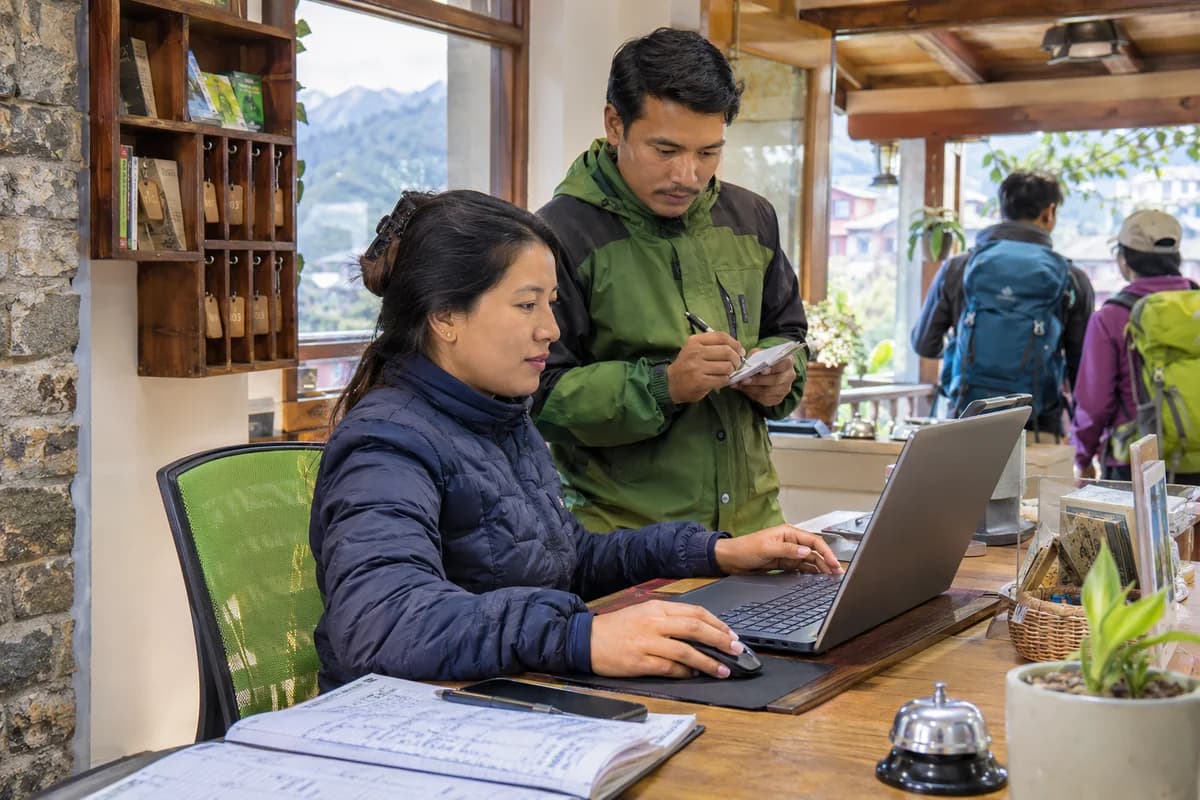
Working with a team in India from Nepal.
Nepali firms are small and family run. A guesthouse in Pokhara, a trekking agency in Thamel, a private school in Butwal and a savings cooperative in a hill town all keep records in registers and spreadsheets. Seasons are sharp. Tourist months bring a rush, and the quiet months are for fixing systems.
Our team sits in Bengaluru. Nepal has no office of ours and we hold no local licence, and no Nepali customers or partners can be named. Work happens over video calls. The time zone is nearly the same as ours, so scheduling is simple.
What changes when your business is in Nepal.
Hours, money, language and data are decided with you at the start, not discovered later.
What the software has to fit.
The filing cycles, payment habits and licences a small business there already works around.
Trades we write for in Nepal.
Products that fit them.
Capabilities often asked for.
What we would build for Nepal businesses.
Usually in this order, starting with whatever the audit ranks first.
WhatsApp Business API and Chatbots
WhatsApp Business API work covers number onboarding, template approval, opt-in records and a chatbot with human handover, all set up under the client’s own Meta account. It connects WhatsApp to a CRM, billing or booking system, so every message is sent from an existing record and every reply is written back. It suits businesses that already take orders, payments or bookings in chat.
Learn moreGlobal Compliance and Localisation
Software has to change for each country. Currency tables, VAT and sales tax codes, invoice layouts, translation files, storage regions and consent records are built as configuration that your team can edit without code changes. The legal question stays with your adviser.
Learn moreAPI and System Integration
Connections between existing tools, with record ownership, duplicate handling and reconciliation agreed for each flow.
Learn moreMake the scope specific to your business.
Work through a real example from your operation and agree the handoffs, controls and support the project needs.
VAT, PAN and invoices
Can you explain the balance from its original documents?
Select a partly settled example in “VAT, PAN and invoices”. Ask for the invoice, allocated receipts and remaining balance to be shown together before agreeing the opening figures.
Background reading: ERPNext: outstanding invoices
Payments and data rules
Can the same receipt be allocated without counting the money twice?
Take an unallocated amount in “Payments and data rules” and apply it to the intended balance. Review the remaining amount and the original receipt reference together.
Background reading: ERPNext: payment allocation
Questions from businesses in Nepal.
Do you have a team or office in Nepal?
No. Our work is done from Bengaluru, by video, email and WhatsApp, and we hold no Nepali licence and name no customers there. Your own person owns decisions.
Can receipts and screens use Nepali script?
Yes. Screens, receipts and vouchers can show Nepali and English side by side. We test Devanagari print and export with real names first, because that is where a wrong font shows.
Can a booking show dollars and Nepali currency?
Yes. Each booking keeps its quoted currency and shows the local total for the books, and rate sources are agreed with your accountant, so none are hard coded.
Will it work with weak internet in the hills?
Screens are built to save as you go and recover after a drop, and for very remote sites an offline sheet that syncs later can be scoped. We state the limits plainly in the plan.
Can the system show Bikram Sambat dates?
Yes, dates can display in both calendars on reports and fee schedules. Your team confirms the conversion rules in testing.
How do you handle tax billing rules?
The fields your accountant specifies are built, but rules change, so confirm the requirement with your accountant. Anything beyond a normal invoice is scoped before a quote.
Can one system serve a trek agency and a lodge?
Both can sit in one system if both are yours. Agency bookings and lodge rooms share one guest record, so a trekker’s deposit and room nights appear together. Separate businesses keep separate books. We agree that split with your accountant before any invoice is issued.
Tell us what you run.
Share your requirements and an engineer will read them before getting in touch, at an hour that suits your day.
What happens after you share your requirements
- We review your brief and the systems you already use.
- We clarify the workflow, missing information and the work to consider first.
- The proposed scope sets out the deliverables, responsibilities and dependencies.
- Review the scope and commercial terms before deciding whether to proceed.
Start with your requirements
Describe your current process, the people involved and the change you need. Start with the details you know; we can clarify the rest together.
Share your requirements