Connect room calendars, housekeeping, folios and OTA payouts in one hotel system.
Independent hotels run a property management system, several online travel agency extranets, a paper arrival register and a housekeeping chat group, and rooms get sold twice. Our hotel software can replace those pieces, or add the missing screens around the system you already pay for. Housekeeping, the restaurant and accounts then read one guest folio. Travel agent dues stop being a printout.
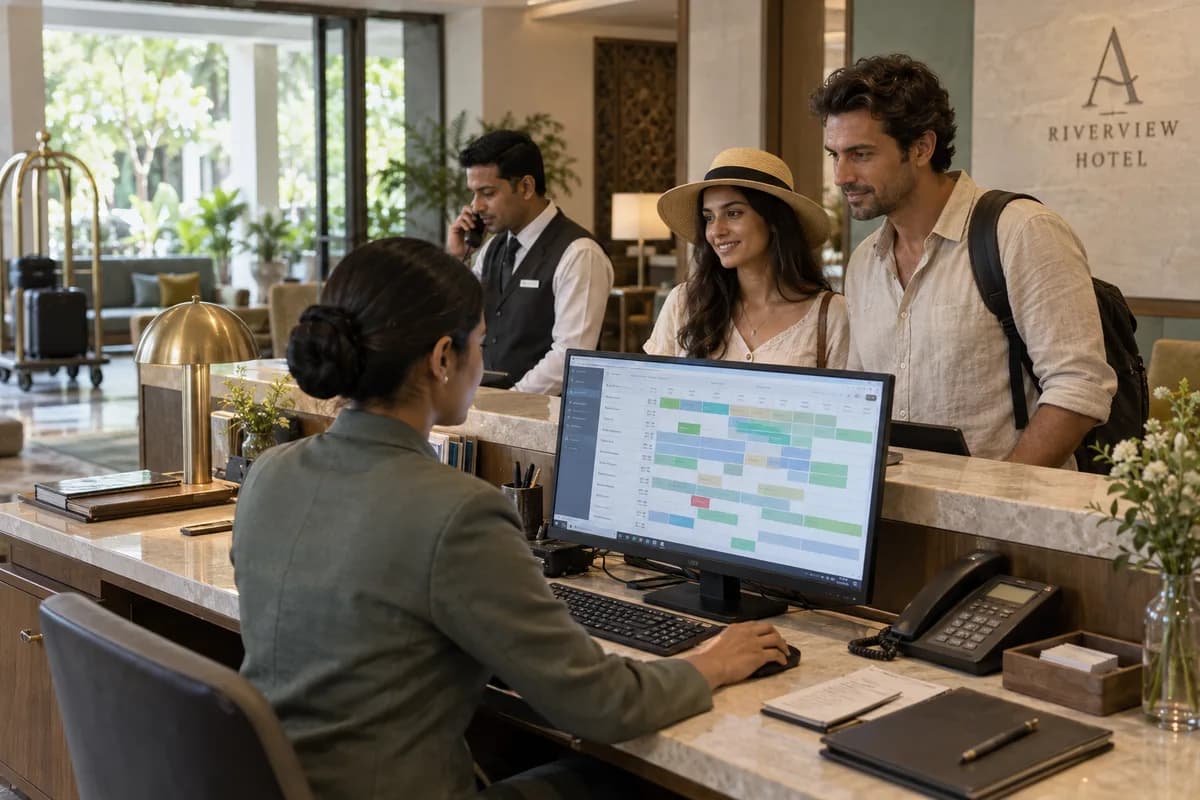
Rooms sell on Booking.com, Expedia, Agoda, your own site and over the phone. One person at the desk tracks all five while handing out keys.
A new system is rarely the first answer. The handovers leak: desk to housekeeping, kitchen to folio, folio to accounts. Last month’s folios show where charges went missing, so we start there.
A booking arrives from an online travel agency. A corporate travel desk emails a rooming list, and a regular calls the manager, each expecting a different rate plan. The desk enters all three, blocks the room on other channels, and fills a registration card with ID at check-in.
During the stay, housekeeping marks rooms clean in a chat group, the restaurant writes room charges on a kitchen order slip, and the minibar is counted at checkout. Three records feed one bill.
At month end, accounts match OTA payouts against the bank, raise tax invoices with corporate tax numbers, and chase travel agents on the city ledger, mostly in the accounting package from printouts. No-shows and cancellations are argued channel by channel.
What goes wrong for hotels without a proper system.
What we would build for hotels.
Named the way your team already talks about the work. We start with whichever part the audit shows is costing you most.
A requirements checklist for hotels.
What to cover, which reports to ask for and what to put to every vendor, ready to print or save as a PDF.
Ready products that fit hotels.
Each one is adapted to how your business works before it goes live, and anything your trade needs that it lacks is added then. You are not paying to build the basics again.
Hotel Management Software
A property management system for room bookings, the reservation chart, front desk, housekeeping, rate plans, guest folios and banquet hall bookings in hotels and resorts.
Learn moreRestaurant Management System
Table and counter orders, kitchen tickets (KOT), menu and recipe stock, platform orders, POS billing with tax and day close for restaurants.
Learn moreBank Reconciliation Software
Statement import, automated matching, part payments and bank charges, an exception list with reasons, month-end sign-off, the bank reconciliation statement and an audit trail.
Learn moreOther products in the same sector as hotels.
The business modules hotels use most.
Each one is also available on its own, or inside a system built for you.
- Bank Reconciliation
- Estimate/Quotation Management
- Online Booking Portal
- Price Lists and Schemes
- Invoice Management
- Resource and Room Booking
- Contact & Account Management
- Point of Sale Billing
- Order Management
- Stock Tracking and Alerts
- Bill of Materials
- Purchase Order Management
- Attendance & Time Tracking
- Audit Trail
- Data Migration and Import
- Workflow and Approvals
- Multi-Branch Consolidation
- Report Builder
- Asset AMC Tracking
- Finance and Accounting Reporting
- Fixed Asset Register
- All business solutions
All solutions by area
- Applicant Tracking (5)
- CRM (8)
- Finance & Accounting (10)
- Helpdesk (4)
- Human Resources (13)
- Inventory Management (5)
- Project Management (7)
- Manufacturing (6)
- Procurement (4)
- Sales and Distribution (6)
- Field Service (5)
- Statutory and Compliance (4)
- Retail and POS (4)
- Bookings and Appointments (3)
- Subscriptions (2)
- Assets and Fleet (4)
- Platform (6)
- Analytics (2)
- Documents (1)
Where AI can help hotels.
Each one reads records you already keep, and a person approves every decision.
- AI Campaign Analytics
- AI Campaign Optimisation
- AI Chatbots
- AI Conversational AI
- AI Customer Journey
- AI Digital Presence
- AI Employee Engagement Analytics
- AI Engagement
- AI Feedback and Review Analytics
- AI Loyalty
- AI Marketing Analytics
- AI Media Buying
- AI Sentiment Analysis
- AI Social Marketing
- AI for Sales
- AI for Marketing
- AI for Customer Support
- AI for HR
- AI for Finance
- AI for Operations
- AI for Supply Chain and Logistics
- AI for Security
- AI for Procurement
- All AI solutions
Where we work with hotels.
The services behind it.
API and System Integration
Accounting software, WhatsApp, payment gateways, tax portals and your own apps sharing one set of numbers.
Learn moreBusiness Process Automation
Approvals, reminders, follow-ups and reports that run on their own instead of on someone remembering.
Learn moreERP, CRM and Business Software Implementation
One record of stock, orders, customers and accounts, set up so your team opens it every day.
Learn moreData Engineering and Business Intelligence
Dashboards that answer the owner’s Monday questions without anyone building an Excel sheet first.
Learn moreAll our other services
- Custom Software and Product Engineering
- Software Maintenance, Support and Rescue
- AI and Intelligent Automation
- UI/UX Design and Prototyping
- Cloud Engineering and Managed Infrastructure
- DevOps & Automation Services
- QA and Software Testing
- Performance Engineering
- Cybersecurity and Application Security
- IoT and Edge Computing
- Technology Strategy and Product Consulting
- E-Commerce and Digital Commerce
- MVP Product Development
- Web and Mobile Application Development
- SaaS Product Development
- WhatsApp Business API and Chatbots
- Data Migration and Moving Off Spreadsheets
- Training and Adoption
- Data Protection and Privacy Readiness
- Tax and e-Invoice Engineering
- Managed IT Support
- Dedicated Team and Staff Augmentation
- Business Intelligence and Reporting Tools
- Cloud Cost Optimisation
- Global Compliance and Localisation
Written for hotels.
Practical notes on running the business, not product marketing.
How the work runs from Bengaluru for your city.
- 1
The audit, by call
A screen-share and a look at the sheets, accounting reports and WhatsApp groups your team uses. No travel needed.
- 2
A written proposal
Scope, what we build first and the cost, agreed in writing before anything starts.
- 3
Build in short rounds
Working screens shared every few weeks. Your team tests them from your own office.
- 4
Go-live, in person when it helps
For data migration and training we can come to your city. Travel is agreed in advance.
- 5
Support online
Fixes, changes and hosting handled remotely by the same team that built it.
Software we have built and run in this sector.
Published with the client’s agreement, with what was built and what changed.
Questions hotels ask before they call.
Do we have to replace our current property management system?
Usually not. Most such systems handle the booking itself, and the pain sits around them, in work staff patch together. If you do want to replace it, our hotel software covers the room chart, rate plans, front desk, housekeeping, folios and banquet halls. Online agency bookings reach it through a channel manager you run.
Can it post hotel entries into our books?
Not built in. Day-end revenue, tax on rooms and food, and OTA payouts can reach your accountant as an export, priced separately once the ledgers are known.
Is a ready hotel package better for a small property?
Often not for a homestay with one or two channels, since an off-the-shelf system and channel manager are usually enough and cheaper. Custom work helps once you add a restaurant, banquets or a second property.
Can it handle restaurant and banquet billing?
Yes. Kitchen orders post to the room folio or a walk-in bill, and a banquet booking carries its advance, menu and hall. If your restaurant already runs a till system, a link to it is scoped during implementation.
What determines the price of a hotel system?
Rooms, outlets and connected channels set the size. So do the front desk, housekeeping and accounts users, and whether it replaces your current property system or works alongside. Travel agency extranets and an accounting export add scope. Each part appears as a separate line in the quotation.
What should a hotel collect before we begin?
Collect the rate plans, the arrival register, housekeeping lists, a restaurant order slip and the travel agent ledger. Add a month of channel payouts. A front office head, a housekeeping lead and an accountant should be free to review screens.
Who owns guest folios and agent ledgers if the hotel leaves?
The hotel does, entirely. It holds the source and every guest record. Folios, registration cards, agency dues and invoices can be exported in plain-file form at any point. We keep supporting it, and GullySystem manages the servers unless the hotel names a different host.
What happens after I share my requirements?
An engineer reads what you send and replies within one business day. We then look at the software, spreadsheets and WhatsApp groups your business runs on today and write down what works, what slows your team down and what is missing. A demo login, a screen-share or a few screenshots are enough. You get a short written summary ordered by priority, with no obligation to hire us afterwards.
How much will the software cost?
We don’t publish a price, because it depends on what the system has to do. That first review settles the scope, and the cost goes into a written proposal before any work starts.
Bengaluru areas with many hotels.
Part of these wider groups.
Tell us how your business runs today.
A few lines on your spreadsheets, software and WhatsApp groups is enough. We reply the same working day.
What happens after you share your requirements
- A senior engineer reads your answers. Nobody phones first.
- Within one business day you get a written note: what we understood, what we would start with, and the questions we still have.
- If it fits, a proposal follows with the order of work, what we need from you and what you receive at each step.
- No call is booked and nothing is paid until you have read the note. Your details stay with us.
Start with your requirements
Seven short steps that tell us what you need. A senior engineer reads them before anyone gets in touch.
Share your requirements