Manage menu versions, head counts, purchases and settlement for each event.
Caterers run weddings, corporate lunches and daily lunch-box contracts from messaging chats, quotations and purchase lists. The work starts at the quotation and ends at settlement, with menu versions the family approves, quantities worked from the closing count, and every extra plate added at the hall recorded.
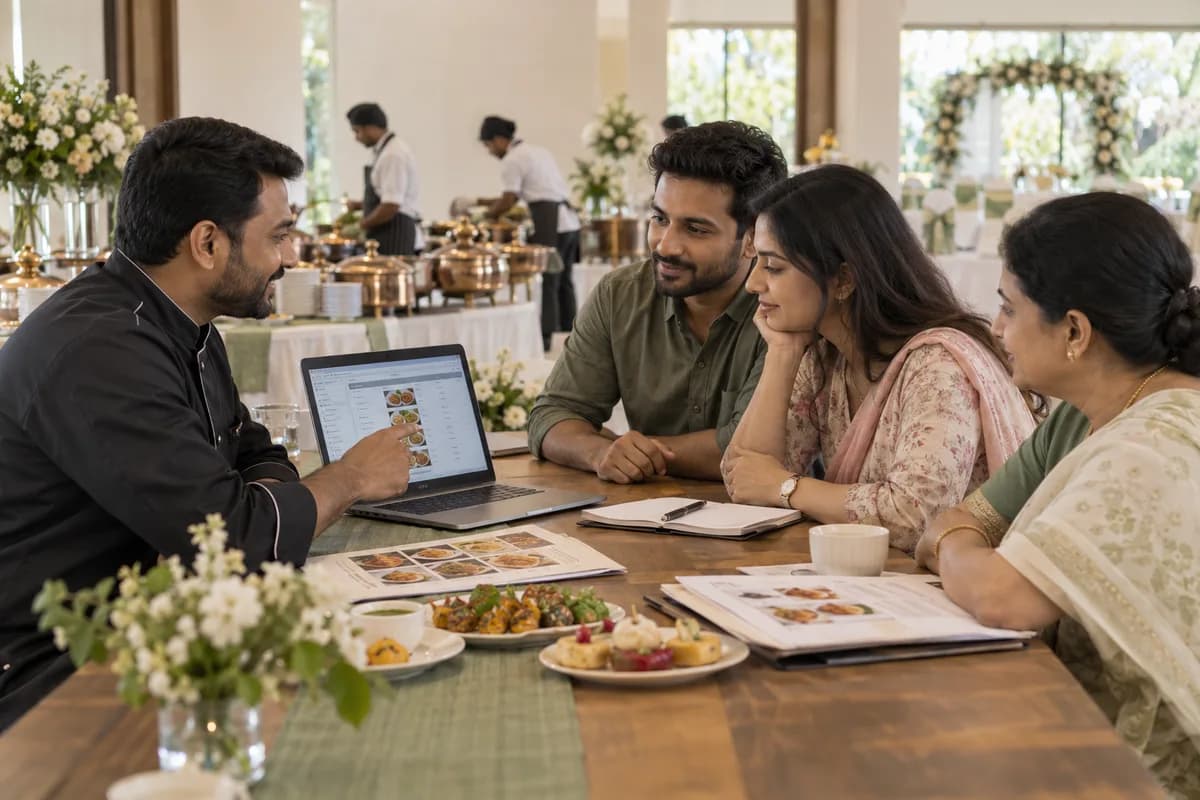
In one week a caterer may feed a thousand guests at a wedding hall. In the next, the work is lunch for an office canteen every working day.
Both depend on a confirmed menu, an honest head count, groceries bought in time and the balance collected before service ends, and each of these is usually decided by phone.
An enquiry comes through a relative, a listing site or the hall manager. You meet the family, suggest menus for each session, send a per-plate quotation and take an advance. The menu then changes several times as the family’s needs become clear, and live counters are added or dropped.
Three days before the event, the head cook works out rice, lentils, vegetables, oil and sweets from the closing count, usually on paper and usually from memory of the last similar event. Purchases are made at the market and with regular suppliers. Cooks, servers, large cooking pots and chafing dishes are booked and confirmed again the night before.
On the day, plates are added at the hall. Settlement follows, while corporate and hostel contracts bring monthly invoices with sales tax or VAT, any withholding, and head counts that change daily.
What goes wrong for caterers without a proper system.
What we would build for caterers.
Named the way your team already talks about the work. We start with whichever part the audit shows is costing you most.
A requirements checklist for caterers.
What to cover, which reports to ask for and what to put to every vendor, ready to print or save as a PDF.
A product already built for caterers.
It is adapted to how your business works before it goes live, and anything your trade needs that it lacks is added then.
Catering Management Software
Event orders with menu versions, per-plate costing, purchase planning, kitchen and staff rosters, hire items and settlements for caterers.
Other products in the same sector as caterers.
The business modules caterers use most.
Each one is also available on its own, or inside a system built for you.
- Order Management
- Quote & Proposal Management
- Purchase Order Management
- Production Planning
- Attendance & Time Tracking
- Receipts Management
- Roles and Permissions
- All business solutions
All solutions by area
- Applicant Tracking (5)
- CRM (8)
- Finance & Accounting (10)
- Helpdesk (4)
- Human Resources (13)
- Inventory Management (5)
- Project Management (7)
- Manufacturing (6)
- Procurement (4)
- Sales and Distribution (6)
- Field Service (5)
- Statutory and Compliance (4)
- Retail and POS (4)
- Bookings and Appointments (3)
- Subscriptions (2)
- Assets and Fleet (4)
- Platform (6)
- Analytics (2)
- Documents (1)
Where AI can help caterers.
Each one reads records you already keep, and a person approves every decision.
The services behind it.
Business Process Automation
Approvals, reminders, follow-ups and reports that run on their own instead of on someone remembering.
Learn moreCustom Software and Product Engineering
Software built around how your business actually runs, when nothing off the shelf fits without workarounds.
Learn moreWeb and Mobile Application Development
Web and mobile apps for customers, field staff and dealers, built to work on ordinary phones.
Learn moreAll our other services
- Software Maintenance, Support and Rescue
- AI and Intelligent Automation
- API and System Integration
- ERP, CRM and Business Software Implementation
- Data Engineering and Business Intelligence
- UI/UX Design and Prototyping
- Cloud Engineering and Managed Infrastructure
- DevOps & Automation Services
- QA and Software Testing
- Performance Engineering
- Cybersecurity and Application Security
- IoT and Edge Computing
- Technology Strategy and Product Consulting
- E-Commerce and Digital Commerce
- MVP Product Development
- SaaS Product Development
- WhatsApp Business API and Chatbots
- Data Migration and Moving Off Spreadsheets
- Training and Adoption
- Data Protection and Privacy Readiness
- Tax and e-Invoice Engineering
- Managed IT Support
- Dedicated Team and Staff Augmentation
- Business Intelligence and Reporting Tools
- Cloud Cost Optimisation
- Global Compliance and Localisation
Written for caterers.
Practical notes on running the business, not product marketing.
How the work runs from Bengaluru for your city.
- 1
The audit, by call
A screen-share and a look at the sheets, accounting reports and WhatsApp groups your team uses. No travel needed.
- 2
A written proposal
Scope, what we build first and the cost, agreed in writing before anything starts.
- 3
Build in short rounds
Working screens shared every few weeks. Your team tests them from your own office.
- 4
Go-live, in person when it helps
For data migration and training we can come to your city. Travel is agreed in advance.
- 5
Support online
Fixes, changes and hosting handled remotely by the same team that built it.
Software we have built and run in this sector.
Published with the client’s agreement, with what was built and what changed.
Questions caterers ask before they call.
Can it make tax invoices and post them to my accounting software?
Tax invoices, yes, with advances and balances shown against the same event. Posting into your accounting system is not built in. An export for your accountant is scoped at implementation, with its own price.
Will our head cook use it?
If it is simple enough, yes. His screen shows the approved menu and quantities on a phone, with nothing to type.
Is there ready catering software we could buy?
A few exist, mostly built for restaurants or cloud kitchens. If one fits your events and costing, use it. We are useful when menus, plate costing and corporate contracts do not fit those screens. Share one real event and we can say whether it fits.
Is the family’s approval of the final menu recorded?
Yes. Every change becomes a fresh version, and the approval is recorded against the one the family accepted. The kitchen sees only the approved one.
Why do caterer quotations differ?
Each kitchen’s mix of events decides it: how many outlets or halls, how many users, and whether per-plate costing, vessel tracking and corporate meal contracts are all wanted. A link to accounting software and old event files to bring in matter too. Every part is then costed separately.
What do we put together before the caterer’s build starts?
Pull out past quotations, two or three menus, the purchase lists of a recent event, the vessel and staff lists, and your corporate contracts. The head cook, the event manager and whoever keeps accounts should be named so someone can judge each screen as it is shown.
Can we walk away later with menus and event data?
Yes. Menus, costings, bookings and vessel records are yours, together with the software. Everything leaves as ordinary spreadsheets. Its developers stay on for support. Hosting is at GullySystem, or on a server of your own.
What happens after I share my requirements?
An engineer reads what you send and replies within one business day. We then look at the software, spreadsheets and WhatsApp groups your business runs on today and write down what works, what slows your team down and what is missing. A demo login, a screen-share or a few screenshots are enough. You get a short written summary ordered by priority, with no obligation to hire us afterwards.
How much will the software cost?
We don’t publish a price, because it depends on what the system has to do. That first review settles the scope, and the cost goes into a written proposal before any work starts.
Part of these wider groups.
Tell us how your business runs today.
A few lines on your spreadsheets, software and WhatsApp groups is enough. We reply the same working day.
What happens after you share your requirements
- A senior engineer reads your answers. Nobody phones first.
- Within one business day you get a written note: what we understood, what we would start with, and the questions we still have.
- If it fits, a proposal follows with the order of work, what we need from you and what you receive at each step.
- No call is booked and nothing is paid until you have read the note. Your details stay with us.
Start with your requirements
Seven short steps that tell us what you need. A senior engineer reads them before anyone gets in touch.
Share your requirements