Job-work, stock and hospital records for Lucknow’s chikan traders, hospitals and Gomti Nagar firms.
Lucknow’s economy includes chikankari, large hospitals and the offices of Gomti Nagar. A chikan piece passes through cutters, printers, embroiderers and washers before a Chowk trader sells it, and the record of that movement is usually a notebook. Hospitals along Raebareli Road and Shaheed Path run software of mixed age. Software for each is built in Nagarbhavi, Bengaluru, and used remotely.
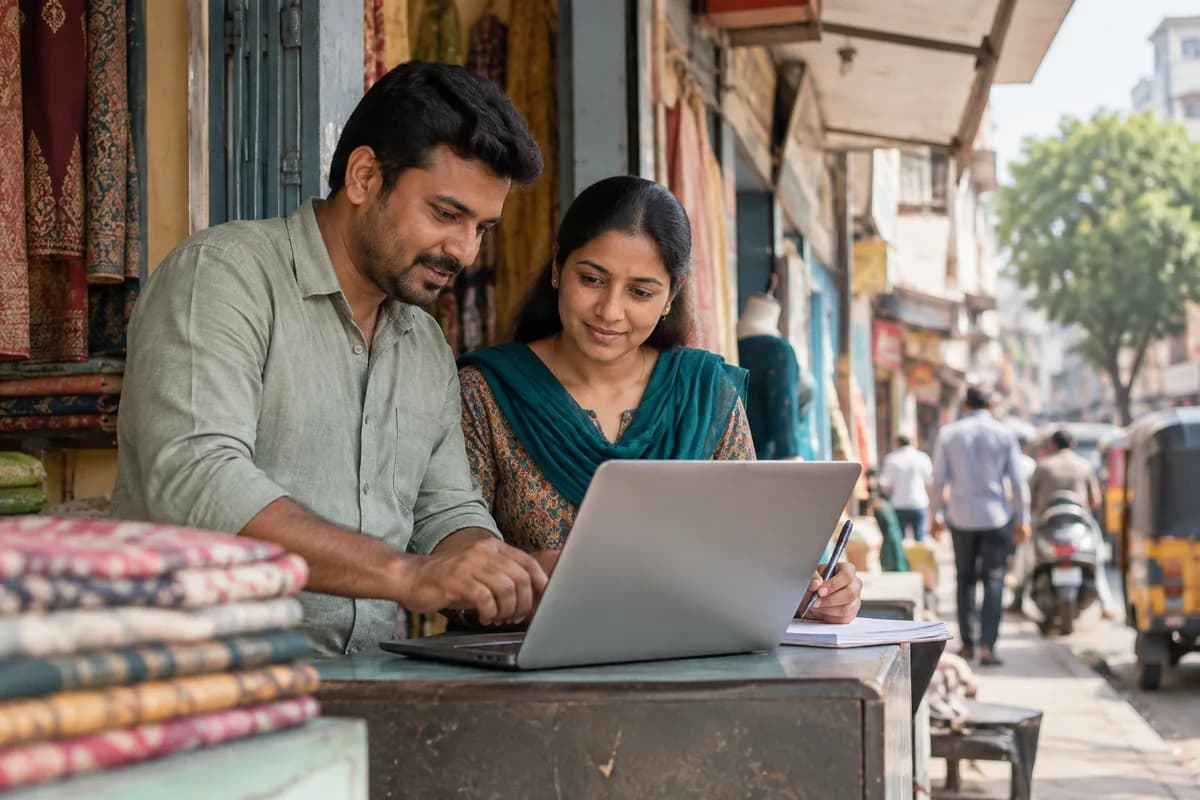
Chikankari is cut, block-printed, embroidered and washed in stages across Lucknow and the villages beyond it, with most of the embroidery done by women working from home. The work leaves the shop and returns weeks later. The wholesale trade sits in Chowk and Aminabad, and showrooms in Hazratganj and Janpath Market sell to shoppers, tourists and boutiques from across India.
SGPGI on Raebareli Road and the private hospitals along Shaheed Path draw patients from across the state. Gomti Nagar, Vibhuti Khand and Aliganj hold offices, coaching institutes, banquet halls and professional firms. Amausi, Chinhat and Talkatora hold the industrial units.
The areas, estates and markets that matter in Lucknow.
How Lucknow businesses pick and use software.
Chikan trade follows a long-standing pattern: a master gives out cut and printed fabric, embroiderers return it weeks later, and a notebook sits between them. Traders now selling to boutiques on Instagram and WhatsApp need stock by design and work-in-progress by karigar. That is where software starts.
Hospitals and Gomti Nagar firms are used to software, and often have an IT person or administrator with clear requirements. Questions on data security, hosting and code ownership come early. They are worth settling before any build starts.
Where Lucknow businesses lose time and money.
Pieces held by embroiderers are hard to count
A chikan trader gives out hundreds of printed pieces to women across villages. Which pieces are back, which are late and which came back spoilt is recorded in one notebook. Spoilt pieces are easy to miss.
Boutique orders from WhatsApp photos are matched to stock by hand
Boutiques in Mumbai or Bengaluru pick designs from photos. Whether a design is in stock in their sizes is checked by someone walking to the shelf. It is slow.
Hospital systems were added one at a time
A Shaheed Path hospital may run one package for OPD, another for the lab and a third for pharmacy. Reports for management are stitched together in Excel every month. The stitching repeats monthly.
What we would build for Lucknow businesses.
Usually in this order, starting with whatever the audit ranks first.
Custom Software and Product Engineering
Software built around how your business actually runs, when nothing off the shelf fits without workarounds.
Learn moreERP, CRM and Business Software Implementation
One record of stock, orders, customers and accounts, set up so your team opens it every day.
Learn moreAPI and System Integration
Accounting software, WhatsApp, payment gateways, tax portals and your own apps sharing one set of numbers.
Learn moreE-Commerce and Digital Commerce
An online store or B2B order portal wired to your stock, billing and dispatch.
Learn moreCybersecurity and Application Security
Logins, roles, backups and data exposure checked, so a staff exit or a lost phone is not a crisis.
Learn moreA product already built for Lucknow businesses.
It is adapted to how your business works before it goes live, and anything your trade needs that it lacks is added then.
Hospital/Clinic Management System
Appointments, OPD queue, patient records, billing, medicine stock and staff rosters for clinics and small hospitals, set up around your doctors and departments.
How the work runs from Bengaluru for Lucknow.
- 1
The audit, by call
A screen-share and a look at the sheets, accounting reports and WhatsApp groups your team uses. No travel needed.
- 2
A written proposal
Scope, what we build first and the cost, agreed in writing before anything starts.
- 3
Build in short rounds
Working screens shared every few weeks. Your team tests them from your own office.
- 4
Go-live, in person when it helps
For data migration and training we can come to Lucknow. Travel is agreed in advance.
- 5
Support online
Fixes, changes and hosting handled remotely by the same team that built it.
The work we have published.
We don’t claim Lucknow clients we don’t have. These are systems our team built; the way we work is the same wherever you are.
PetSeva: matching owners to the right vet, at any hour
A two-sided veterinary platform where vets are searchable by specialisation and bookable outside clinic hours. It now carries more than 2,000 veterinary doctors.
Read the case study Paying guest accommodationSAM Atithi Pavathi: bed-level occupancy as the source of truth
PG management software where allocation, rates and invoices are derived from bed-level occupancy and not maintained in parallel spreadsheets.
Read the case study School transport servicesSAM Tours: school transport on a single ledger
Registration, fee collection, routing and finance write to the same records, closing the gap between journeys run and fees collected.
Read the case study Microfinance and Self Help GroupsVikasa RDO: making SHG loan recovery auditable
Loan proposals, recoveries and commissions sit on one record, with a person attached to every state change, so a business handling a bank’s money can show where each rupee went.
Read the case studyQuestions Lucknow owners ask before they call.
Can a chikan trader track pieces given to embroiderers on a phone?
Yes. A job-work app gives each embroiderer or middleman an account of pieces issued and returned, with a photograph of the design. Late pieces show at a glance, and payment follows piece count.
Our Lucknow hospital already has three systems. Can they be connected?
It depends on the systems. Where they allow data export or an API, they can be connected and one management report built. Where they do not, we say plainly whether replacing one of them is the better path.
What happens after I share my requirements?
An engineer reads what you send and replies within one business day. We then look at the software, spreadsheets and WhatsApp groups your business runs on today and write down what works, what slows your team down and what is missing. A demo login, a screen-share or a few screenshots are enough. You get a short written summary ordered by priority, with no obligation to hire us afterwards.
How much will the software cost?
We don’t publish a price, because it depends on what the system has to do. That first review settles the scope, and the cost goes into a written proposal before any work starts.
Industries we build for in Lucknow.
Tell us what your Lucknow business runs on today.
Send a short note on the spreadsheets, software or WhatsApp groups your team depends on. We reply the same working day.
What happens after you share your requirements
- A senior engineer reads your answers. Nobody phones first.
- Within one business day you get a written note: what we understood, what we would start with, and the questions we still have.
- If it fits, a proposal follows with the order of work, what we need from you and what you receive at each step.
- No call is booked and nothing is paid until you have read the note. Your details stay with us.
Start with your requirements
Seven short steps that tell us what you need. A senior engineer reads them before anyone gets in touch.
Share your requirements