Run every consultation from token to prescription to bill. Old case sheet, one tap.
Clinics and doctors run the day on a token register, handwritten prescriptions and lab reports that arrive by message or sit in a plastic cover nobody can search. The screens follow the order of your consulting day. Token, prescription and bill follow in order. Each patient keeps one case sheet across visits, holding vitals, past prescriptions and reports, so the next doctor sees the whole story. Reminders go out before the review date.
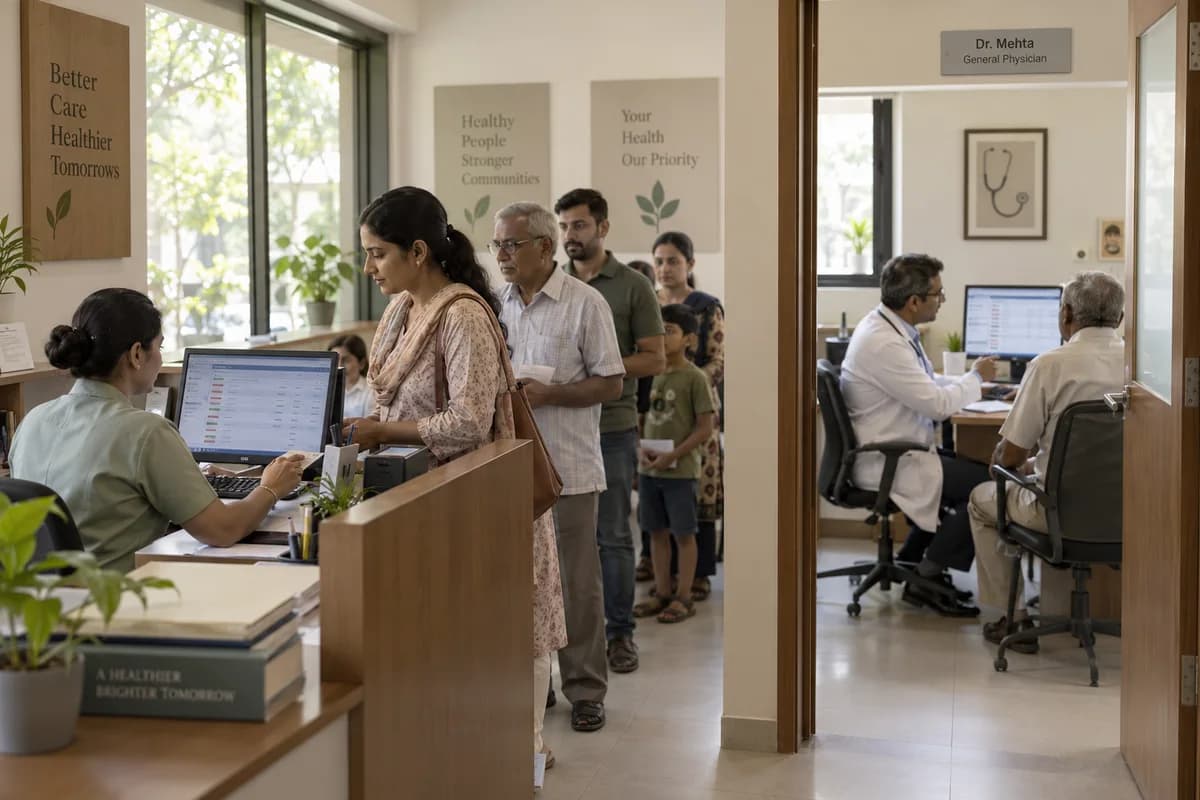
A family physician, a specialist’s evening session and a polyclinic with a pathology counter all face the same morning. There is a crowd, a token book, and a doctor who needs last month’s notes before the patient sits down.
The software is meant to shorten that morning. It must not add typing. Each screen follows one consulting session, from the first token slip to the last receipt.
The receptionist writes name, age and complaint against a visit number, takes the consultation fee and sends the patient in. The doctor records pulse, blood pressure and weight, listens with the stethoscope, writes the prescription by hand on the letterhead and orders tests from the lab next door.
The patient then walks to the collection counter. Reports return on paper or on WhatsApp, and the patient carries them to the next visit in a plastic cover, along with older prescriptions from other doctors.
Review dates, vaccination dates and chronic follow-ups depend on the patient remembering, or on a receptionist with a diary, a pen and a free hour. Often neither happens. At month end, consultation fees, lab income and each doctor’s share are added up by hand from the token register, the lab book and the pharmacy bill pad.
What goes wrong for clinics and doctors without a proper system.
What we would build for clinics and doctors.
Named the way your team already talks about the work. We start with whichever part the audit shows is costing you most.
A requirements checklist for clinics and doctors.
What to cover, which reports to ask for and what to put to every vendor, ready to print or save as a PDF.
A product already built for clinics and doctors.
It is adapted to how your business works before it goes live, and anything your trade needs that it lacks is added then.
Hospital/Clinic Management System
Appointments, OPD queue, patient records, billing, medicine stock and staff rosters for clinics and small hospitals, set up around your doctors and departments.
Other products in the same sector as clinics and doctors.
- Addiction Treatment Centre Management Software
- Ayurveda Clinic Management Software
- Assisted Living Community Management Software
- Audiology Clinic Management Software
- Cardiology Clinic Management Software
- Chiropractic Clinic Management Software
- Counsellor and Psychotherapist Management Software
- Dental Clinic Management Software
- Skin and Aesthetics Clinic Management Software
- Diagnostic Centre Management Software
- ENT Clinic Management Software
- Hospital Operations Management Software
- All industry products
The business modules clinics and doctors use most.
Each one is also available on its own, or inside a system built for you.
- Appointment Scheduling
- Invoice Management
- Stock Tracking and Alerts
- Leave & Holiday Management
- WhatsApp, SMS and Email Notifications
- Payroll Management
- Audit Trail
- Roles and Permissions
- All business solutions
All solutions by area
- Applicant Tracking (5)
- CRM (8)
- Finance & Accounting (10)
- Helpdesk (4)
- Human Resources (13)
- Inventory Management (5)
- Project Management (7)
- Manufacturing (6)
- Procurement (4)
- Sales and Distribution (6)
- Field Service (5)
- Statutory and Compliance (4)
- Retail and POS (4)
- Bookings and Appointments (3)
- Subscriptions (2)
- Assets and Fleet (4)
- Platform (6)
- Analytics (2)
- Documents (1)
Where AI can help clinics and doctors.
Each one reads records you already keep, and a person approves every decision.
The services behind it.
ERP, CRM and Business Software Implementation
One record of stock, orders, customers and accounts, set up so your team opens it every day.
Learn moreBusiness Process Automation
Approvals, reminders, follow-ups and reports that run on their own instead of on someone remembering.
Learn moreCybersecurity and Application Security
Logins, roles, backups and data exposure checked, so a staff exit or a lost phone is not a crisis.
Learn moreWeb and Mobile Application Development
Web and mobile apps for customers, field staff and dealers, built to work on ordinary phones.
Learn moreAll our other services
- Custom Software and Product Engineering
- Software Maintenance, Support and Rescue
- AI and Intelligent Automation
- API and System Integration
- Data Engineering and Business Intelligence
- UI/UX Design and Prototyping
- Cloud Engineering and Managed Infrastructure
- DevOps & Automation Services
- QA and Software Testing
- Performance Engineering
- IoT and Edge Computing
- Technology Strategy and Product Consulting
- E-Commerce and Digital Commerce
- MVP Product Development
- SaaS Product Development
- WhatsApp Business API and Chatbots
- Data Migration and Moving Off Spreadsheets
- Training and Adoption
- Data Protection and Privacy Readiness
- Tax and e-Invoice Engineering
- Managed IT Support
- Dedicated Team and Staff Augmentation
- Business Intelligence and Reporting Tools
- Cloud Cost Optimisation
- Global Compliance and Localisation
Written for clinics and doctors.
Practical notes on running the business, not product marketing.
How the work runs from Bengaluru for your city.
- 1
The audit, by call
A screen-share and a look at the sheets, accounting reports and WhatsApp groups your team uses. No travel needed.
- 2
A written proposal
Scope, what we build first and the cost, agreed in writing before anything starts.
- 3
Build in short rounds
Working screens shared every few weeks. Your team tests them from your own office.
- 4
Go-live, in person when it helps
For data migration and training we can come to your city. Travel is agreed in advance.
- 5
Support online
Fixes, changes and hosting handled remotely by the same team that built it.
Software we have built and run in this sector.
Published with the client’s agreement, with what was built and what changed.
Questions clinics and doctors ask before they call.
Is this too large for a small clinic?
No. Modules you do not need are switched off. A single-doctor clinic often uses only the queue, the case sheet and billing, and adds the pharmacy shelf, the lab bench or a second consulting room later.
Can it link to a national health record scheme?
No. Records stay in your own system. If a national health record scheme matters to your clinic, raise it during scoping, because that is separate work and is quoted on its own.
Who can see patient data?
Only the staff you permit, by role. Receptionists see bookings and bills. Doctors see clinical notes. Every change is logged. No healthcare certification is claimed.
Would a free doctor app be enough?
A ready app may suit a solo doctor. Custom work fits clinics with several doctors, an in-house lab or pharmacy, or a second branch that shares patients, a shared token system and a common price list for consultations and procedures.
How is a clinic quoted?
Doctors and visiting consultants, reception desks, and any lab or pharmacy link set the scale. Old case sheets to be keyed in add work. Tokens, case sheets and billing are listed as separate parts, so a small clinic can start with the queue alone.
What does a clinic need ready before we start?
Bring a sample case sheet, the prescription letterhead, the fee list, a visiting consultant share sheet and a few lab reports. Choose a receptionist and a doctor to test each screen with real visits. Clinics and doctors start with real paperwork.
If the clinic changes software, what happens to case sheets?
Case sheets, prescriptions, lab reports and billing stay with the clinic, which can carry them to another system in open files. Ownership of the clinic’s code is the clinic’s. Repairs come from the original builders for as long as you stay.
What happens after I share my requirements?
An engineer reads what you send and replies within one business day. We then look at the software, spreadsheets and WhatsApp groups your business runs on today and write down what works, what slows your team down and what is missing. A demo login, a screen-share or a few screenshots are enough. You get a short written summary ordered by priority, with no obligation to hire us afterwards.
How much will the software cost?
We don’t publish a price, because it depends on what the system has to do. That first review settles the scope, and the cost goes into a written proposal before any work starts.
Bengaluru areas with many clinics and doctors.
Cities where clinics and doctors are common.
Related industries.
- Addiction treatment centres
- Alternative medicine practices
- Assisted and senior living communities
- Audiology and hearing clinics
- Cardiology clinics
- Chiropractic clinics
- Counsellors and psychotherapists
- Dental clinics
- Dermatology clinics
- Diagnostic and imaging centres
- ENT clinics
- Eye hospitals and clinics
- Fertility and IVF clinics
- Gyms and fitness studios
- Hospice providers
- Hospitals and nursing homes
- In-home care providers
- Nutritionists and dietitians
- OB-GYN clinics
- Occupational therapy clinics
- Optometrists
- Orthodontic clinics
- Orthopaedic hospitals and clinics
- Pathology labs
- Physiotherapists
- Plastic surgery clinics
- Podiatry clinics
- Psychiatry clinics
- Speech therapy clinics
- Telehealth providers
- Urgent care centres
- Urology clinics
- Veterinary clinics
- Wellness centres
Part of a wider group.
Tell us how your business runs today.
A few lines on your spreadsheets, software and WhatsApp groups is enough. We reply the same working day.
What happens after you share your requirements
- A senior engineer reads your answers. Nobody phones first.
- Within one business day you get a written note: what we understood, what we would start with, and the questions we still have.
- If it fits, a proposal follows with the order of work, what we need from you and what you receive at each step.
- No call is booked and nothing is paid until you have read the note. Your details stay with us.
Start with your requirements
Seven short steps that tell us what you need. A senior engineer reads them before anyone gets in touch.
Share your requirements