Healthcare · Ayurveda Clinic Management SoftwareConsultations, treatment courses, medicines and billing on one patient record.
A patient sees the vaidya, starts a day-wise therapy course and collects medicines from the dispensary, and every step is written on one record. Rooms and stock follow the same record. The prescription, the therapist, the therapy room and the dispensary batch are tied to that visit, and the bill and the review date come from it too.
- Your therapy list, medicine list and room set-up entered as your clinic works
- Existing patient register and open treatment courses migrated
- Formats and rules changed by GullySystem staff when you ask
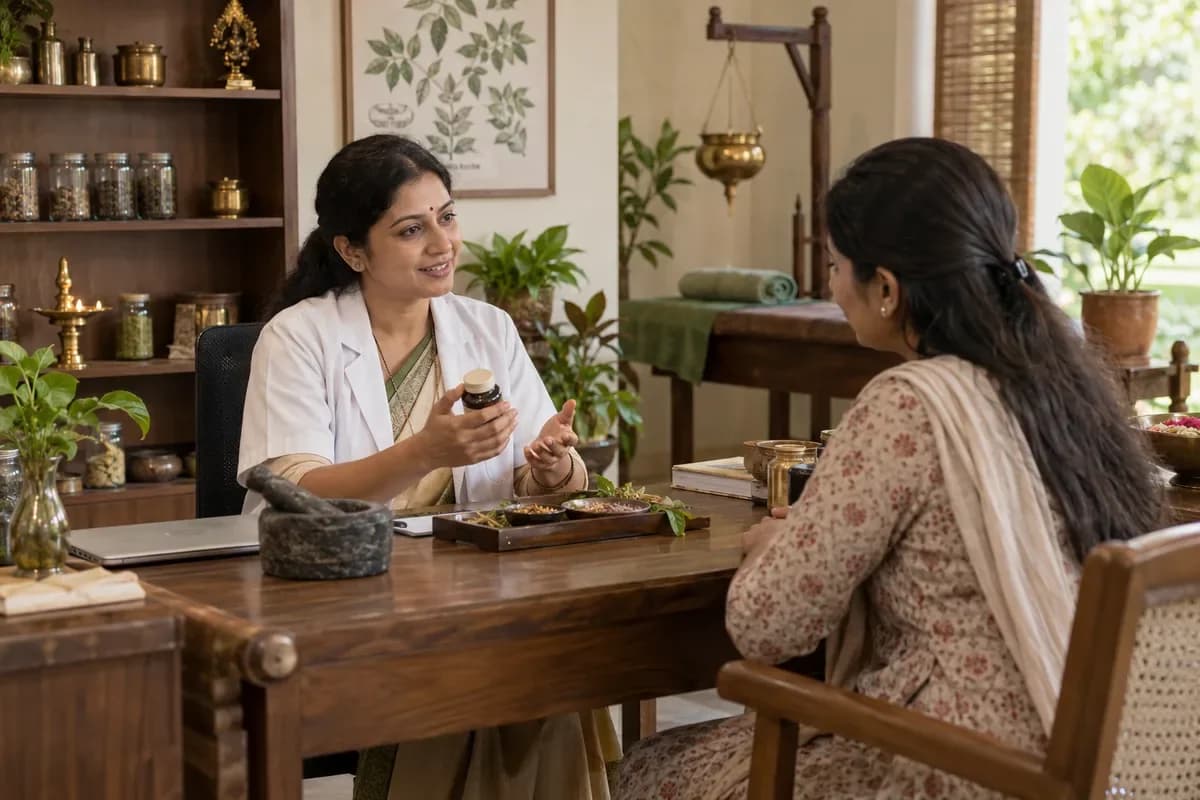
GullySystem sets up Ayurveda Clinic Management Software so that a clinic runs on one patient record, shared by its vaidyas, therapists, dispensary and front desk. The case sheet holds prescriptions with dose and anupana, day-wise therapy courses, therapy room bookings and pharmacy batches for every patient who walks in or books ahead. Branches and stores start where you choose.
What goes wrong before the software.
How the work flows through it, step by step.
- 1
Registration and appointment
A patient books by phone, on WhatsApp or walks in. The front desk opens an existing record or starts one, and gives a token or a time with a vaidya.
- 2
Consultation
The vaidya notes complaints, history, prakriti and findings, then writes the diagnosis in the clinic’s own words. Earlier visits sit on the same screen.
- 3
Prescription and course
Medicines, dose, anupana and diet advice go on the prescription. If therapy is advised, a course is planned day by day with the therapy, room and therapist.
- 4
Therapy and stay
Each sitting is marked done by the therapist. For Panchakarma, the patient’s room and stay dates are recorded alongside.
- 5
Dispensary and billing
The dispensary issues medicines from batches in stock. One bill covers consultation, therapy, medicines and room charges, paid by cash, a bank transfer or a card.
- 6
Follow-up
Each visit ends with a booked review date, and a WhatsApp or SMS nudge reaches the patient beforehand. Patients whose medicines are about to finish appear in a list.
What is inside.
Every module can be switched on, left out or changed to match how your team already works.
Patient registration and case sheets
Keep patient details, history, prakriti notes, allergies and every earlier visit in one case sheet.
Learn moreAppointments and token queue
Manage bookings, walk-ins and the waiting queue by vaidya, with reschedules and cancellations.
Learn moreConsultation and prescription
Record complaints, findings and diagnosis, then write the prescription with dose, anupana and diet advice.
Learn moreTreatment course planning
Plan therapy courses day by day, with the therapy, therapist and room, and track each sitting as it is done.
Learn moreTherapy rooms and therapists
Schedule treatment tables, steam rooms and therapists so one room is never booked twice.
Learn morePanchakarma stay management
Record in-patient room allotment, stay dates, diet, daily therapy and charges for patients who stay at the centre.
Learn moreMedicine dispensary and pharmacy stock
Issue kashayams, choornams, tablets, arishtams and oils from batches, with expiry dates and reorder levels.
Learn moreHerbs and in-house preparations
Track raw herbs, therapy oils and medicines the clinic prepares, with quantities used against each batch.
Learn moreBilling and payments
Issue one bill for consultation, therapy, medicines and room charges, with advances and cash, transfer or card payments.
Learn moreFollow-up and reminders
Set review dates and send WhatsApp or SMS reminders to patients due for review or medicine refill.
Learn moreThe business modules it is built from.
Each one is also available on its own, or inside a system built for you.
- Appointment Scheduling
Reception books appointments and walk-ins by vaidya, runs the token queue, and handles reschedules and cancellations from the same list.
- Resource and Room Booking
Treatment tables, steam rooms and therapists are scheduled together, so the therapy coordinator never books one room for two patients at once.
- Stock Tracking and Alerts
The dispensary issues kashayams, choornams, tablets, arishtams and oils from batches, with expiry dates and reorder levels watched for each item.
- Batch and Serial Tracking
Raw herbs, therapy oils and clinic-made medicines carry batch records, so the pharmacist can see which lot went into each preparation.
- Bill of Materials
Each in-house preparation has a recipe of herbs and quantities, and use is recorded against the batch it produced.
- Invoice Management
Billing staff issue one invoice covering consultation, therapy, medicines and room charges, with advances and cash, transfer or card payments applied.
- Service Reminders
Review dates are set at the visit, and patients due for review or a medicine refill appear on a daily list for the front desk.
- WhatsApp, SMS and Email Notifications
WhatsApp and SMS messages go to patients whose review or refill date has arrived, sent straight from the follow-up record.
How we would put it in.
Setup, data migration, integrations and anything built on top.
Explore moreBrowse business and AI solutions
Looking for another part of your workflow? Browse the modules by business function.
- Applicant Tracking (5)
- CRM (8)
- Finance & Accounting (10)
- Helpdesk (4)
- Human Resources (13)
- Inventory Management (5)
- Project Management (7)
- Manufacturing (6)
- Procurement (4)
- Sales and Distribution (6)
- Field Service (5)
- Statutory and Compliance (4)
- Retail and POS (4)
- Bookings and Appointments (3)
- Subscriptions (2)
- Assets and Fleet (4)
- Platform (6)
- Analytics (2)
- Documents (1)
- All business solutions
Topics beyond the modules.
Each page covers one part of how the system is used, connected or controlled.
Reports for Ayurveda clinic owners and managers
These reports come from the consultations, therapy sittings, dispensary issues and bills that the clinic already enters.
Learn moreAyurveda clinic connections to WhatsApp and payments
The Ayurveda clinic system links WhatsApp, SMS and payments to the routine of a front desk and dispensary.
Learn moreViews for vaidyas and therapists
An Ayurveda clinic has several people who touch the same patient record.
Learn moreOne system, each person sees their part.
For vaidyas
See the day’s patients, earlier case sheets, the prescription screen and the therapy courses you have advised.
For the front desk
Manage appointments, the queue, registration and billing, and see which course day each patient is on.
For therapists
See your sittings for the day, the therapy and oil advised, and mark each one done.
For the dispensary
Fill prescriptions from batches, watch expiry and reorder levels, and place supplier orders.
For owners
See patients and revenue by vaidya and therapy, courses open, stock position and who is due for review.
The numbers the owner asks for.
- Patients and revenue by vaidya
- Therapy courses open, completed and missed
- Sittings by therapist and room
- Medicines to reorder and batches near expiry
- Raw herb and oil use against preparations
- Patients due for review or medicine refill
Who this is built for.
- Single-vaidya Ayurveda clinics with a dispensary
- Ayurvedic clinics with several vaidyas and a therapy wing
- Panchakarma centres with in-patient rooms
- Ayurveda clinics that prepare some of their own medicines and oils
- Ayurvedic hospitals and centres with more than one branch
When it is not the right choice.
- A vaidya who sees a few patients a day and writes prescriptions by hand can manage with a register.
- A multi-speciality hospital with wards, labs and insurers will find Hospital/Clinic Management System fits better.
Adapted to your business before it goes live.
You are not handed a login and left to it. The product is set up around your records, your people and the tools you already use.
Works alongside
- SMS
- Card and wallet payments
- Accounting export
- Barcode or label printer
Questions to settle before choosing the system.
Review these scenarios against the product configuration and record anything that still needs to be agreed.
Appointments and token queue
What becomes available when a booking is moved or cancelled?
Use “Appointments and token queue” to move a booking, then cancel a second example. Check the released slot, the person or resource still assigned, and any amount left to settle before accepting the revised schedule.
Background reading: ERPNext: appointment records
Treatment course planning
Which observation would change the proposed scope?
For “Treatment course planning”, observe someone completing the task with a representative example. Record where they stop, ask another person or re-enter information, then choose the smallest change whose result the team can verify.
Background reading: GOV.UK: researching user needs
Questions owners ask before a demo.
Does it support Ayurvedic terms like prakriti and anupana?
Yes. Case sheet and prescription fields use your clinic’s own terms. The headings are set up with your vaidyas during implementation.
Can it plan a Panchakarma course?
Yes. A course is laid out day by day with therapy, therapist and room, and each sitting is marked done. Your vaidya decides the content of each course.
Can the pharmacy track medicine batches?
Yes. Medicines are issued from batches with expiry dates, and reorder levels flag what is running low. The dispensary issues against the prescription on the patient’s record.
Can patients book online or consult over video?
No. Appointments are entered by the front desk after a phone call, a WhatsApp message or a walk-in. Teleconsultation is not included. A patient booking page is separate work. Reminders before a visit go out on WhatsApp or SMS.
Is a therapy course sold as a prepaid package?
No. A course is planned day by day and billed as the sittings are done. An advance against the course is recorded, but there is no prepaid balance of sittings.
Is sales tax charged on medicines and therapy?
Whether tax applies to a medicine or a therapy depends on the country, so your accountant should confirm it before bills are set up. Bill formats follow what your clinic issues.
What records does a health inspection or accreditation visit ask for?
It keeps case sheets, prescriptions, sittings by therapist and room, medicine batches with expiry dates, and bills for every patient, ready to show an inspector. Whether that meets your regulator’s rules is for your own adviser to confirm, and GullySystem does not claim that the software makes a clinic compliant.
Can billing figures reach my accounting software?
Not built in. Billing and stock reports can be handed to your accountant from the software. A direct link is priced as extra work at set-up.
Who owns the patient data?
You do. The proposal sets out, for case sheets and bills, how your records can be taken out.
What does it cost?
Cost depends on how many vaidyas and therapy rooms are scheduled. It also depends on whether in-patient Panchakarma stays are managed, how large the dispensary and herb preparation stock is, and whether paper registers must be moved over. No price is published ahead of time. A demo comes first, then a quotation with a price against each part.
How soon could the vaidyas and front desk use it?
Registration with case sheets, appointments and the prescription screen suit an early start, because every patient passes through them. Therapy courses, room scheduling, stays and the dispensary follow in turn. The proposal names each stage and its dates.
What should the clinic prepare in advance?
Gather the patient register, a few case sheets and prescriptions, the therapy list with rooms, and the medicine and herb stock sheet with batches. A sample bill and a treatment course card help too. Each vaidya, the front desk, therapists and the dispensary should have one contact for questions as screens are built.
Wondering what it would cost? Share your requirements and an engineer will come back with a scope.
Every part, on its own page.
Each page covers one part of the system: what it records, who uses it and what it hands on.
- Patient Case Sheets for Ayurveda Clinics
- Appointments and Token Queue for Ayurveda Clinics
- Treatment Course Planning for Ayurveda Clinics
- Therapy Room and Therapist Scheduling
- Consultation and Prescription Records for Ayurveda Clinics
- Panchakarma Stay Management Software
- Herb and Preparation Register for Ayurveda Clinics
- Ayurveda Medicine Dispensary and Stock
- Follow-up and Reminders for Ayurveda Clinics
- Billing and Payments for Ayurveda Clinics
- Ayurveda Clinic Software Views by Role
- Ayurveda Clinic Software Connections
- Ayurveda Clinic Reports and Dashboards
Written for this trade.
Practical notes on running the business, not product marketing.
How to Automate an Ayurveda Clinic with Software
A practical guide for Ayurveda clinic owners: what to put on one patient record, how courses, rooms and the dispensary connect, and what to set up first.
Learn moreHow to Keep Ayurveda Treatment Course and Herbal Medicine Stock Records
How an Ayurveda clinic can record therapy courses day by day and track herbs, oils and medicine batches, so use of stock is traceable to patients.
Learn moreBuilt for.
The trades this product is set up for. Pick yours to see how the work runs there.
Related products.
Selling these goods online as well?
These e-commerce pages describe the online side: the storefront, dealer ordering and the connections to a system like this one.
See Ayurveda Clinic Management Software set up around your records.
Tell us how you run things today. An engineer reads it and writes back with what fits as it is, what would need changing, and what we would start with.
What happens after you share your requirements
- We review your brief and the systems you already use.
- We clarify the workflow, missing information and the work to consider first.
- The proposed scope sets out the deliverables, responsibilities and dependencies.
- Review the scope and commercial terms before deciding whether to proceed.
Start with your requirements
Describe your current process, the people involved and the change you need. Start with the details you know; we can clarify the rest together.
Share your requirements