Health and wellness · Software for podiatry clinicsFollow every foot assessment, wound dressing, orthotic and review visit on one patient record.
Podiatry clinics treat feet, nails, skin, wounds and gait problems, over a run of short visits. The software keeps assessments, treatment notes, wound progress, orthotic orders and review dates on one patient record. A recall list shows who is due back.
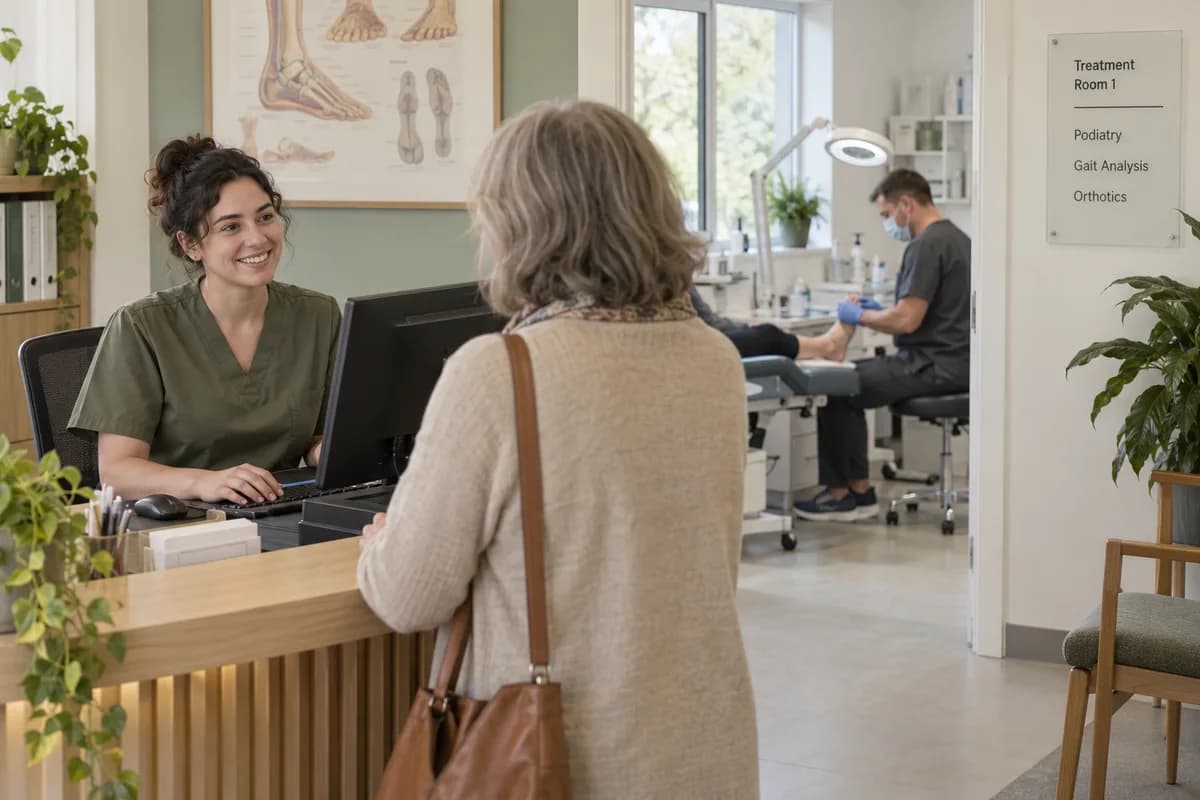
Podiatry is care by repeat visits. Nail and skin treatments recur. A foot check for a patient at risk comes round every year. A wound may need a dressing twice a week until it closes, and each visit adds a small note to a long story. Every visit adds a note. A recall list built from treatment dates shows which patients with an open wound or a yearly foot check have not been booked. The clinician can ring them before the gap grows.
Paper files and a general diary hold that story, and neither shows a wound’s progress. Orthotic orders sit with the lab by phone or email. A patient who stops attending is easy to miss, and a patient with an open wound who stops attending is a clinical concern that nobody has been asked to watch.
The front desk books short and long appointments against each podiatrist and treatment room, and checks that referral letters or cover details are on file. The podiatrist records history, footwear, circulation and sensation checks, skin and nail findings, and the plan for the next visit.
Wound patients are measured and photographed at intervals. The dressing used is noted. Biomechanical patients are assessed on gait and posture, cast or scanned for orthotics, and fitted when the devices return from the lab.
The clinic owner watches the diary, the sterilisation and consumables stock, the referrals coming in from doctors and the visiting clinicians who share the rooms and split the takings. Some work is done at care homes or in patients’ homes, away from the clinic. Billing follows each visit. Cover or referral paperwork is sent where the patient has it.
What goes wrong for podiatry clinics without a proper system.
What podiatry clinics gain from one system.
Not a feature list. These are the moments in the working day that go differently once the records sit together.
What we would build for podiatry clinics.
Named the way your team already talks about the work. We start with whichever part the audit shows is costing you most.
A requirements checklist for podiatry clinics.
What to cover, which reports to ask for and what to put to every vendor, ready to print or save as a PDF.
A product already built for podiatry clinics.
It is adapted to how your business works before it goes live, and anything your trade needs that it lacks is added then.
Podiatry Clinic Management Software
Appointments, foot assessments, wound care, orthotic orders, referrals, sterilisation records, billing and recalls for podiatry clinics.
What Podiatry Clinic Management Software covers, feature by feature
- Podiatry Appointments by Clinician and Room
- Podiatry Patient Records on One Screen
- Foot Assessment and Treatment Notes for Podiatrists
- Podiatry Wound Measurements and Photograph Timeline
- Gait and Biomechanical Assessment for Podiatry Clinics
- Orthotic and Device Order Tracking for Podiatrists
- Home and Care Home Visit Planning for Podiatrists
- Podiatry Referrals and Reports to Referring Doctors
- Podiatry Billing, Deposits and Patient Receipts
- Podiatry Supplies Stock and Sterilisation Cycle Logs
- Podiatry Recalls and Reminders for Overdue Reviews
Other products in the same sector as podiatry clinics.
- Addiction Treatment Centre Management Software
- Ayurveda Clinic Management Software
- Assisted Living Community Management Software
- Audiology Clinic Management Software
- Cardiology Clinic Management Software
- Hospital/Clinic Management System
- Chiropractic Clinic Management Software
- Counsellor and Psychotherapist Management Software
- Dental Clinic Management Software
- Skin and Aesthetics Clinic Management Software
- Diagnostic Centre Management Software
- ENT Clinic Management Software
- All industry products
The business modules podiatry clinics use most.
Each one is also available on its own, or inside a system built for you.
Appointment Scheduling
Short nail-care slots and longer assessment visits are booked against each podiatrist and treatment room. A patient on a wound dressing plan sees the next visit booked. Late cancellations reopen for the waiting list.
Learn moreTechnician Scheduling
Orthotic technicians and visiting podiatrists are scheduled for casts, fittings and domiciliary rounds. The coordinator sees who is free to fit an insole on Thursday. Travel between homes is planned.
Learn moreJob Work Management
Casts or scans sent to an outside lab for custom orthoses go out with a job number and return on a set date. The clinic sees which pair is still at the lab. Fit and reject notes are recorded.
Learn moreDocument Management
Referral letters, consent forms, footwear photos and gait reports sit under each patient with role-based access. The front desk finds the right letter quickly. Opening of a file is recorded.
Learn moreInvoice Management
A treatment visit, an orthotic order and a review each produce a clear invoice, with insurer details where relevant. Patients who pay by instalment see the balance. Accounts staff match receipts.
Learn moreStock Tracking and Alerts
Dressings, scalpel blades, padding, felt and insole blanks carry reorder levels. The nurse sees dressings running low before a wound clinic day. Sterile packs near expiry are flagged.
Learn moreService Reminders
Recall messages go to patients due for a nail review, a diabetic check or an orthotic fit check. The receptionist sees who has not replied. A booked patient drops off the list.
Learn moreTask Management
Follow-up calls, letters to the family doctor and orthotic chasers are assigned to named staff with due dates. The practice manager sees what is overdue. Done tasks close with a note.
Learn moreAll solutions by area
- Applicant Tracking (5)
- CRM (8)
- Finance & Accounting (10)
- Helpdesk (4)
- Human Resources (13)
- Inventory Management (5)
- Project Management (7)
- Manufacturing (6)
- Procurement (4)
- Sales and Distribution (6)
- Field Service (5)
- Statutory and Compliance (4)
- Retail and POS (4)
- Bookings and Appointments (3)
- Subscriptions (2)
- Assets and Fleet (4)
- Platform (6)
- Analytics (2)
- Documents (1)
Where AI can help podiatry clinics.
Each one reads records you already keep, and a person approves every decision.
The services behind it.
ERP, CRM and Business Software Implementation
Appointments by podiatrist and room, foot assessments, wound records, orthotic orders, recalls and billing are set up as one patient record. Referral and cover details sit at the front desk, and the clinic’s own assessment headings are used.
Learn moreBusiness Process Automation
A wound review can generate the next appointment. A yearly risk check can create a recall, and a lab order can prompt a fitting booking when the device is back. Reminders go to patients before each visit.
Learn moreCybersecurity and Application Security
Wound photographs, circulation findings and referral letters are health data. Role-based access, audit logs of who opened a record, encrypted storage and secure sharing with a referring doctor or care home protect each patient’s file.
Learn moreAll our other services
- Custom Software and Product Engineering
- Software Maintenance, Support and Rescue
- AI and Intelligent Automation
- API and System Integration
- Data Engineering and Business Intelligence
- UI/UX Design and Prototyping
- Cloud Engineering and Managed Infrastructure
- DevOps & Automation Services
- QA and Software Testing
- Performance Engineering
- IoT and Edge Computing
- Technology Strategy and Product Consulting
- E-Commerce and Digital Commerce
- MVP Product Development
- Web and Mobile Application Development
- SaaS Product Development
- WhatsApp Business API and Chatbots
- Data Migration and Moving Off Spreadsheets
- Training and Adoption
- Data Protection and Privacy Readiness
- Tax and e-Invoice Engineering
- Managed IT Support
- Dedicated Team and Staff Augmentation
- Business Intelligence and Reporting Tools
- Cloud Cost Optimisation
- Global Compliance and Localisation
How the work runs from Bengaluru for your city.
- 1
The audit, by call
A screen-share and a look at the sheets, accounting reports and WhatsApp groups your team uses. No travel needed.
- 2
A written proposal
Scope, what we build first and the cost, agreed in writing before anything starts.
- 3
Build in short rounds
Working screens shared every few weeks. Your team tests them from your own office.
- 4
Go-live, in person when it helps
For data migration and training we can come to your city. Travel is agreed in advance.
- 5
Support online
Fixes, changes and hosting handled remotely by the same team that built it.
Software we have built and run in this sector.
Published with the client’s agreement, with what was built and what changed.
Check the difficult cases before choosing software.
Use examples from your own records to test the workflows that matter in your business.
Referrals and reports
What does one row mean before totals are combined?
Choose one period in “Referrals and reports” and compare it with the source records. Define the date basis and grouping before accepting a total that combines several kinds of entry.
Background reading: Microsoft: reporting grain and relationships
Appointments by podiatrist and room
What becomes available when a booking is moved or cancelled?
Use “Appointments by podiatrist and room” to move a booking, then cancel a second example. Check the released slot, the person or resource still assigned, and any amount left to settle before accepting the revised schedule.
Background reading: ERPNext: appointment records
Questions podiatry clinics ask before they call.
Can it follow a wound from visit to visit?
Yes. Each visit adds a measurement, a photograph and the dressing used. The podiatrist opens one view of the wound from its first visit to the latest, and the clinic decides which measures to record.
Does it cover visits made outside the clinic?
Yes. Home and care home visits are booked like any other appointment. Notes keyed in on a handheld device land directly in the patient’s chart.
Can orthotic orders be tracked from the assessment?
Yes. The order starts from the gait assessment, goes to the lab with a due date and is marked received and fitted. The desk sees a list of devices still outstanding.
Does it send claims to payers?
Not by default. Each country and each payer has its own referral and cover conditions. Claim documents can be printed for the patient, and any direct submission is quoted separately during implementation.
How is a foot clinic’s system quoted?
By the number of podiatrists, rooms and sites, the front desk and clinical users, and the parts picked: wound tracking, orthotic orders, referrals or recalls. Visits outside the clinic and a billing link are counted. Each part carries a separate price.
What should a podiatry practice gather first?
A treatment note form, a wound chart, an orthotic order sheet, a referral letter format and the sterilisation record. Nominate the lead podiatrist and the reception lead to look over what is shown.
What happens to patient records if the clinic moves on?
They stay with the clinic, as does the code. Notes, wound photos and orthotic orders leave in plain files. Support remains with us, and GullySystem hosts unless the clinic would prefer its own host.
What happens after I share my requirements?
We review your brief and clarify the work with you. We then look at the software, spreadsheets and WhatsApp groups your business runs on today and write down what works, what slows your team down and what is missing. A demo login, a screen-share or a few screenshots are enough. You get a short written summary ordered by priority, with no obligation to hire us afterwards.
How much will the software cost?
We don’t publish a price, because it depends on what the system has to do. That first review settles the scope, and the cost goes into a written proposal before any work starts.
Related industries.
- Addiction treatment centres
- Alternative medicine practices
- Assisted and senior living communities
- Audiology and hearing clinics
- Cardiology clinics
- Chiropractic clinics
- Clinics and doctors
- Counsellors and psychotherapists
- Dental clinics
- Dermatology clinics
- Diagnostic and imaging centres
- ENT clinics
- Eye hospitals and clinics
- Fertility and IVF clinics
- Gyms and fitness studios
- Hospice providers
- Hospitals and nursing homes
- In-home care providers
- Nutritionists and dietitians
- OB-GYN clinics
- Occupational therapy clinics
- Optometrists
- Orthodontic clinics
- Orthopaedic hospitals and clinics
- Pathology labs
- Physiotherapists
- Plastic surgery clinics
- Psychiatry clinics
- Speech therapy clinics
- Telehealth providers
- Urgent care centres
- Urology clinics
- Veterinary clinics
- Wellness centres
Part of a wider group.
Tell us how your business runs today.
A few lines on your spreadsheets, software and WhatsApp groups is enough. We reply the same working day.
What happens after you share your requirements
- We review your brief and the systems you already use.
- We clarify the workflow, missing information and the work to consider first.
- The proposed scope sets out the deliverables, responsibilities and dependencies.
- Review the scope and commercial terms before deciding whether to proceed.
Start with your requirements
Describe your current process, the people involved and the change you need. Start with the details you know; we can clarify the rest together.
Share your requirements