Kathmandu · CountriesKathmandu’s trekking agents, hotels, schools, cooperatives and aid groups all work from one crowded valley.
Kathmandu is Nepal’s capital and the main gateway for trekkers and climbers. Agencies in Thamel plan treks, New Road traders sell imported goods, and schools, cooperatives and aid groups keep their records here. GullySystem, in Bengaluru, writes booking, member and fee software.
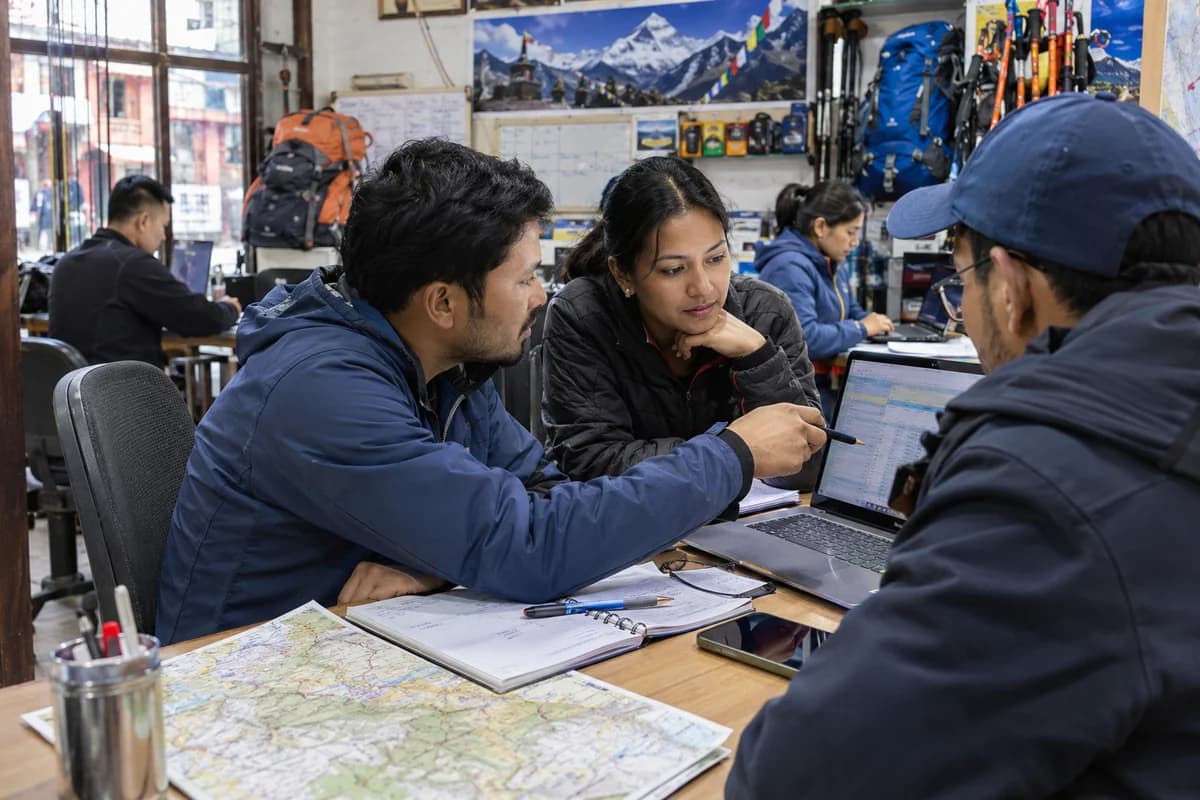
The valley holds the state, the airport and most head offices. Trekking agencies sell permits and flights in spring and autumn, then wait through the monsoon. Aid groups and cooperatives report to regulators and donors all year.
Records stay on paper far longer than owners like. Kathmandu runs fifteen minutes ahead of India. Saturday is the weekly holiday, so planning calls is simple. Nepali and English share most contracts.
The districts, business parks and markets that matter in Kathmandu.
How Kathmandu businesses pick and use software.
Trekking and travel agencies that sell permits, flights and guides and must settle with each supplier. Each trip involves permits, flights, guides, porters and lodges, and a change in one item ripples through all the others within a day or two. Permits are checked at the gate.
Cooperatives and NGOs that report to regulators and donors and need member and grant records in order. Regulators and donors both ask for records that match, and staff spend weeks before each audit rebuilding numbers from registers and spreadsheets. Audits loom.
Where Kathmandu businesses lose time and money.
Trek bookings change daily
Weather closes a flight. A guide falls ill. One itinerary record per trip keeps guides, lodges and clients informed together. A client who changes the date by two days affects the flight, the hotel, the guide’s schedule and the supplier invoices, and the agent must tell each of them by hand.
Donor reports take weeks to assemble
Spending sits in spreadsheets by project. A shared ledger tagged by grant produces each report from one place. Donors expect the same figures to match the audited accounts, the project plan and the monthly narrative, and mismatches lead to long email chains. When a grant officer asks which receipts support a particular line, the finance team can open the entry and see the invoice, the approval and the payment date together.
Cooperative members’ savings are in registers
Deposits and loans are written by hand. A member ledger with interest worked out on schedule answers a balance question in seconds. Staff retype the same entries.
What we would build for Kathmandu businesses.
Usually in this order, starting with whatever the audit ranks first.
WhatsApp Business API and Chatbots
WhatsApp Business API work covers number onboarding, template approval, opt-in records and a chatbot with human handover, all set up under the client’s own Meta account. It connects WhatsApp to a CRM, billing or booking system, so every message is sent from an existing record and every reply is written back. It suits businesses that already take orders, payments or bookings in chat.
Learn moreGlobal Compliance and Localisation
Software has to change for each country. Currency tables, VAT and sales tax codes, invoice layouts, translation files, storage regions and consent records are built as configuration that your team can edit without code changes. The legal question stays with your adviser.
Learn moreData Migration and Moving Off Spreadsheets
Data migration and spreadsheet replacement covers auditing existing files, cleaning and deduplicating records, loading them into a new system and reconciling the loaded result against known totals. Both systems then run side by side before cutover. Originals stay untouched.
Learn moreReady products that fit Kathmandu businesses.
Each one is adapted to how your business works before it goes live, and anything your trade needs that it lacks is added then. You are not paying to build the basics again.
Travel Agency Management Software
Enquiries, day-wise itineraries and costing, supplier bookings, vouchers, advances and balances, cancellations, refunds and corporate receivables for travel agencies.
Learn moreNGO and Trust Management Software
Donors, receipts, fund heads, programmes, beneficiaries, grants, volunteers and trustee reporting for NGOs and charitable trusts.
Learn moreCooperative Bank Management Software
Member register, share capital, passbook savings, fixed and recurring deposits, agent collection sheets, loans with sureties, committee resolutions, branch cash count and board reports for cooperative banks.
Learn moreHow the work runs from Bengaluru for Kathmandu.
- 1
The audit, by call
A screen-share and a look at the sheets, accounting reports and WhatsApp groups your team uses. No travel needed.
- 2
A written proposal
Scope, what we build first and the cost, agreed in writing before anything starts.
- 3
Build in short rounds
Working screens shared every few weeks. Your team tests them from your own office.
- 4
Go-live, in person when it helps
For data migration and training we can come to Kathmandu. Travel is agreed in advance.
- 5
Support online
Fixes, changes and hosting handled remotely by the same team that built it.
The work we have published.
We don’t claim Kathmandu clients we don’t have. These are systems our team built; the way we work is the same wherever you are.
PetSeva: matching owners to the right vet, at any hour
A two-sided veterinary platform where vets are searchable by specialisation and bookable outside clinic hours. It now carries more than 2,000 veterinary doctors.
Read the case study Paying guest accommodationSAM Atithi Pavathi: bed-level occupancy as the source of truth
PG management software where allocation, rates and invoices are derived from bed-level occupancy and not maintained in parallel spreadsheets.
Read the case study School transport servicesSAM Tours: school transport on a single ledger
Registration, fee collection, routing and finance write to the same records, closing the gap between journeys run and fees collected.
Read the case study Microfinance and Self Help GroupsVikasa RDO: making SHG loan recovery auditable
Loan proposals, recoveries and commissions sit on one record, with a person attached to every state change, so a business handling a bank’s money can show where each rupee went.
Read the case studyMake the scope specific to your business.
Work through a real example from your operation and agree the handoffs, controls and support the project needs.
Donor reports take weeks to assemble
What does one row mean before totals are combined?
Choose one period in “Donor reports take weeks to assemble” and compare it with the source records. Define the date basis and grouping before accepting a total that combines several kinds of entry.
Background reading: Microsoft: reporting grain and relationships
Trek bookings change daily
What becomes available when a booking is moved or cancelled?
Use “Trek bookings change daily” to move a booking, then cancel a second example. Check the released slot, the person or resource still assigned, and any amount left to settle before accepting the revised schedule.
Background reading: ERPNext: appointment records
Questions Kathmandu owners ask before they call.
Can a Thamel trekking agency manage permits, guides and lodges per trip?
Yes. Each trip record lists the permits, guides, porters, lodges and payments, and shows which items are still open before the group flies out.
Can a Kathmandu cooperative keep member savings and loans together?
Yes. Each member has one ledger with deposits, loans, interest and repayments, and staff can print a statement for any date.
What happens after I share my requirements?
We review your brief and clarify the work with you. We then look at the software, spreadsheets and WhatsApp groups your business runs on today and write down what works, what slows your team down and what is missing. A demo login, a screen-share or a few screenshots are enough. You get a short written summary ordered by priority, with no obligation to hire us afterwards.
How much will the software cost?
We don’t publish a price, because it depends on what the system has to do. That first review settles the scope, and the cost goes into a written proposal before any work starts.
Industries we build for in Kathmandu.
Elsewhere in Nepal.
Tell us what your Kathmandu business runs on today.
Send a short note on the spreadsheets, software or WhatsApp groups your team depends on. We reply the same working day.
What happens after you share your requirements
- We review your brief and the systems you already use.
- We clarify the workflow, missing information and the work to consider first.
- The proposed scope sets out the deliverables, responsibilities and dependencies.
- Review the scope and commercial terms before deciding whether to proceed.
Start with your requirements
Describe your current process, the people involved and the change you need. Start with the details you know; we can clarify the rest together.
Share your requirements