Payyannur · LocationsPayyannur’s coconut farms, colleges and Gulf-linked shops keep accounts for small sellers across the town.
Payyannur, in northern Kannur district, is remembered for the 1930 salt march led by K. Kelappan. Today it is a trading town with coconut farms, handloom and weaving traditions, colleges, and families with Gulf incomes. The naval academy at Ezhimala is nearby. The team works from Bengaluru and supports Payyannur clients through calls and chat.
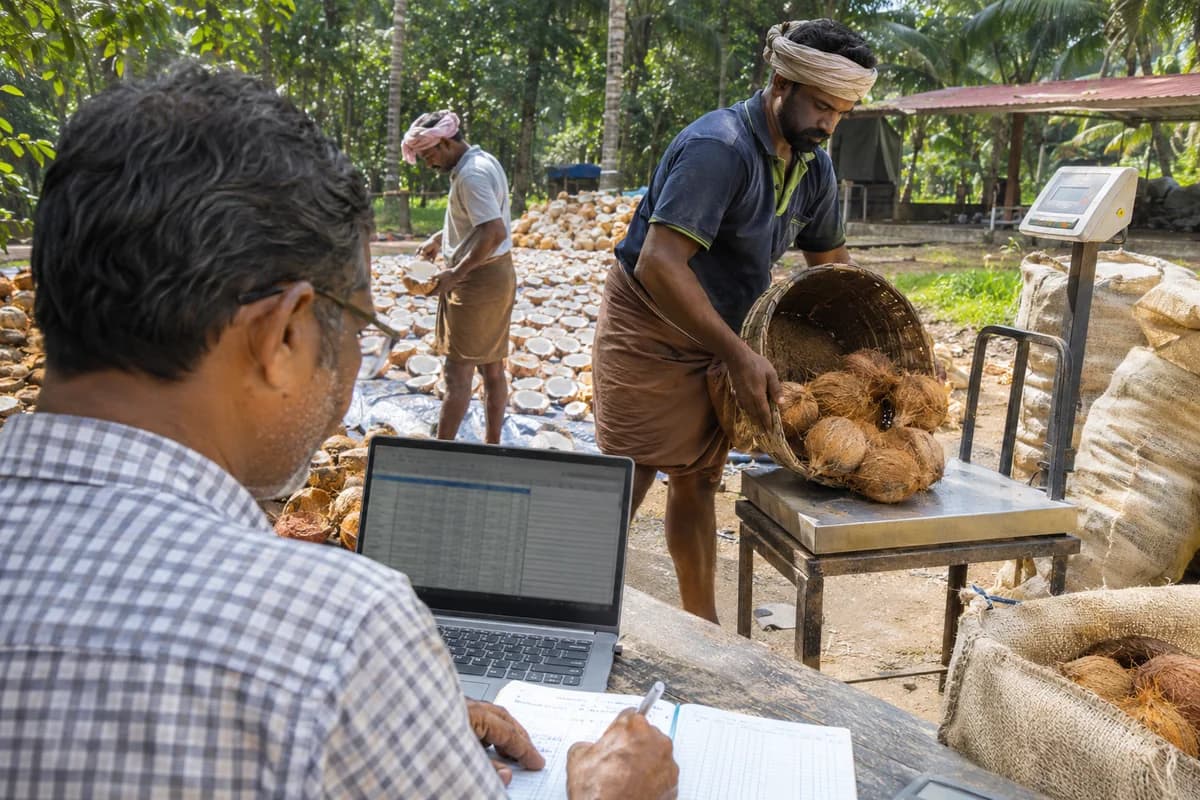
Coconut is the farm base. Owners sell nuts, copra and coconut oil through local traders, and climbers are paid per tree or per round. Seasonal rain affects drying, so copra yards track the weather as closely as the price.
Kannur district has a long handloom tradition. Several weaving units work in the area. Colleges in and around town bring students into rented rooms, and the backwaters at Kavvayi attract visitors who stay in homestays and boat houses.
The areas, estates and markets that matter in Payyannur.
How Payyannur businesses pick and use software.
Coconut owners with more than one plot want yield per plot and per round. Climber pay follows the same count.
Hostel and rental owners deal with students who pay on varied dates, so a clear due list saves a daily round of calls and awkward conversations at the door.
Where Payyannur businesses lose time and money.
Harvest rounds are remembered
Nuts picked on each round are counted by the climber and the owner, but when copra is sold nobody can match the figures to a plot.
Hostel rents slip
Students pay in parts, their parents pay by transfer, and deposits are returned at the year end. The ledger is a pocket notebook.
Boat trips are booked by call
A homestay and a boat operator share a guest but not a record. Cancellations are passed on by message and reach the desk late.
What we would build for Payyannur businesses.
Usually in this order, starting with whatever the audit ranks first.
Web and Mobile Application Development
Web and mobile apps for customers, field staff and dealers, built to work on ordinary phones.
Learn moreBusiness Process Automation
Approvals, reminders and reports triggered by agreed rules, with exceptions assigned to a responsible person.
Learn moreERP, CRM and Business Software Implementation
One record of stock, orders, customers and accounts, set up so your team opens it every day.
Learn moreData Engineering and Business Intelligence
Dashboards that answer the owner’s Monday questions without anyone building an Excel sheet first.
Learn moreReady products that fit Payyannur businesses.
Each one is adapted to how your business works before it goes live, and anything your trade needs that it lacks is added then. You are not paying to build the basics again.
Crop Farm Management Software
Field plans, input stores, spray logs, machine hours, harvest weighbridge tickets, bin stock and grain contracts for arable crop farms.
Learn morePaying Guest Management System
Bed-level occupancy, rent and food billing, deposits and tenant documents for PG owners, set up around your blocks and sharing rates.
Learn moreHomestays and Guesthouse Management Software
Room and bed calendar, enquiries, guest register, deposits, meals, extras, housekeeping and bills for homestays and guesthouses.
Learn moreHow the work runs from Bengaluru for Payyannur.
- 1
The audit, by call
A screen-share and a look at the sheets, accounting reports and WhatsApp groups your team uses. No travel needed.
- 2
A written proposal
Scope, what we build first and the cost, agreed in writing before anything starts.
- 3
Build in short rounds
Working screens shared every few weeks. Your team tests them from your own office.
- 4
Go-live, in person when it helps
For data migration and training we can come to Payyannur. Travel is agreed in advance.
- 5
Support online
Fixes, changes and hosting handled remotely by the same team that built it.
The work we have published.
We don’t claim Payyannur clients we don’t have. These are systems our team built; the way we work is the same wherever you are.
PetSeva: matching owners to the right vet, at any hour
A two-sided veterinary platform where vets are searchable by specialisation and bookable outside clinic hours. It now carries more than 2,000 veterinary doctors.
Read the case study Paying guest accommodationSAM Atithi Pavathi: bed-level occupancy as the source of truth
PG management software where allocation, rates and invoices are derived from bed-level occupancy and not maintained in parallel spreadsheets.
Read the case study School transport servicesSAM Tours: school transport on a single ledger
Registration, fee collection, routing and finance write to the same records, closing the gap between journeys run and fees collected.
Read the case study Microfinance and Self Help GroupsVikasa RDO: making SHG loan recovery auditable
Loan proposals, recoveries and commissions sit on one record, with a person attached to every state change, so a business handling a bank’s money can show where each rupee went.
Read the case studyMake the scope specific to your business.
Work through a real example from your operation and agree the handoffs, controls and support the project needs.
Harvest rounds are remembered
Which observation would change the proposed scope?
For “Harvest rounds are remembered”, observe someone completing the task with a representative example. Record where they stop, ask another person or re-enter information, then choose the smallest change whose result the team can verify.
Background reading: GOV.UK: researching user needs
Questions Payyannur owners ask before they call.
Can a coconut owner log each harvest round by plot?
Yes. A round records nuts picked, climber and plot, and copra sales are linked back. Pay for the climber follows the same entry.
Can a hostel owner see rent due for each student?
Yes. Each resident has a ledger of rent, deposit and part payments, and a due list can be shared by WhatsApp, so the owner sees at a glance who has paid this month.
What happens after I share my requirements?
We review your brief and clarify the work with you. We then look at the software, spreadsheets and WhatsApp groups your business runs on today and write down what works, what slows your team down and what is missing. A demo login, a screen-share or a few screenshots are enough. You get a short written summary ordered by priority, with no obligation to hire us afterwards.
How much will the software cost?
We don’t publish a price, because it depends on what the system has to do. That first review settles the scope, and the cost goes into a written proposal before any work starts.
Industries we build for in Payyannur.
Tell us what your Payyannur business runs on today.
Send a short note on the spreadsheets, software or WhatsApp groups your team depends on. We reply the same working day.
What happens after you share your requirements
- We review your brief and the systems you already use.
- We clarify the workflow, missing information and the work to consider first.
- The proposed scope sets out the deliverables, responsibilities and dependencies.
- Review the scope and commercial terms before deciding whether to proceed.
Start with your requirements
Describe your current process, the people involved and the change you need. Start with the details you know; we can clarify the rest together.
Share your requirements