Staff rota and shifts for cinemas
The rota plans shifts around the show times. Box office, floor, kitchen and projection each have their own cover, and the manager sees it beside the programme. After the shift, the hours each person worked are recorded, so the sheet at the end of the week shows what happened.
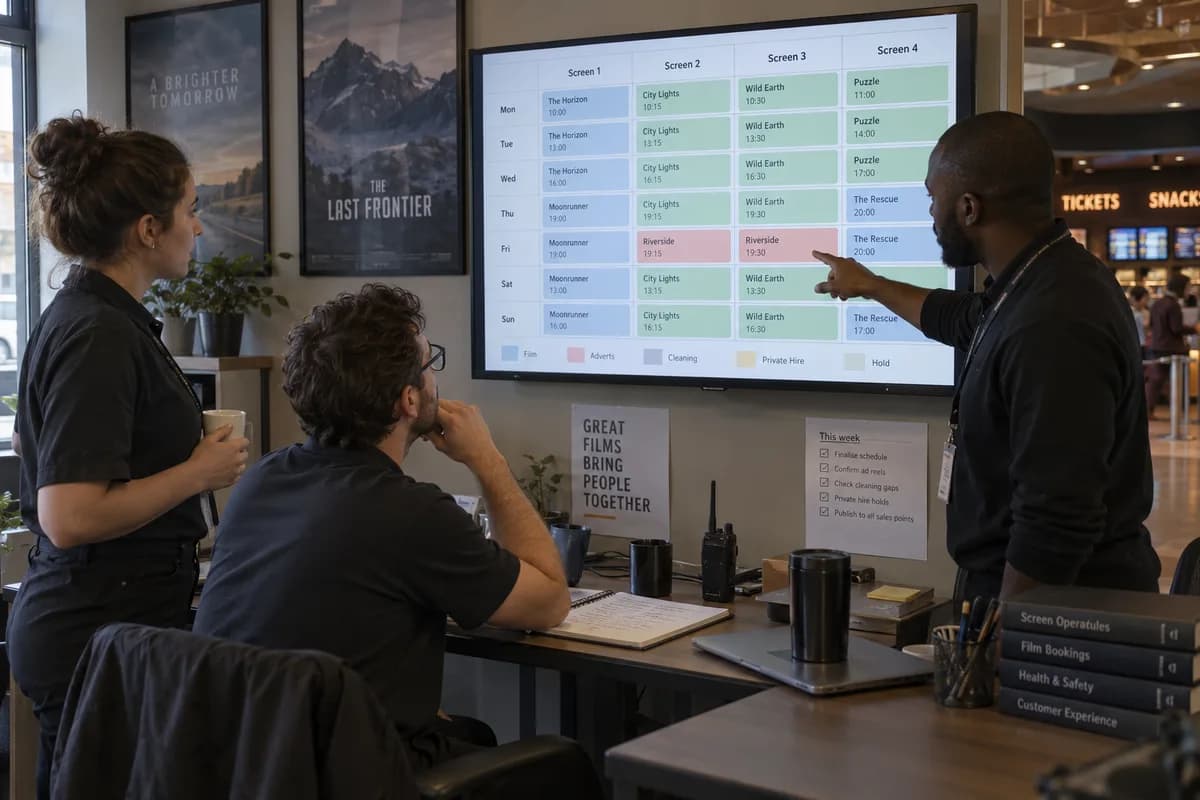
What a cinema staff rota records
A cinema runs on small teams working in several places at once, from the door to the booth. It keeps each team’s shifts as records, set against the shows they serve, along with the hours that people then worked. Here is what each record holds.
A cinema rota through the week
The rota is drawn once and tested daily. Shows move, a film runs long, someone falls ill, and the plan has to bend. Four moments show how the rota is used, from the first draft to the final hours entered.
Who plans, works and reads the rota
Everyone is on the rota. Few write it. Each role below sees the sheet from its own place, as a worker, a planner or a reader. Who may change a shift is agreed at set-up.
Staff rota decisions to settle before set-up
A rota touches pay and trust. Its rules deserve care. Settle the points below with the owner and the manager before the first week is drawn, and tell staff how the sheet will work.
How the rota connects to the cinema
Planning starts from the programme and reports back to it. It takes show times from the schedule and rosters the box office, floor, kitchen and projection teams around them. Hours worked go on to the owner and the accounts. The five links below name the handoffs.
- Takes show times and screens from the show schedule
- Plans kitchen shifts around the snack counter’s busy shows
- Plans box office cover around the ticket sales points
- Lists projection shifts beside the equipment log
- Gives the accounting export the hours worked
Where the staff rota stops
Shifts and hours are its whole job. It does not work out pay, check that the rota meets employment or working-time rules, or hire and train anyone. Wages, leave and the legal duty to staff belong to the owner and an adviser. It records time that is entered, not time that goes unreported. A theatre with a handful of regular staff can pin a printed sheet to the wall.
Frequently asked questions
Can shifts follow a change to the programme?
Yes, shifts are read beside the programme. When a show moves or is added, the manager moves the shifts to match. The change is made on the rota, and the people affected are told. Nothing is redrawn from scratch.
Does it record the hours someone really worked?
Yes, hours are entered after the shift. They may differ from the plan, and both can be read. The owner and the accountant use the record, not the draft. Who enters them is a set-up choice.
Can the kitchen and box office have separate shifts?
Each team has its own shifts. The kitchen and the box office are planned apart but sit on one sheet. A gap in one team shows plainly beside the cover of another. Cover is read team by team.
Will it work out wages from the hours?
It records hours and does not pay anyone. Pay rates and any local rules are applied by the owner’s payroll or the accountant. Ask at the demo what can be exported to them. Wage rules differ by place, so they stay outside.
Who sees the whole rota?
Managers see the whole rota. Staff see their own shifts and their team’s, or only their own, as set-up decides. Owners read the hours worked. Access is agreed with the owner during implementation. Pay figures are not part of the sheet.
How this feature fits the system.
Movie Theatre Management Software: the parts that work with this feature, the trades that use it and the ways to put it in place.
Screens and show schedule
Each screen is a shared resource booked by show, with cleaning gaps and advert reels, so overlapping shows are flagged before publishing.
Resource and Room BookingTicket sales at counter, kiosk and online
The booking page shows live seats from the same map the box office uses, so a ticket sold online is gone at the counter.
Online Booking PortalConcession sales and combos
The counter screen sells snacks, drinks and combos, with each combo priced against the items inside it and a bill printed at once.
Point of Sale BillingTell us what you need.
Tell us what your team does today, where work gets stuck and what you want to change.
What happens after you share your requirements
- We review your brief and the systems you already use.
- We clarify the workflow, missing information and the work to consider first.
- The proposed scope sets out the deliverables, responsibilities and dependencies.
- Review the scope and commercial terms before deciding whether to proceed.
Start with your requirements
Describe your current process, the people involved and the change you need. Start with the details you know; we can clarify the rest together.
Share your requirements