Run screenings, ticket sales, concessions and film bookings from one record.
A cinema earns from tickets, concessions and screen advertising, and these rarely share a record. Movie theatre software holds the screen schedule, seat sales, concession stock, film bookings and distributor settlements together. Box office, kiosk and online sales feed one count for each show. Managers read attendance, takings and stock without adding sheets by hand.
A cinema sells the same seat again at each showing, and each showing has its own count, its own price band and its own film terms. Tickets sell at the box office, at a kiosk and online. Concession sales run on separate tills.
Movie theatre software joins these into one record per showing. Screens, shows, seats, tickets, snack stock and film rental settlements are linked, so the manager sees the day as a single account. Nothing is rebuilt from till rolls at night.
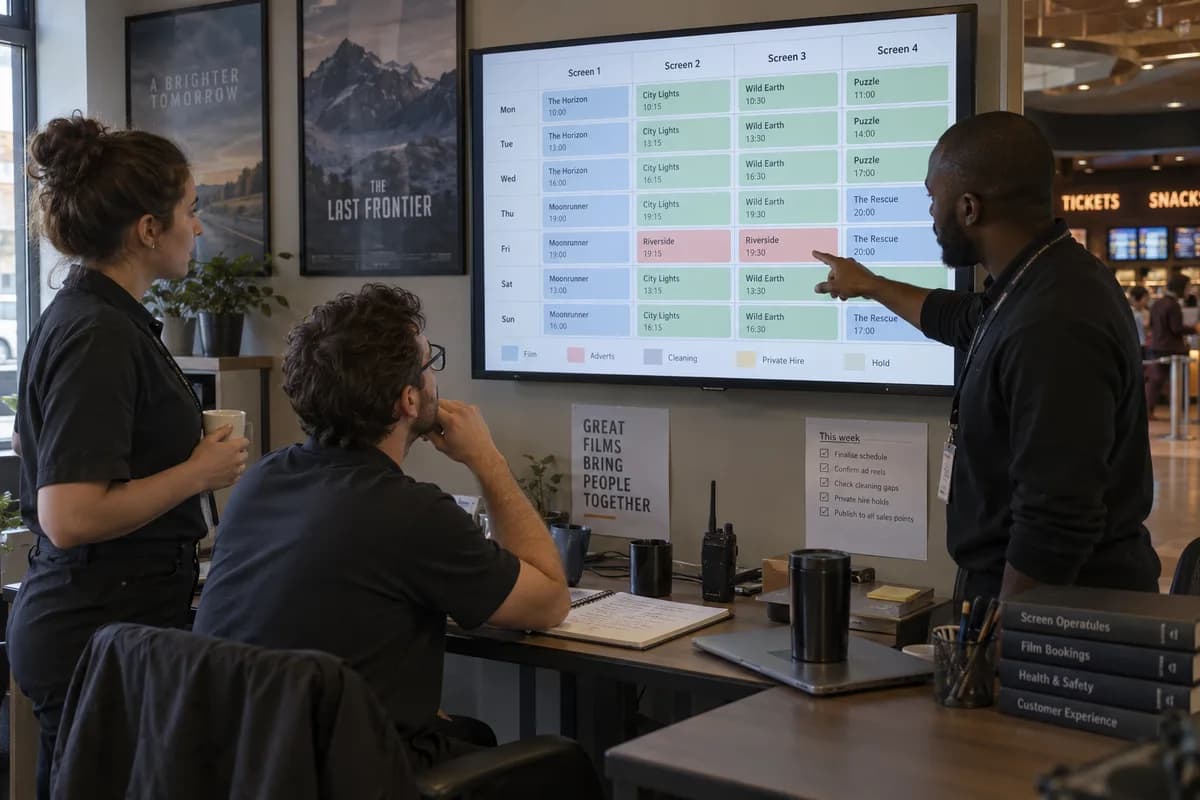
The programme is set a week ahead. Each film is booked from a distributor on agreed terms, either a share of the box office or a flat rental, with a minimum run of days. Screens are scheduled with cleaning gaps and advert reels between shows. Seats are held back for private hire or a press show.
On the day, the box office, kiosks and website sell against one seat map, with adult, child and concession price bands. The snack counter keeps its own stock of popcorn, drinks and packaging. At close, the manager reconciles tickets sold against admissions scanned and prepares the distributor return. Projectors and sound systems are serviced on a cycle.
What goes wrong for movie theatres without a proper system.
What we would build for movie theatres.
Named the way your team already talks about the work. We start with whichever part the audit shows is costing you most.
A requirements checklist for movie theatres.
What to cover, which reports to ask for and what to put to every vendor, ready to print or save as a PDF.
A product already built for movie theatres.
It is adapted to how your business works before it goes live, and anything your trade needs that it lacks is added then.
Movie Theatre Management Software
Show schedules, seat maps, ticketing, concession stock, film bookings, distributor settlements, private hire and staff shifts for cinemas and movie theatres.
Other products in the same sector as movie theatres.
The business modules movie theatres use most.
Each one is also available on its own, or inside a system built for you.
- Resource and Room Booking
- Online Booking Portal
- Point of Sale Billing
- Stock Tracking and Alerts
- Contract Management
- Loyalty and Offers
- Attendance & Time Tracking
- Asset AMC Tracking
- All business solutions
All solutions by area
- Applicant Tracking (5)
- CRM (8)
- Finance & Accounting (10)
- Helpdesk (4)
- Human Resources (13)
- Inventory Management (5)
- Project Management (7)
- Manufacturing (6)
- Procurement (4)
- Sales and Distribution (6)
- Field Service (5)
- Statutory and Compliance (4)
- Retail and POS (4)
- Bookings and Appointments (3)
- Subscriptions (2)
- Assets and Fleet (4)
- Platform (6)
- Analytics (2)
- Documents (1)
Where AI can help movie theatres.
Each one reads records you already keep, and a person approves every decision.
The services behind it.
Business Process Automation
Approvals, reminders and reports triggered by agreed rules, with exceptions assigned to a responsible person.
Learn moreWeb and Mobile Application Development
Web and mobile apps for customers, field staff and dealers, built to work on ordinary phones.
Learn moreE-Commerce and Digital Commerce
An online store or B2B order portal wired to your stock, billing and dispatch.
Learn moreData Engineering and Business Intelligence
Dashboards that answer the owner’s Monday questions without anyone building an Excel sheet first.
Learn moreAll our other services
- Custom Software and Product Engineering
- Software Maintenance, Support and Rescue
- AI and Intelligent Automation
- API and System Integration
- ERP, CRM and Business Software Implementation
- UI/UX Design and Prototyping
- Cloud Engineering and Managed Infrastructure
- DevOps & Automation Services
- QA and Software Testing
- Performance Engineering
- Cybersecurity and Application Security
- IoT and Edge Computing
- Technology Strategy and Product Consulting
- MVP Product Development
- SaaS Product Development
- WhatsApp Business API and Chatbots
- Data Migration and Moving Off Spreadsheets
- Training and Adoption
- Data Protection and Privacy Readiness
- Tax and e-Invoice Engineering
- Managed IT Support
- Dedicated Team and Staff Augmentation
- Business Intelligence and Reporting Tools
- Cloud Cost Optimisation
- Global Compliance and Localisation
How the work runs from Bengaluru for your city.
- 1
The audit, by call
A screen-share and a look at the sheets, accounting reports and WhatsApp groups your team uses. No travel needed.
- 2
A written proposal
Scope, what we build first and the cost, agreed in writing before anything starts.
- 3
Build in short rounds
Working screens shared every few weeks. Your team tests them from your own office.
- 4
Go-live, in person when it helps
For data migration and training we can come to your city. Travel is agreed in advance.
- 5
Support online
Fixes, changes and hosting handled remotely by the same team that built it.
The work we have published.
We only name clients whose work is published. None of them is in this trade; they show how the team works, not that it has built for this trade.
PetSeva: matching owners to the right vet, at any hour
A two-sided veterinary platform where vets are searchable by specialisation and bookable outside clinic hours. It now carries more than 2,000 veterinary doctors.
Read the case study Paying guest accommodationSAM Atithi Pavathi: bed-level occupancy as the source of truth
PG management software where allocation, rates and invoices are derived from bed-level occupancy and not maintained in parallel spreadsheets.
Read the case study School transport servicesSAM Tours: school transport on a single ledger
Registration, fee collection, routing and finance write to the same records, closing the gap between journeys run and fees collected.
Read the case study Microfinance and Self Help GroupsVikasa RDO: making SHG loan recovery auditable
Loan proposals, recoveries and commissions sit on one record, with a person attached to every state change, so a business handling a bank’s money can show where each rupee went.
Read the case studyCheck the difficult cases before choosing software.
Use examples from your own records to test the workflows that matter in your business.
Film bookings and distributor settlement
What becomes available when a booking is moved or cancelled?
Use “Film bookings and distributor settlement” to move a booking, then cancel a second example. Check the released slot, the person or resource still assigned, and any amount left to settle before accepting the revised schedule.
Background reading: ERPNext: appointment records
Concession stock and sales
What happens to movements entered while a count is being checked?
For “Concession stock and sales”, choose a count date and trace the movements around it. Agree who investigates a difference before an adjustment changes the available balance.
Background reading: ERPNext: stock reconciliation
Questions movie theatres ask before they call.
Can the box office, kiosks and website sell against the same seat map?
Yes. All three use one seat map for each show. A seat sold at one point is gone from the others at once, so a double sale does not happen.
Can it prepare the return that a film distributor asks for?
Yes. Net takings for each show, the days run and the agreed share are drawn from the ticket record. The layout each distributor requires is confirmed during implementation.
Does a single-screen cinema need it?
Not always. One screen with a weekly programme can run on a ticket book and a simple sheet. Several screens, a kiosk and a busy snack counter make a different job.
Can the snack counter run on it as well?
Yes. The counter sells from its own stock list, and combos draw down the items they contain. Reorder levels are set item by item.
Which choices set the cost of a cinema system?
It follows the parts selected: screens and schedule, ticketing across counter, kiosk and web, film bookings, distributor settlement, concession stock and equipment log. Screen count, kiosks, printers and staff accounts affect the size, and a payment link is separate work. Once we have shown screens, every part receives its own price.
What should a theatre gather before work starts?
Collect a weekly schedule, a seat map, a distributor booking and settlement sheet, the concession stock list and the equipment service log. The manager, a box office lead and a snack counter supervisor will be asked questions and shown screens as they appear. Choose them early.
Who holds the ticket and settlement records afterwards?
The theatre does. Shows, sales and settlements, along with the code behind them, are all yours, and any of it can go out as spreadsheets whenever you ask. Support stays with the developers. GullySystem hosts it, or you may run it on your own machine. That is the whole arrangement.
What happens after I share my requirements?
An engineer reads what you send and replies within one business day. We then look at the software, spreadsheets and WhatsApp groups your business runs on today and write down what works, what slows your team down and what is missing. A demo login, a screen-share or a few screenshots are enough. You get a short written summary ordered by priority, with no obligation to hire us afterwards.
How much will the software cost?
We don’t publish a price, because it depends on what the system has to do. That first review settles the scope, and the cost goes into a written proposal before any work starts.
Part of a wider group.
Tell us how your business runs today.
A few lines on your spreadsheets, software and WhatsApp groups is enough. We reply the same working day.
What happens after you share your requirements
- A senior engineer reads your answers. Nobody phones first.
- Within one business day you get a written note: what we understood, what we would start with, and the questions we still have.
- If it fits, a proposal follows with the order of work, what we need from you and what you receive at each step.
- No call is booked and nothing is paid until you have read the note. Your details stay with us.
Start with your requirements
Seven short steps that tell us what you need. A senior engineer reads them before anyone gets in touch.
Share your requirements