Venice · CountriesVenice runs on boats, glass, visitors, festivals and the long habit of doing everything across water.
Venice moves by water. Deliveries arrive by boat, taxis are motorboats, and glassmakers on Murano shape objects that are sold worldwide. Festivals such as the Biennale and the film festival bring crowds to the lagoon. Mestre and Marghera, on the mainland, hold offices and industry. GullySystem, a Bengaluru company, writes booking, shop and transport software for such businesses.
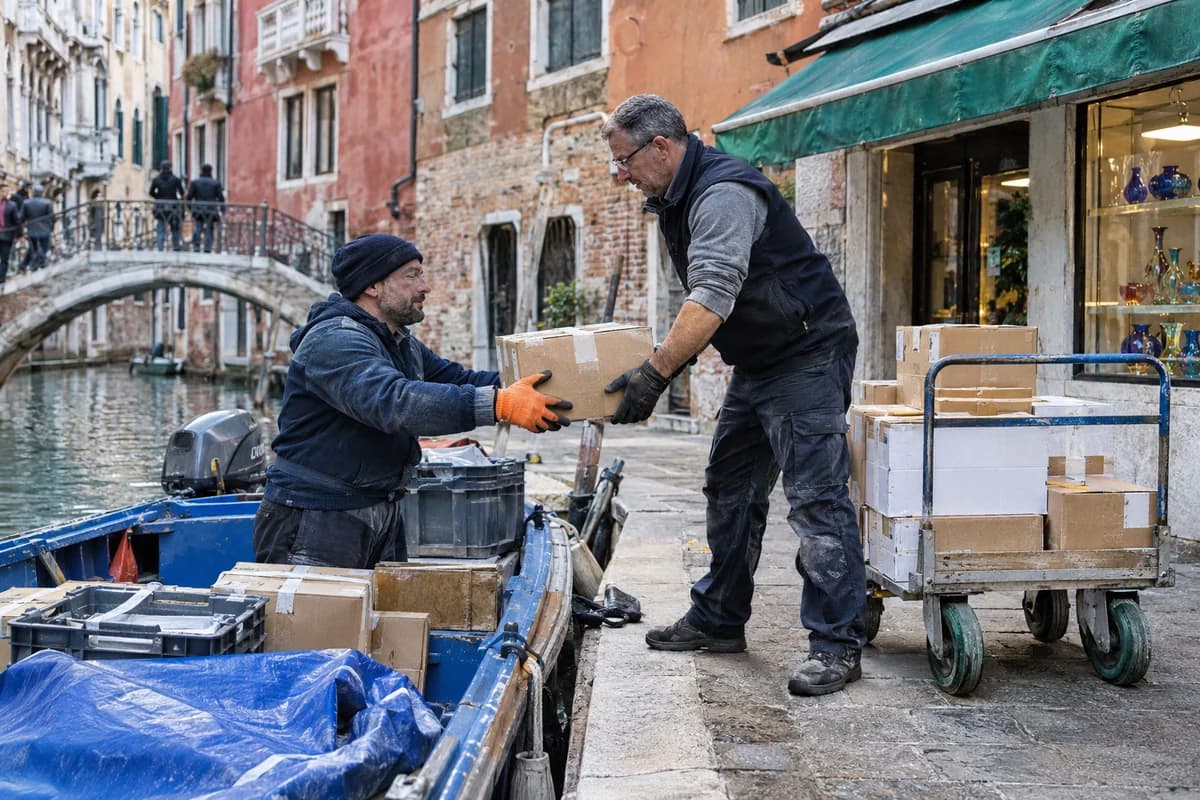
Water sets the rules in Venice. A box of stock cannot be driven to the shop. It goes by boat, then by hand over bridges. Costs and timing are different, and every delivery has to be planned in advance.
Visitors fill the calendar, and guesthouses, glass shops, guides and water taxis depend on a few dense seasons around Carnival, the Biennale and the film festival. Staff and suppliers live on the mainland. They commute daily.
The districts, business parks and markets that matter in Venice.
How Venice businesses pick and use software.
Glass shops and workshops that sell standard pieces and custom commissions, and ship fragile goods to buyers abroad.
Guesthouses and holiday rental hosts with a few rooms, booking channels of every kind and constant changes.
Where Venice businesses lose time and money.
Custom glass orders are lost in chat
One buyer wants a special colour and the details are scattered over messages. An order record with sketch, price and deposit keeps everything about the piece in one place.
Small guesthouses juggle four calendars
Each platform keeps its own diary. One calendar that shares dates across all of them prevents double bookings and the awkward call to a guest who has already travelled.
Boat fares and trips are written at the quay
Drivers jot rides on paper and sort them out later. Recording each trip on a phone shows income and fuel by day without an evening spent adding up.
What we would build for Venice businesses.
Usually in this order, starting with whatever the audit ranks first.
Web and Mobile Application Development
Web and mobile apps for customers, field staff and dealers, built to work on ordinary phones.
Learn moreE-Commerce and Digital Commerce
An online store or B2B order portal wired to your stock, billing and dispatch.
Learn moreAPI and System Integration
Connections between existing tools, with record ownership, duplicate handling and reconciliation agreed for each flow.
Learn moreWhatsApp Business API and Chatbots
WhatsApp Business API work covers number onboarding, template approval, opt-in records and a chatbot with human handover, all set up under the client’s own Meta account. It connects WhatsApp to a CRM, billing or booking system, so every message is sent from an existing record and every reply is written back. It suits businesses that already take orders, payments or bookings in chat.
Learn moreReady products that fit Venice businesses.
Each one is adapted to how your business works before it goes live, and anything your trade needs that it lacks is added then. You are not paying to build the basics again.
Gift Shop Management Software
Occasion-based stock, personalised orders, hampers, gift cards, maker consignment, wrapping and courier parcels for gift shops.
Learn moreVacation Rental Management Software
Unit calendars, channel reservations, guest messages, turnover cleans, maintenance jobs, deposits, occupancy tax lines and owner statements for vacation rental operators.
Learn moreTaxi Company Management Software
Bookings, dispatch, duty slips, fare settlement, lease owners, vehicle papers, workshop jobs and corporate voucher billing for taxi companies.
Learn moreHow the work runs from Bengaluru for Venice.
- 1
The audit, by call
A screen-share and a look at the sheets, accounting reports and WhatsApp groups your team uses. No travel needed.
- 2
A written proposal
Scope, what we build first and the cost, agreed in writing before anything starts.
- 3
Build in short rounds
Working screens shared every few weeks. Your team tests them from your own office.
- 4
Go-live, in person when it helps
For data migration and training we can come to Venice. Travel is agreed in advance.
- 5
Support online
Fixes, changes and hosting handled remotely by the same team that built it.
The work we have published.
We don’t claim Venice clients we don’t have. These are systems our team built; the way we work is the same wherever you are.
PetSeva: matching owners to the right vet, at any hour
A two-sided veterinary platform where vets are searchable by specialisation and bookable outside clinic hours. It now carries more than 2,000 veterinary doctors.
Read the case study Paying guest accommodationSAM Atithi Pavathi: bed-level occupancy as the source of truth
PG management software where allocation, rates and invoices are derived from bed-level occupancy and not maintained in parallel spreadsheets.
Read the case study School transport servicesSAM Tours: school transport on a single ledger
Registration, fee collection, routing and finance write to the same records, closing the gap between journeys run and fees collected.
Read the case study Microfinance and Self Help GroupsVikasa RDO: making SHG loan recovery auditable
Loan proposals, recoveries and commissions sit on one record, with a person attached to every state change, so a business handling a bank’s money can show where each rupee went.
Read the case studyMake the scope specific to your business.
Work through a real example from your operation and agree the handoffs, controls and support the project needs.
Custom glass orders are lost in chat
Which observation would change the proposed scope?
For “Custom glass orders are lost in chat”, observe someone completing the task with a representative example. Record where they stop, ask another person or re-enter information, then choose the smallest change whose result the team can verify.
Background reading: GOV.UK: researching user needs
Questions Venice owners ask before they call.
Can a small guesthouse use this without an IT person?
Yes. The screens are meant for a host with a phone or a laptop, and we provide training. Technical setup is ours to handle.
Can we sell fragile items online and track shipping?
A web shop with order tracking is possible. Packing and insurance terms for each parcel are set by you and your carrier.
What happens after I share my requirements?
We review your brief and clarify the work with you. We then look at the software, spreadsheets and WhatsApp groups your business runs on today and write down what works, what slows your team down and what is missing. A demo login, a screen-share or a few screenshots are enough. You get a short written summary ordered by priority, with no obligation to hire us afterwards.
How much will the software cost?
We don’t publish a price, because it depends on what the system has to do. That first review settles the scope, and the cost goes into a written proposal before any work starts.
Industries we build for in Venice.
Tell us what your Venice business runs on today.
Send a short note on the spreadsheets, software or WhatsApp groups your team depends on. We reply the same working day.
What happens after you share your requirements
- We review your brief and the systems you already use.
- We clarify the workflow, missing information and the work to consider first.
- The proposed scope sets out the deliverables, responsibilities and dependencies.
- Review the scope and commercial terms before deciding whether to proceed.
Start with your requirements
Describe your current process, the people involved and the change you need. Start with the details you know; we can clarify the rest together.
Share your requirements