Islamabad · CountriesIslamabad’s ministries, aid organisations, software firms and twin city Rawalpindi shape a trade built on offices and services.
Islamabad is the capital, with ministries, embassies, development agencies and software firms. Its twin city, Rawalpindi, holds the old wholesale bazaars and a large garrison, and thousands of people cross between the two for work every morning. Hospitals and coworking offices fill the gaps. GullySystem writes project, records and desk-booking software for these firms from Bengaluru.
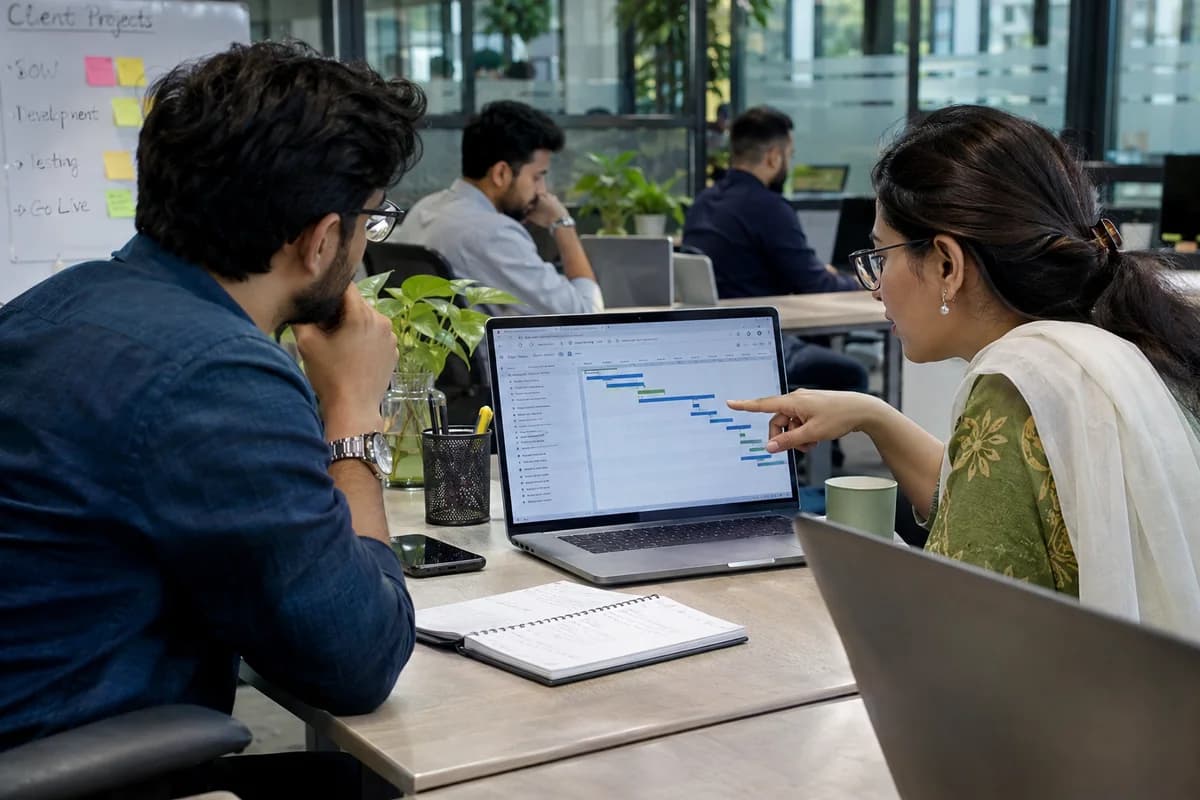
Money moves in grants and contracts here. Aid groups report to donors in formats that change with each programme. Software firms bill clients abroad while paying engineers locally, so their cash arrives in dollars and leaves in the local currency every month.
Rawalpindi sits next door. Markets and workshops there serve the capital, and the two cities share traffic, patients and shoppers every day. Islamabad runs half an hour behind Bengaluru, so calls fit inside your working day.
The districts, business parks and markets that matter in Islamabad.
How Islamabad businesses pick and use software.
Aid and charitable organisations that report to several donors, track each grant separately and must show a donor within days how every unit of a grant was spent.
Small software companies that bill clients abroad and need project time, invoices and payroll in one place.
Where Islamabad businesses lose time and money.
Each donor wants a different report
One grant needs spending by activity, another by district. Tag every expense once. Sorting by donor then saves the repeated rewrites that otherwise fill the weeks before each reporting deadline.
Project hours go unbilled
Developers log time in chat and sheets. A timesheet linked to each client contract shows what can be invoiced.
Desks and meeting rooms clash
Desks sell by the day, rooms by the hour. A shared calendar ends clashes.
What we would build for Islamabad businesses.
Usually in this order, starting with whatever the audit ranks first.
Custom Software and Product Engineering
Software built around how your business actually runs, when nothing off the shelf fits without workarounds.
Learn moreBusiness Intelligence and Reporting Tools
Business intelligence and reporting work joins accounting vouchers, CRM records and spreadsheet tabs inside Power BI, Metabase or Looker Studio, using metric definitions agreed in writing first. Role dashboards and scheduled packs follow. The model is documented. Your analyst can extend it. Share your requirements and we will say which tool fits.
Learn moreWeb and Mobile Application Development
Web and mobile apps for customers, field staff and dealers, built to work on ordinary phones.
Learn moreReady products that fit Islamabad businesses.
Each one is adapted to how your business works before it goes live, and anything your trade needs that it lacks is added then. You are not paying to build the basics again.
NGO and Trust Management Software
Donors, receipts, fund heads, programmes, beneficiaries, grants, volunteers and trustee reporting for NGOs and charitable trusts.
Learn moreSoftware Development Company Management Software
Statements of work, project plans, timesheets, bench allocation, change requests, milestone and time-and-materials invoices and margin for software development companies.
Learn moreCoworking Space Management Software
Seat and cabin plans, meeting-room bookings, visitor access, a member app and monthly tax invoices connected on one member record.
Learn moreHow the work runs from Bengaluru for Islamabad.
- 1
The audit, by call
A screen-share and a look at the sheets, accounting reports and WhatsApp groups your team uses. No travel needed.
- 2
A written proposal
Scope, what we build first and the cost, agreed in writing before anything starts.
- 3
Build in short rounds
Working screens shared every few weeks. Your team tests them from your own office.
- 4
Go-live, in person when it helps
For data migration and training we can come to Islamabad. Travel is agreed in advance.
- 5
Support online
Fixes, changes and hosting handled remotely by the same team that built it.
The work we have published.
We don’t claim Islamabad clients we don’t have. These are systems our team built; the way we work is the same wherever you are.
PetSeva: matching owners to the right vet, at any hour
A two-sided veterinary platform where vets are searchable by specialisation and bookable outside clinic hours. It now carries more than 2,000 veterinary doctors.
Read the case study Paying guest accommodationSAM Atithi Pavathi: bed-level occupancy as the source of truth
PG management software where allocation, rates and invoices are derived from bed-level occupancy and not maintained in parallel spreadsheets.
Read the case study School transport servicesSAM Tours: school transport on a single ledger
Registration, fee collection, routing and finance write to the same records, closing the gap between journeys run and fees collected.
Read the case study Microfinance and Self Help GroupsVikasa RDO: making SHG loan recovery auditable
Loan proposals, recoveries and commissions sit on one record, with a person attached to every state change, so a business handling a bank’s money can show where each rupee went.
Read the case studyMake the scope specific to your business.
Work through a real example from your operation and agree the handoffs, controls and support the project needs.
Each donor wants a different report
What does one row mean before totals are combined?
Choose one period in “Each donor wants a different report” and compare it with the source records. Define the date basis and grouping before accepting a total that combines several kinds of entry.
Background reading: Microsoft: reporting grain and relationships
Questions Islamabad owners ask before they call.
Can an aid organisation report to several donors from one record?
Yes. Spending is entered once with tags for grant and activity, and each donor’s report is a view of the same data, so the numbers never disagree between reports.
Can a software firm track hours against fixed-price contracts?
Yes. Hours are logged per task and compared with the quoted effort, and they can appear on the invoice if the client wants to see them. Fixed prices stay fixed.
What happens after I share my requirements?
We review your brief and clarify the work with you. We then look at the software, spreadsheets and WhatsApp groups your business runs on today and write down what works, what slows your team down and what is missing. A demo login, a screen-share or a few screenshots are enough. You get a short written summary ordered by priority, with no obligation to hire us afterwards.
How much will the software cost?
We don’t publish a price, because it depends on what the system has to do. That first review settles the scope, and the cost goes into a written proposal before any work starts.
Industries we build for in Islamabad.
Elsewhere in Pakistan.
Tell us what your Islamabad business runs on today.
Send a short note on the spreadsheets, software or WhatsApp groups your team depends on. We reply the same working day.
What happens after you share your requirements
- We review your brief and the systems you already use.
- We clarify the workflow, missing information and the work to consider first.
- The proposed scope sets out the deliverables, responsibilities and dependencies.
- Review the scope and commercial terms before deciding whether to proceed.
Start with your requirements
Describe your current process, the people involved and the change you need. Start with the details you know; we can clarify the rest together.
Share your requirements