Software Solutions for Food Packaging Sellers
Food packaging goes to restaurants, bakeries and cloud kitchens that order it every week. They need containers by capacity, lids that fit, and papers from the maker that show what a product is made of. Cases are the unit, repeat orders the habit and a stock-out stops a kitchen.
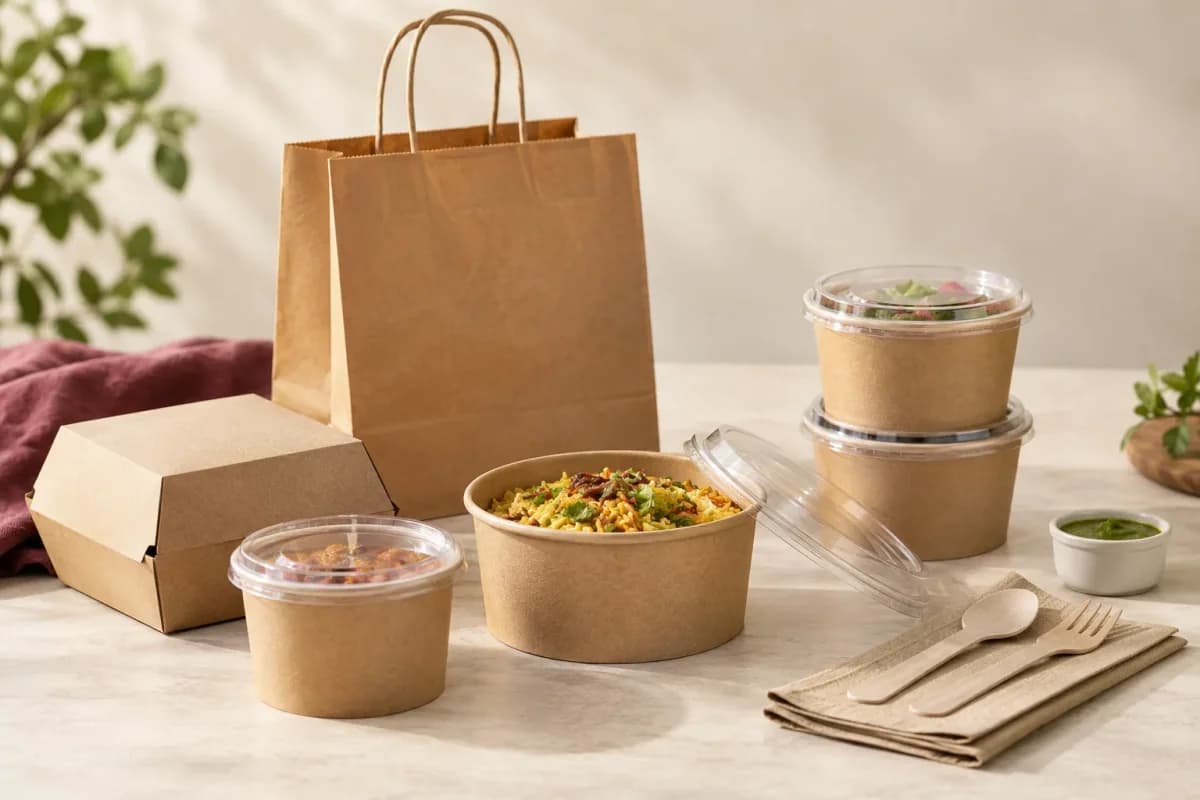
Sell food containers, pouches and cups with lids paired and declarations on file.
A cloud kitchen cannot send a biryani without the right container and lid. If either runs out, the kitchen stops, so reliable restock matters more than a low price.
Buyers also ask what a container is made of, and the seller needs the maker’s document at hand.
Suppliers to restaurants and kitchens
A supplier delivers containers, cups and wraps to restaurants on a weekly cycle.
Suppliers to bakeries and sweet shops
A supplier sells cake boxes, trays and ribbons in smaller runs, with seasonal peaks.
Printers of branded food packs
A converter prints logos on cups, bags and boxes for food brands, with large minimums.
The workflow for food packaging.
- 1
Selecting capacity and shape
The buyer picks a container by capacity in millilitres or grams, and by shape.
- 2
Pairing lids
The listing shows which lids fit the container, and offers them in the same order.
- 3
Reading the maker’s notes
Material and use notes from the maker are shown, with the declaration document attached.
- 4
Ordering by case
Cases are the unit of sale, with a price per piece for guidance and a minimum of one case.
- 5
Setting up a weekly delivery
A kitchen schedules a standing order with a delivery day and a stock check.
The challenges, and what they cost.
What is specific to this trade.
These are requirements we would confirm in discovery. They describe what the solution may need to handle. They are not features that already exist.
- Capacity, material and pack size for every item
- Lid and container pairings
- The maker’s declarations and their dates
- Delivery days for repeat buyers
What we would build for food packaging.
Chosen from the commerce capabilities this business needs, not a list of everything.
Who works in the system, and what each can do.
What it would connect to.
An integration is confirmed only after its API, access and scope are checked. A connection that updates on a schedule is described as scheduled, not real-time.
- Your stock and billing system, so shortages show before a delivery
- A delivery planning tool for weekly routes, if it publishes a way to connect
- Your accounting package, for weekly invoices
How the work runs, and what we need from you.
What you provide
- Your containers, lids and cases with capacity
- The maker’s documents for each product
- Your regular buyers and their delivery days
Pair the lids first
Container and lid pairings are recorded before the catalogue is built, since errors there cost buyers most.
Attach the documents
Declarations are linked to products and checked for dates before they are shown.
What you receive.
- A capacity-based catalogue
- Lid pairing records
- Supplier declaration files on each product
- A standing order flow
How progress is judged.
Measures are agreed against your own baseline. We do not promise a result in advance.
- Deliveries with a missing lid
- Declaration requests answered from the record
Selling at home and abroad.
Food packaging bought for export or imported food needs documents from the maker, and rules on food-contact materials differ by country. The catalogue stores the declarations you hold and states no rule itself.
The wider requirements for packaging supplies are on the Packaging Supplies page.
Related subcategories.
Packaging Supplies E-commerce & B2B Ordering Software
Existing product, extended
Dealer orders already run on GullySystem’s wholesale and dealer ordering software, which holds dealer logins, price lists, stock by godown, credit limits and dispatch. The public store and size-led catalogue are configured around it.
Capacity, lid pairing and supplier declarations are fields on the product record in the category catalogue and listing details.
Read about the softwareExisting GullySystem products that apply
Related services
Test the order that does not follow the usual path.
Bring an awkward order or catalogue example to discovery and agree who handles the exception.
Capacity and shape catalogue
Does each sellable combination have the right stock and price?
Choose an example from “Capacity and shape catalogue” with more than one option. Check the selected combination, item identifier, available quantity and price through to the order, including a combination that should not be sold.
Background reading: Shopify: product variants
Stock-outs stop the buyer’s service
Which location and stock state support the delivery promise?
Use “Stock-outs stop the buyer’s service” to follow an item moved between two locations. Distinguish stock on hand, stock already committed and stock still travelling before presenting an available quantity to a buyer.
Background reading: Shopify: inventory and locations
Questions about food packaging e-commerce.
Does the software say a product is safe for food?
No. It stores the maker’s declaration and shows it. Suitability is the maker’s statement and the buyer’s own check.
Can a kitchen order for its seasonal peak ahead of time?
Yes. A standing order can be raised for a festival week, with stock held where you have it.
Can branded packs be sold online?
As a quote request. Artwork approval and minimum runs are handled by staff.
Talk through your commerce requirement.
Share what you sell, where orders arrive and how you manage stock and fulfilment today.
- Your products and sales channels
- Your order and stock workflow
- The connections you need
Start with your requirements
Describe your current process, the people involved and the change you need. Start with the details you know; we can clarify the rest together.
Share your requirements