Nahan · LocationsNahan’s shops, offices and ginger growers need records that move between town and village.
Nahan, the seat of Sirmaur district, mixes government offices, schools, a medical college and a hill bazaar. Farmers around it grow ginger, garlic and off-season vegetables for markets outside the hills. Factories at Kala Amb and Paonta Sahib are a drive away. GullySystem writes billing, stock and ledger software for traders and growers, working remotely from Nagarbhavi, Bengaluru.
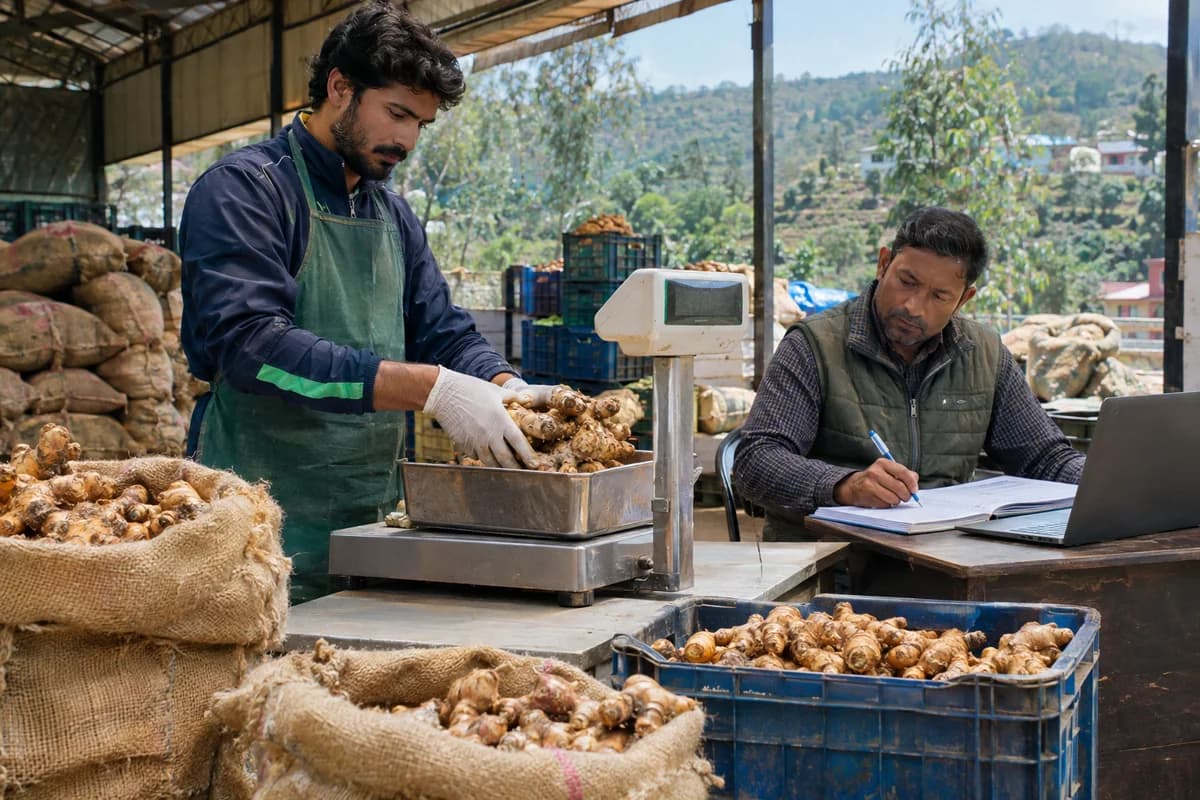
The town sits on a ridge. Narrow lanes of shops run below the old palace area, with district offices around them. Staff, students and visitors give the bazaar a steady daily trade through the year.
Villages across Sirmaur grow ginger, garlic and vegetables out of season, sold to buyers in Delhi, Saharanpur and Chandigarh. Lower down, Kala Amb and Paonta Sahib have factories that hire from the district. Nahan’s traders sit between the two.
The areas, estates and markets that matter in Nahan.
How Nahan businesses pick and use software.
Input dealers want a ledger by farmer, with the next harvest as the expected date of payment, so that no one has to remember who agreed to what last spring.
Produce traders need weight and rate on every lot. Settling with growers quickly, once a buyer pays, is what they want.
Retail shops want to bill fast on market days. Small screens that need little training suit them.
Where Nahan businesses lose time and money.
Growers are paid late because the buyer’s payment is unclear
A trader sends ginger to a distant buyer and waits. The grower asks for money, and the trader has no tidy account of what is pending. Lot-wise records show it.
Seed and fertiliser dues pile up before harvest
Shops give inputs on credit and track dues in notebooks. Season-wise ledgers show which farmers are due after the crop is sold.
Trips down to the plains are billed from memory
Drivers return with partial payments, diesel bills and loading charges. A trip sheet per vehicle settles the day’s account.
Market day billing queues form
Customers from villages arrive together and the counter slows. A faster billing screen with saved items clears the queue.
What we would build for Nahan businesses.
Usually in this order, starting with whatever the audit ranks first.
ERP, CRM and Business Software Implementation
One record of stock, orders, customers and accounts, set up so your team opens it every day.
Learn moreWeb and Mobile Application Development
Web and mobile apps for customers, field staff and dealers, built to work on ordinary phones.
Learn moreBusiness Process Automation
Approvals, reminders and reports triggered by agreed rules, with exceptions assigned to a responsible person.
Learn moreAPI and System Integration
Connections between existing tools, with record ownership, duplicate handling and reconciliation agreed for each flow.
Learn moreReady products that fit Nahan businesses.
Each one is adapted to how your business works before it goes live, and anything your trade needs that it lacks is added then. You are not paying to build the basics again.
Fertiliser Dealer Management Software
Truck receipts, bag counts by grade, warehouse stacks, farmer sales, seasonal credit and sale registers for dealers who sell fertiliser to growers.
Learn moreCrop Farm Management Software
Field plans, input stores, spray logs, machine hours, harvest weighbridge tickets, bin stock and grain contracts for arable crop farms.
Learn moreHow the work runs from Bengaluru for Nahan.
- 1
The audit, by call
A screen-share and a look at the sheets, accounting reports and WhatsApp groups your team uses. No travel needed.
- 2
A written proposal
Scope, what we build first and the cost, agreed in writing before anything starts.
- 3
Build in short rounds
Working screens shared every few weeks. Your team tests them from your own office.
- 4
Go-live, in person when it helps
For data migration and training we can come to Nahan. Travel is agreed in advance.
- 5
Support online
Fixes, changes and hosting handled remotely by the same team that built it.
The work we have published.
We don’t claim Nahan clients we don’t have. These are systems our team built; the way we work is the same wherever you are.
PetSeva: matching owners to the right vet, at any hour
A two-sided veterinary platform where vets are searchable by specialisation and bookable outside clinic hours. It now carries more than 2,000 veterinary doctors.
Read the case study Paying guest accommodationSAM Atithi Pavathi: bed-level occupancy as the source of truth
PG management software where allocation, rates and invoices are derived from bed-level occupancy and not maintained in parallel spreadsheets.
Read the case study School transport servicesSAM Tours: school transport on a single ledger
Registration, fee collection, routing and finance write to the same records, closing the gap between journeys run and fees collected.
Read the case study Microfinance and Self Help GroupsVikasa RDO: making SHG loan recovery auditable
Loan proposals, recoveries and commissions sit on one record, with a person attached to every state change, so a business handling a bank’s money can show where each rupee went.
Read the case studyMake the scope specific to your business.
Work through a real example from your operation and agree the handoffs, controls and support the project needs.
Seed and fertiliser dues pile up before harvest
Can you explain the balance from its original documents?
Select a partly settled example in “Seed and fertiliser dues pile up before harvest”. Ask for the invoice, allocated receipts and remaining balance to be shown together before agreeing the opening figures.
Background reading: ERPNext: outstanding invoices
Growers are paid late because the buyer’s payment is unclear
Can the same receipt be allocated without counting the money twice?
Take an unallocated amount in “Growers are paid late because the buyer’s payment is unclear” and apply it to the intended balance. Review the remaining amount and the original receipt reference together.
Background reading: ERPNext: payment allocation
Questions Nahan owners ask before they call.
Can a dealer keep a separate ledger for each farmer?
Yes. Each farmer has a ledger with purchases, payments and the date the crop is expected to sell. Dues lists can be filtered by village or by season.
Our staff are not used to computers. Is that a problem?
It is not a problem if screens are kept simple. Billing and ledger entry need only a few fields. A short recorded video covers each task for new staff.
What happens after I share my requirements?
We review your brief and clarify the work with you. We then look at the software, spreadsheets and WhatsApp groups your business runs on today and write down what works, what slows your team down and what is missing. A demo login, a screen-share or a few screenshots are enough. You get a short written summary ordered by priority, with no obligation to hire us afterwards.
How much will the software cost?
We don’t publish a price, because it depends on what the system has to do. That first review settles the scope, and the cost goes into a written proposal before any work starts.
Industries we build for in Nahan.
Tell us what your Nahan business runs on today.
Send a short note on the spreadsheets, software or WhatsApp groups your team depends on. We reply the same working day.
What happens after you share your requirements
- We review your brief and the systems you already use.
- We clarify the workflow, missing information and the work to consider first.
- The proposed scope sets out the deliverables, responsibilities and dependencies.
- Review the scope and commercial terms before deciding whether to proceed.
Start with your requirements
Describe your current process, the people involved and the change you need. Start with the details you know; we can clarify the rest together.
Share your requirements