Siddipet · LocationsSiddipet’s paddy farmers, saree weavers and new reservoir-fed fields give shops a steady, seasonal trade.
Siddipet has seen water arrive through new reservoirs, and paddy now dominates its fields; rice mills, input dealers and transporters have grown with it. The town is also associated with Gollabhama sarees, a woven craft. GullySystem supports shops and mills here online from Bengaluru, mainly with credit books, mill stock and weaver orders.
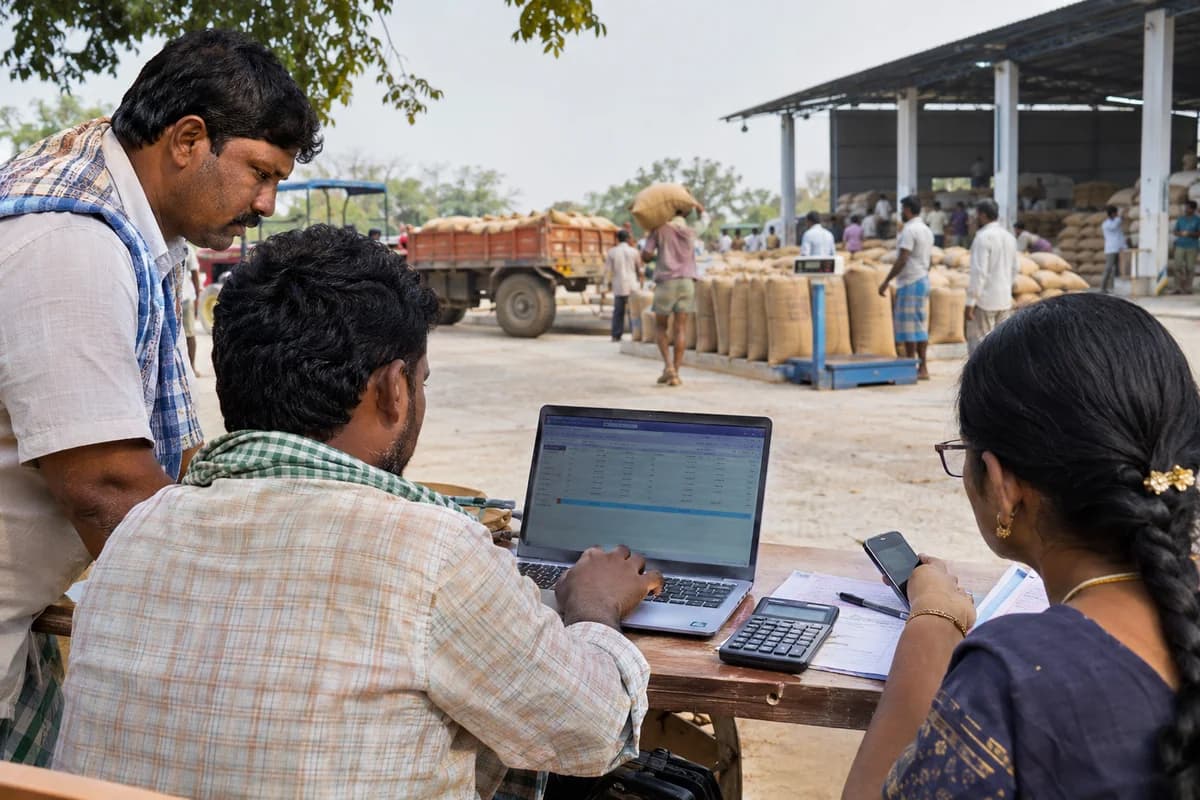
More canal and reservoir water has meant more paddy and more procurement; farmers sell to government centres and private millers; the town’s dealers extend credit for inputs before each crop.
Weaving continues in smaller households. Gollabhama saree makers take orders from retailers in the city and work to a pattern. Orders are quick to change; they are slow to be recorded, and a change made on the phone is forgotten by evening.
The areas, estates and markets that matter in Siddipet.
How Siddipet businesses pick and use software.
A miller wants to see paddy in, rice out and loads dispatched; three registers should not be needed for that.
A weaver or small dealer needs each order’s pattern, colour and due date on a phone, in Telugu.
Where Siddipet businesses lose time and money.
Procurement bag counts are rechecked
Counts at the centre, at the weighbridge and at the mill rarely match the first time; the difference falls on whoever signed last.
Weaving orders change by phone call
A colour or border shifts after the thread is bought. The original order is lost. Payment is argued over.
Dealers chase credit after the harvest
Balances sit in notebooks. Small dealers write off amounts they cannot prove.
Lorry hire is booked by word
Mills book vehicles by phone and settle later. Freight cost per load is never clear.
What we would build for Siddipet businesses.
Usually in this order, starting with whatever the audit ranks first.
Web and Mobile Application Development
Web and mobile apps for customers, field staff and dealers, built to work on ordinary phones.
Learn moreBusiness Process Automation
Approvals, reminders and reports triggered by agreed rules, with exceptions assigned to a responsible person.
Learn moreERP, CRM and Business Software Implementation
One record of stock, orders, customers and accounts, set up so your team opens it every day.
Learn moreData Engineering and Business Intelligence
Dashboards that answer the owner’s Monday questions without anyone building an Excel sheet first.
Learn moreReady products that fit Siddipet businesses.
Each one is adapted to how your business works before it goes live, and anything your trade needs that it lacks is added then. You are not paying to build the basics again.
Rice Mill Management Software
Paddy intake and moisture, parboiling, milling yield, broken percentage, by-products, bag counts and wholesale rice dispatch for rice mills.
Learn moreFertiliser Dealer Management Software
Truck receipts, bag counts by grade, warehouse stacks, farmer sales, seasonal credit and sale registers for dealers who sell fertiliser to growers.
Learn moreTailoring Shop Management Software
Customer measurements, garment orders, fabric stock, trial fittings, alterations, tailor piece-rate pay, advances and delivery slips for tailoring shops.
Learn moreHow the work runs from Bengaluru for Siddipet.
- 1
The audit, by call
A screen-share and a look at the sheets, accounting reports and WhatsApp groups your team uses. No travel needed.
- 2
A written proposal
Scope, what we build first and the cost, agreed in writing before anything starts.
- 3
Build in short rounds
Working screens shared every few weeks. Your team tests them from your own office.
- 4
Go-live, in person when it helps
For data migration and training we can come to Siddipet. Travel is agreed in advance.
- 5
Support online
Fixes, changes and hosting handled remotely by the same team that built it.
The work we have published.
We don’t claim Siddipet clients we don’t have. These are systems our team built; the way we work is the same wherever you are.
PetSeva: matching owners to the right vet, at any hour
A two-sided veterinary platform where vets are searchable by specialisation and bookable outside clinic hours. It now carries more than 2,000 veterinary doctors.
Read the case study Paying guest accommodationSAM Atithi Pavathi: bed-level occupancy as the source of truth
PG management software where allocation, rates and invoices are derived from bed-level occupancy and not maintained in parallel spreadsheets.
Read the case study School transport servicesSAM Tours: school transport on a single ledger
Registration, fee collection, routing and finance write to the same records, closing the gap between journeys run and fees collected.
Read the case study Microfinance and Self Help GroupsVikasa RDO: making SHG loan recovery auditable
Loan proposals, recoveries and commissions sit on one record, with a person attached to every state change, so a business handling a bank’s money can show where each rupee went.
Read the case studyMake the scope specific to your business.
Work through a real example from your operation and agree the handoffs, controls and support the project needs.
Procurement bag counts are rechecked
Does receiving less than ordered leave the correct quantity open?
Bring a short delivery to the “Procurement bag counts are rechecked” walkthrough. Separate what arrived, what was accepted and what remains due before checking the supplier’s bill.
Background reading: ERPNext: purchase receipts
Questions Siddipet owners ask before they call.
Can orders from weavers be tracked with colour and due date?
Yes. Each order carries pattern, colour, quantity and due date, and changes are saved with a time; labels and notes can be in Telugu.
Is there someone in Siddipet to set this up?
Not in the town. Everything is set up and supported online from Nagarbhavi in Bengaluru; staff are trained remotely, and the screens are kept short so a counter person can learn them in a day.
What happens after I share my requirements?
We review your brief and clarify the work with you. We then look at the software, spreadsheets and WhatsApp groups your business runs on today and write down what works, what slows your team down and what is missing. A demo login, a screen-share or a few screenshots are enough. You get a short written summary ordered by priority, with no obligation to hire us afterwards.
How much will the software cost?
We don’t publish a price, because it depends on what the system has to do. That first review settles the scope, and the cost goes into a written proposal before any work starts.
Industries we build for in Siddipet.
Tell us what your Siddipet business runs on today.
Send a short note on the spreadsheets, software or WhatsApp groups your team depends on. We reply the same working day.
What happens after you share your requirements
- We review your brief and the systems you already use.
- We clarify the workflow, missing information and the work to consider first.
- The proposed scope sets out the deliverables, responsibilities and dependencies.
- Review the scope and commercial terms before deciding whether to proceed.
Start with your requirements
Describe your current process, the people involved and the change you need. Start with the details you know; we can clarify the rest together.
Share your requirements